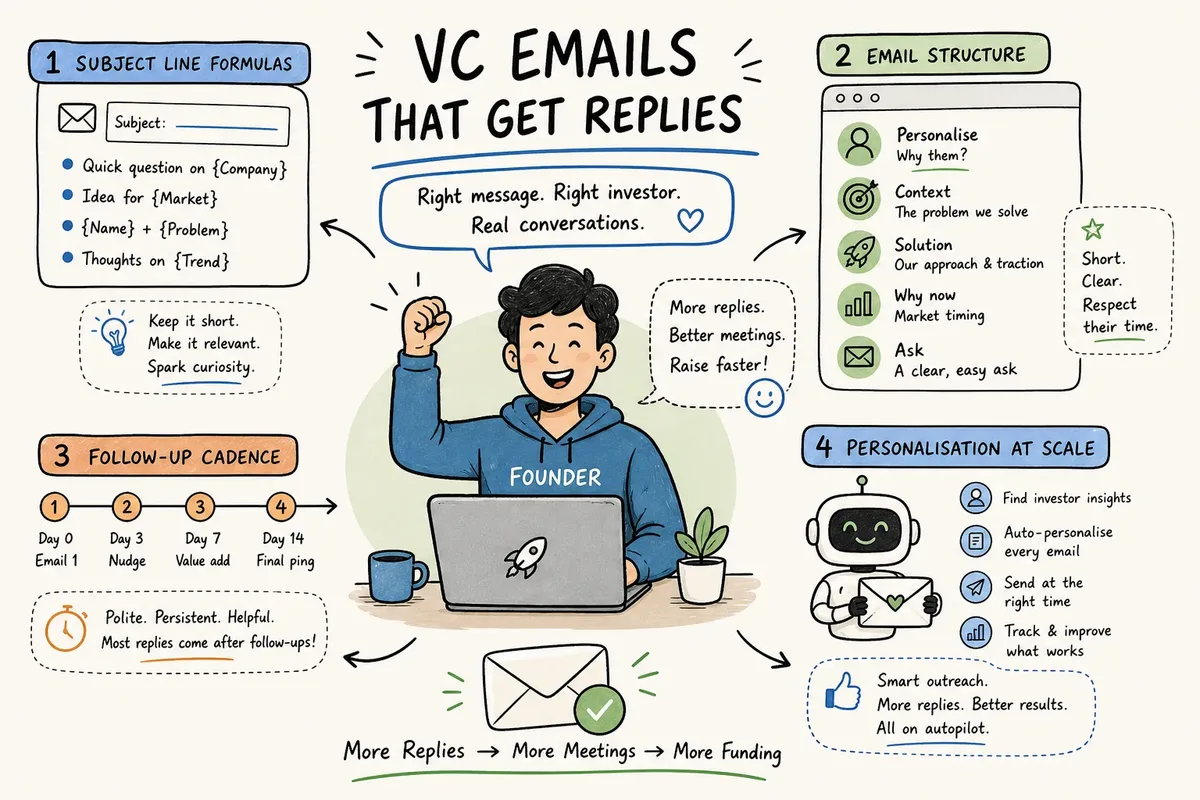
A senior partner at a top-tier venture capital firm receives somewhere between 200 and 500 unsolicited emails every single week. Your VC outreach email is one of them — and most are deleted in under 10 seconds, never read past the subject line, never replied to.
That is not cynicism. It is the operating reality of every inbox on Sand Hill Road, and increasingly in Mumbai, Bengaluru, and Singapore as well.
The gap between what founders send and what VCs actually respond to is staggering. The founders winning investor meetings are not necessarily building better companies — they are writing better emails with sharper personalisation, tighter structure, and smarter follow-up cadences. This guide covers all of it: subject line formulas with real open rate data, the exact five-part sequence that gets replies, personalisation signals that manufacture relevance when a warm intro is not available, and a three-touch follow-up cadence that recovers a significant share of replies from investors who never responded the first time.
Subject line formulas with benchmarked open rates · Five-part email structure under 80 words · Personalisation signals when you have no warm intro · Three-touch follow-up cadence that recovers non-replies · How EzFunding generates investor-specific outreach pre-loaded with portfolio context.
Unsolicited emails a senior VC partner receives weekly — your subject line and first sentence do 80% of the filtering work
Average time a VC spends deciding whether to read further — not enough to evaluate your idea, only your subject line and first sentence
Response rate on generic, non-personalised cold VC outreach — the floor that broadcast emails consistently hit
Response rate on warm introductions — the structural advantage that personalisation-based cold outreach is designed to partially replicate
Why most VC outreach emails fail before they are even opened
The volume problem is real and brutal. Partners at established VC firms receive thousands of unsolicited pitch emails per year. They spend an average of 8 seconds deciding whether to read further — not enough time to evaluate your idea, your market, or your traction. It is barely enough time to scan a subject line and a first sentence. Those two elements do 80% of the filtering work.
Three patterns mark an email as generic instantly:
What a VC is scanning for in those 8 seconds is a mental checklist: stage fit, sector fit, a traction signal, and a specific reason why this founder emailed this particular VC. Every section of this guide is built around answering those four questions in the shortest possible space.
VC outreach email subject lines that lift open rates to 20–30%
The subject line is where your VC outreach email either earns an open or dies. Three formulas consistently outperform the field — each works because it removes ambiguity and front-loads a signal the investor can act on immediately.
The investor's filtering work is done before they click. The number either qualifies you or it does not — and that honesty is exactly what gets the email opened.
Highest open rates in the cold outreach category. Creates immediate relevance by connecting to a company the VC has already backed and believes in.
Specific, sector-clear, and removes all ambiguity about fit. Signals that the founder has researched the fund's thesis rather than blasting a list.
If you have any legitimate name to invoke, lead with it every single time. Never fabricate — a false name-drop can permanently damage your credibility with that fund.
Benchmarks compiled from DocSend 2024, Salesloft outreach research, and OpenVC investor survey data
Keep subject lines under 65 characters — most of the highest-performing formulas run under 10 words. Generic lines sit at the bottom of the open-rate range for cold email. You cannot afford that floor.
How to structure a cold email to VCs that actually gets replies
The word count rule is non-negotiable: keep your cold pitch email under 80 words for elite response rates and never exceed 200 words. Emails over 125 words see substantially lower reply rates. The email must fit on one screen without scrolling — on mobile, that means even tighter. Every word that does not earn its place is a word that pushes a busy partner toward delete.
The five-part sequence that consistently produces replies
How to pitch investors — the complete guide · fundraising-readiness-checklist" class="li">Fundraising readiness checklist
Warm vs cold outreach: working with what you have
The data is unambiguous: warm introductions yield a 47% response rate. Cold outreach without personalisation sits below 2%. That gap is not a matter of email craft — it is structural trust. A warm intro means a trusted voice has already done the pre-qualification on your behalf. But most founders, especially those outside major VC hubs, will not have that network in place when they start raising.
When a warm intro is not available, specificity substitutes for a trusted signal. Reference a VC's recent blog post or podcast appearance and connect it to something your startup is doing. Cite a portfolio company's recent milestone and explain how your product serves that same ecosystem. Note a thesis shift at the fund that aligns with your vertical. Crunchbase, firm websites, and press releases give you deal history, stage focus, and portfolio composition. Look for portfolio overlap: if a VC backed a company that serves customers in the same ecosystem your startup operates in, you have a legitimate and specific connection to draw on.
How to build an investor list that converts · india-what-founders-need-to-know" class="li">Angel investors in India — what founders need to know
VC outreach email follow-up cadence that recovers non-replies
Most founders treat a non-reply as a rejection. It is not. A substantial share of investor replies come through follow-ups, not the initial email. VCs are genuinely busy, and a well-timed follow-up with new information reads as professionalism, not desperation.
How EzFunding generates outreach that VCs actually respond to
EzFunding's personalised outreach generation does not work from generic templates. Every message the platform produces is built around the specific VC's known portfolio companies, recent investments, stated thesis, stage focus, and sector preferences. This is the direct answer to the personalisation problem described throughout this guide.
Matches your startup against 500+ VCs, angel investors, family offices, and accelerators across stage fit, sector fit, geography, and check size — so you know before writing a word whether the fit is genuinely aligned.
Generates investor-specific outreach messages pre-loaded with each investor's portfolio context and thesis language. Not a template with a name swapped in — a researched, contextual first email for every investor in your pipeline.
Surfaces non-dilutive grant opportunities alongside VC matches — so founders see equity and non-equity options in one place, mapped to their specific stage and sector.
The scale advantage is what makes this meaningful at the fundraising stage. Instead of spending hours per investor on research and drafting, founders use EzFunding to build and deploy a full outreach pipeline without sacrificing the personalisation that drives reply rates. A founder who uploads their pitch deck in the morning can have a personalised investor outreach pipeline ready by the afternoon.
How AI helps startups find investors faster · Investor matching explained · How to find investors for your startup
Putting the full framework to work
The complete framework comes down to four components working together. A subject line formula that front-loads a real signal gets you past the 8-second filter. A tight email structure under 80 words, with the five-part sequence and a binary CTA, converts that open into a reply. Personalisation signals that reference specific portfolio context and thesis language replace the warm intro signal when you do not have one. And a disciplined three-touch follow-up cadence captures the replies that never come from the initial email alone.
A well-crafted VC outreach email is not a broadcast — it is a targeted, researched, one-to-one message that shows you know exactly why this investor is the right fit for your round. That specificity is what separates a 2% response rate from a 20% one.
Stop sending generic pitch emails — send outreach VCs actually reply to
Match me with investorsAnalyse my pitch deck firstReferences
- Y Combinator Library — Investor outreach and VC cold email guidance
- First Round Review — VC outreach strategy and investor screening behaviour
- fundraising-report" target="_blank" class="lr">DocSend — Annual Fundraising Report 2024 (email open rates and outreach benchmarks)
- Salesloft — Outreach benchmarking, word count recommendations, and cadence research