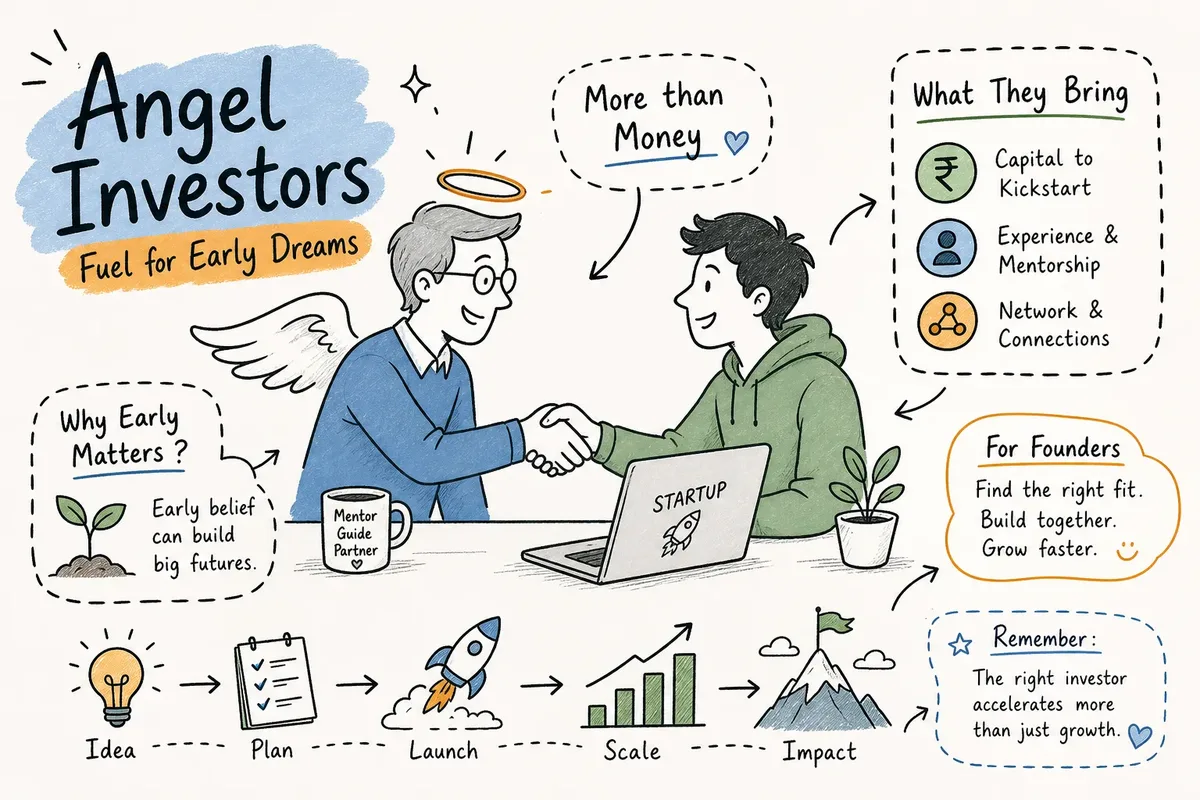
Angel investors in India have quietly funded the earliest stages of companies that went on to become household names. The first cheque, often in the range of ₹25, 50 lakhs, frequently arrives before any institutional investor is paying attention, and those early bets have seeded some of the country's most consequential startups. Yet the most common complaint among founders who have been through a raise is the same: they spent months approaching the wrong investors and received no reply, not because their startup was weak, but because they misunderstood who angels are in India and what they are genuinely looking for.
Understanding the structure of the Indian angel ecosystem, the specific investors who are active right now, and the outreach mechanics that actually convert is the difference between a stalled raise and a signed term sheet. For founders who want to extend that capital search beyond India, platforms like EzFunding offer access to a US angel network with AI-matched compatibility scores and personalised outreach built into the workflow. This article covers everything you need: ecosystem structure, active investors, cheque sizes, the India-to-US comparison, and a ready-to-use outreach plan.
How angel investors in India structure their ecosystem
The SEBI regulatory framework every founder must understand
Angel investors who operate through registered Alternative Investment Funds (AIFs) in India are governed by SEBI regulations that set a minimum investment floor of ₹25 lakhs per cheque, with a cap of ₹10 crore per startup. This applies specifically to formal angel funds, not to informal personal investments, which removes a great deal of confusion founders carry into early conversations. The accreditation criteria are equally specific: an individual must hold an annual income of at least ₹2 crore or a net worth exceeding ₹7.5 crore (with at least ₹3.75 crore in financial assets) to qualify as an accredited investor. These thresholds were confirmed under the September 2025 SEBI amendments to AIF regulations, now fully in force, with a transition deadline of September 2026 for existing funds to comply.
Knowing this shapes how you pitch. Through a formal fund, you are not speaking to someone testing the water with a small personal cheque, you are speaking to a high-net-worth individual with a structured mandate and clear sector preferences. The SEBI minimum per cheque via an AIF is ₹25 lakhs, whereas informal syndicate entry points can be as low as ₹50,000. Approaching formal fund investors without understanding their thesis is an immediate disqualifier, regardless of how strong your deck is.
Syndicates, SPVs, and how deals actually get done
Individual angels rarely invest alone at the seed stage in India. The more common structure involves a lead angel who takes the first position, with others co-investing alongside through a Special Purpose Vehicle (SPV) or syndicate. Platforms like AngelList India manage SPVs programmatically for qualified angels, which means the entry point for individual investors can be as low as ₹50,000 within a pooled vehicle that collectively meets the SEBI minimum of ₹25 lakhs per cheque.
For founders, this structure has a direct implication: the lead angel's conviction carries the round. Once a credible lead commits, the rest of the syndicate follows quickly. Your initial energy should go into identifying and converting one strong lead, rather than simultaneously chasing ten passive co-investors.
Angel investors in India: who is actively writing cheques
The most active individual angels and their sector focus
The names worth knowing are not generalists. Kunal Shah (CRED founder) has made over 308 investments with a strong focus on fintech and consumer internet. Anupam Mittal (Shaadi.com) follows at 245-plus investments, concentrating on consumer internet and D2C. Rajan Anandan, formerly of Google India, has 123-plus investments with a clear thesis around SaaS and deep tech. Add Vijay Shekhar Sharma for fintech and Ramakant Sharma for B2B software, and you have a core cohort of India's most active angels in 2026.
The point is not to compile a list and email everyone on it. Each of these investors has a portfolio that reveals their thesis, and pitching a climate tech startup to an investor whose last twenty deals were in consumer finance is a waste of both parties' time. Cross-reference your sector against their known portfolio before you approach anyone.
Leading angel networks and how to get in front of them
Four networks stand out for founders targeting institutional-grade angel capital in India. The Indian Angel Network (IAN) writes rounds between ₹50 lakhs and ₹50 crores and is the country's largest and oldest formal network. Mumbai Angel Network concentrates on consumer and tech deals. 100X.VC, led by Sanjay Mehta with four unicorns already in the portfolio, runs a structured cohort model. AngelList India provides syndicate-based access with programmatic SPV infrastructure.
Cold applications rarely work with any of these networks. The founders who get in do so through accelerator alumni connections, referrals from existing portfolio company founders, or startup programmes that feed deal flow into network pipelines. T-Hub, NASSCOM 10,000 Startups, and IIT or IIM incubators are practical entry points precisely because they create the warm introductions that open these doors. Build your path into a network before you need the capital.
What Indian angels expect: cheque sizes, equity, and investment criteria
Understanding the financial mechanics of an Indian angel round
Formal angel network cheques typically range from ₹25 lakhs to ₹2 crore per investor, though the upper end can extend further for established networks like IAN. Syndicate participation via platforms can begin much lower. Equity expectations generally sit between 5% and 20% depending on stage and valuation. At the seed">pre-seed stage, angels often use convertible notes rather than priced rounds, which defers the valuation negotiation until there is more data to support a defensible number. Once a lead angel commits, the remaining capital in the round tends to close quickly on the momentum of that first commitment.
How angel investors in India evaluate deals
The evaluation criteria are consistent across networks and individual investors. Traction is the first filter: evidence of market demand through engaged users, early adopters, or initial revenue. Angels at the pre-revenue stage will fund founders who demonstrate demand through retention data and user engagement, but revenue remains the strongest signal.
Team quality is the second filter, specifically a complementary set of skills across technology, sales, and operations, anchored by a founder who demonstrates clarity and conviction in how they explain the business. Growth potential within a large or underserved market is the third criterion. The sector clusters currently attracting the most angel activity in India are fintech, SaaS, healthtech, climate tech, and D2C consumer brands. If your startup sits in one of these verticals and you can show traction with a capable team, you are in the right conversation. If not, your energy is better spent building the proof points that get you there before you start approaching investors. For a concise primer on exactly what angel investors typically look for in startups, see this guide on what angel investors look for.
How the US angel ecosystem compares
Cheque sizes, deal structure, and sector bets in the US market
US angels typically write cheques between $25,000 and $100,000 at seed">pre-seed, with super angels and syndicates going up to $500,000 or more. There is no statutory investment minimum equivalent to India's SEBI floor, which creates more flexibility but also more variability in deal quality and investor seriousness. Equity expectations are broadly similar at 5%, 20%, but the dominant instrument in the US is the SAFE (Simple Agreement for Future Equity) rather than the convertible note, and pre-money valuations for pre-revenue startups typically sit between $3 million and $10 million.
Sector preferences in 2026 lean heavily towards AI infrastructure and vertical AI applications, which account for nearly half of all angel deals by volume. Climate tech is a fast-growing category, gaining meaningful traction with angels who previously focused on SaaS. B2B SaaS remains active but only for startups that can demonstrate strong unit economics: CAC payback under 12 months and an LTV:CAC ratio of at least 3:1. Coastal investors in the Bay Area and New York absorb the majority of capital, which creates a specific access problem for Indian founders.
The access problem and where EzFunding fits in
Without a US network, warm introductions to American angels are nearly impossible to engineer from India. The standard paths, mutual advisors, accelerator alumni, co-investor referrals, all require existing relationships that most Indian founders simply do not have when they first start looking across borders. This is the problem EzFunding | AI Fundraising Intelligence is designed to address.
EzFunding's investor database includes US-based angels, micro-VCs, family offices, and accelerators, each matched against a founder's stage, sector, geography, and cheque size requirements. The platform's AI-generated outreach sequences are informed by each investor's known portfolio history, which helps close the cold outreach gap that stalls most cross-border fundraising attempts. For founders raising simultaneously in India and the US, having both pipelines mapped, scored, and sequenced in one workflow removes the coordination overhead that otherwise makes parallel fundraising feel unmanageable.
Getting in front of the right angels: outreach that converts
The warm intro channels that work in India
Mutual contacts remain the highest-converting path, specifically trusted advisors, co-investors, or lawyers who can vouch for you directly without a cold open. After that, accelerator alumni networks create organic introductions through shared context and peer credibility. LinkedIn engagement with angels who post publicly (Ravi Gururaj and Nitin Gupta are good examples) works when sustained: engage authentically with their content over several weeks before requesting a warm introduction through a mutual connection, rather than sending a direct message cold.
A structured outreach template that gets replies
Structure every outreach message around three blocks. First, a personal hook tied to a specific portfolio company the investor has backed or a shared contact who can vouch for you. Second, one concrete traction proof point: revenue run rate, month-on-month growth percentage, or a committed co-investor. Third, a single ask for a 20-minute call with a calendar link already included. The entire message should remain under 300 words.
The subject line format that performs consistently across Indian and US angel markets is: [Sector] | [Proof Point] | [Connection or Mutual]. Follow up five days later with a relevant industry insight or a new milestone update, not a repeat of your original ask. This sequence outperforms longer pitch-first emails because it asks for a conversation, not a commitment, which is a much easier yes for an investor who does not know you yet. If you need a practical cold outreach playbook with templates and cadence examples, this cold outreach guide for angel investors is a useful reference.
Building your shortlist and planning your first 30 days
How to narrow down to 8, 12 relevant targets
Start with sector fit: filter every name and network mentioned in this article against your industry vertical. Then apply stage fit (are they actively deploying at seed">pre-seed or seed right now?) and cheque size fit (can their typical ticket move your round meaningfully?). Cross-reference recent portfolio deals on LinkedIn, Crunchbase, and IAN's public portfolio page to confirm they are still actively deploying capital in 2026 rather than sitting out the market. This process should yield a shortlist of 8, 12 names where your startup genuinely fits their thesis.
Sequencing your raise across India and the US
For founders targeting both markets, run India-first only if you need local market validation as a proof point for US conversations. Otherwise, run both pipelines in parallel, angel rounds close on momentum, and waiting for one market to close before opening another costs you weeks you cannot recover. Prioritise your warmest intro path in each market simultaneously. Use EzFunding's compatibility scoring to apply the same quality discipline to your US shortlist that you apply to your Indian network targets, so you are not burning outreach cycles on misaligned investors in either market.
From research to your first meeting
Indian angel investors are sector-specific, network-driven, and increasingly global in their portfolio outlook. The SEBI regulatory framework, while structured, is navigable once you understand how syndicates and SPVs work in practice. US angels operate on different structural norms but evaluate startups using the same fundamental criteria: credible traction, a strong team, and a large addressable market.
The outreach playbook works in both markets when you lead with evidence, keep the message short, and ask for a conversation rather than a cheque. The founders who raise fastest are not the ones with the best decks; they are the ones who approach the right investors in the right sequence with a warm intro and a proof point that makes the meeting an obvious yes.
Founders who understand how angel investors in India operate, and who can extend that discipline to the US market, are in a fundamentally stronger position than those who approach both ecosystems without a structured plan. For founders ready to move from research to action, EzFunding | AI Fundraising Intelligence provides a matched investor list with personalised outreach already sequenced. Upload your pitch deck, run the compatibility scoring across both the Indian and US investor databases, and spend your time in meetings rather than in spreadsheets trying to figure out who to email next.