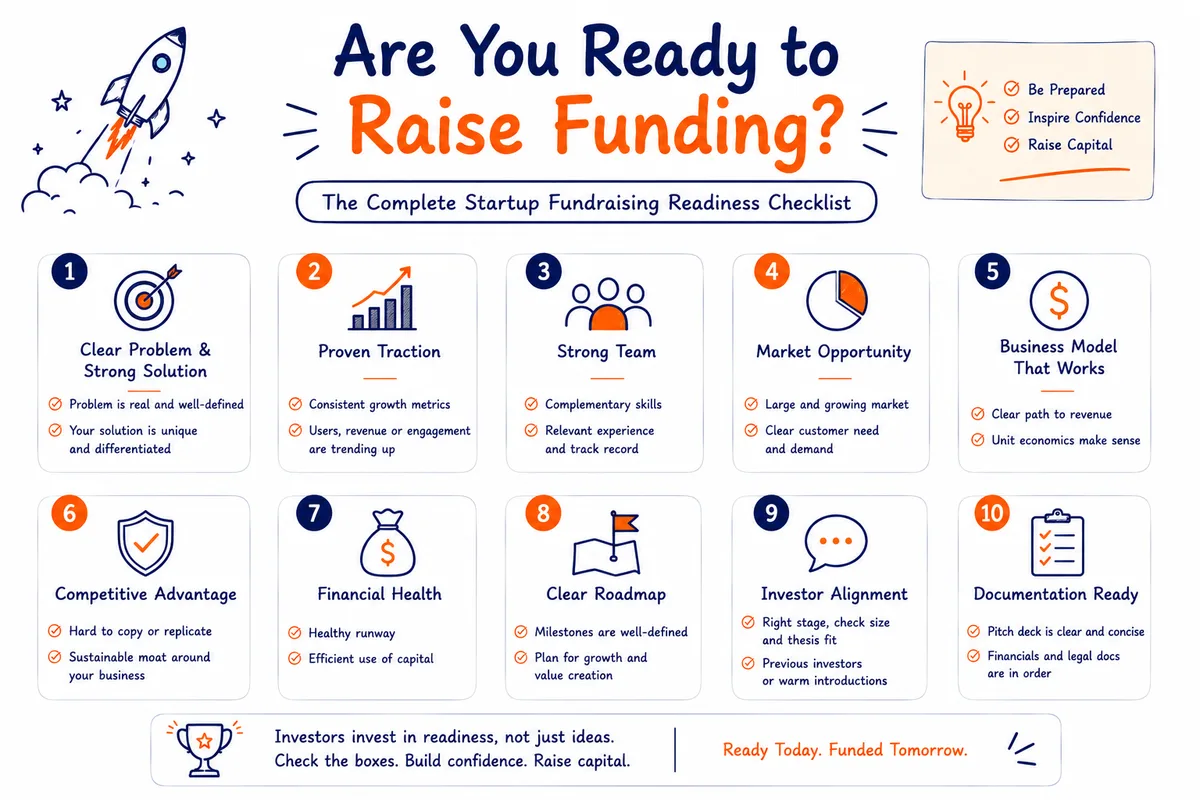
Raising funding before you're ready is one of the most expensive mistakes a founder can make — not just financially, but reputationally.
Investors have long memories. A "no" from a VC firm that sees you six months too early often becomes a permanent "no" — because you have used your first impression to demonstrate that you don't yet understand what the business needs to prove.
Fundraising readiness is not a feeling. It is a measurable state. Investors run every pitch through a structured evaluation across market, team, product, traction, business model, financials, pitch quality, and investor fit. This guide gives founders the same framework investors use — so you can assess yourself before they assess you.
Quick Answer — What Is Fundraising Readiness?
Fundraising readiness is the ability to demonstrate to investors that your startup can deploy capital effectively to hit meaningful growth milestones. It is not about having a perfect business — it is about having enough proof, at the right stage, to justify the risk an investor is being asked to take.
72%
Of seed-stage founders who fail to raise cite approaching investors before hitting key milestones — CB Insights 2024
6.7 mo
Average time to close a seed round — founders who are underprepared average 10+ months — DocSend 2024
6x
More likely to close a round when demonstrating clear product-market fit signals — First Round Review
42%
Of investors cite "lack of market validation" as the top reason they pass on early-stage pitches — OpenVC 2024
Why Most Startups Raise Too Early
The pressure to raise is constant. Startup culture celebrates funding announcements. Accelerators push cohorts toward demo days. Co-founders with runway anxiety start building investor lists before they have anything worth pitching. The result is a wave of premature fundraises that waste months and burn relationships with investors who would have said yes twelve months later.
Top Reasons Investors Pass on Early-Stage Pitches — CB Insights & OpenVC 2024
Sources: CB Insights — Why Startups Fail 2024 · OpenVC Investor Survey 2024
Each of these failure reasons is detectable — and correctable — before you start fundraising. That is exactly what fundraising readiness assessment is for. See also: What investors look for before investing and fundraising-process-a-step-by-step-guide-for-founders" style="color:#7a5cff;font-weight:600;text-decoration:underline;">the startup fundraising process.
The 8 Pillars of Fundraising Readiness
Every investor evaluates startups across eight dimensions before making an investment decision. Most founders prepare for one or two of these — the pitch and the product — and arrive at meetings underprepared for the remaining six. Here is the complete framework:
1. Market
Is the market large enough, real enough, and growing fast enough to justify venture capital?
2. Team
Does the founding team have the skills, experience, and dynamic to execute in this market?
3. Product
Is the product built, tested, and demonstrably better than existing alternatives?
4. Traction
Is there evidence — in the form of users, revenue, or retention — that people want this product?
5. Business Model
Is there a clear, scalable path from revenue to a large, profitable business?
6. Financials
Does the founder understand their numbers — and can they defend them under pressure?
7. Pitch
Can the founder communicate the opportunity clearly, compellingly, and concisely?
8. Investor Fit
Are you approaching investors who actively invest at your stage, sector, and geography?
Market Readiness
Investors fund markets, not just companies. A brilliant team with a strong product in a shrinking or tiny market will not attract venture capital. Market readiness means you can articulate clearly why the market is large, why it is moving, and why now is the right moment to build in it.
Y Combinator Library — Market sizing guidance · Sequoia Capital — Business plan framework
Team Readiness
At seed">pre-seed and seed stage, investors are primarily backing the team. The team slide is the second most scrutinised slide in any pitch deck (after traction). Team readiness is not about having impressive CVs — it is about demonstrating the right combination of skills, domain knowledge, and execution history to win in this specific market.
First Round Review — Team evaluation frameworks
Product Readiness
Product readiness is not about having a perfect product — it is about having a product that is real, testable, and demonstrably valuable to real users. The threshold differs by stage: seed">pre-seed investors accept a prototype, seed investors expect a live product, and Series A investors expect a refined, market-tested product with measurable retention.
Traction Readiness
Traction is the single most scrutinised dimension across all early funding stages. It is also the most commonly misrepresented one. Traction is not the number of sign-ups or waitlist entries — it is evidence that real users are getting real value and coming back. Here is what each funding stage expects:
Traction Benchmarks by Funding Stage — First Round Review & DocSend 2024
Sources: First Round Review · DocSend Annual Pitch Deck Report 2024
seed-fundraising" target="_blank" rel="noopener" style="color:#7a5cff;text-decoration:underline;">Y Combinator — What traction means at seed stage
Business Model Readiness
A business model is ready when you can explain, in concrete terms, how your startup turns user activity into recurring, scalable revenue — and can show early evidence that the model is working. Investors are not just asking "how do you make money?" They are asking "is there a path to a large, defensible, and profitable business from where you are right now?"
Financial Readiness
Financial readiness is frequently the area where technically strong founders are weakest. You do not need a CFO or a Big Four audit to be financially ready for fundraising — but you do need to understand your numbers, manage your burn, and present your financials in a way that demonstrates operational discipline.
Key Financial Metrics Every Investor Will Ask About — OpenVC & First Round Review
Sources: OpenVC Blog · First Round Review — Financial preparation for fundraising
Pitch Readiness
Pitch readiness is the most practised dimension — and still one of the most commonly underprepared. A strong pitch deck and a polished verbal pitch are necessary but not sufficient on their own. Pitch readiness means you can tell the story of your company in a way that makes investors want to be part of it, field the hard questions with composure, and guide the meeting toward a clear next step.
Sequoia Capital — Pitch structure guide · First Round Review — Pitch preparation
Investor Fit Readiness
Investor fit is the dimension most founders skip entirely — and it is the one that determines whether even a perfect pitch gets a term sheet. Approaching a Series B fund with a seed-stage startup, or pitching a fintech-specialist VC with a healthtech product, is structurally impossible to convert. Investor fit readiness means every investor on your list has a genuine reason to write you a cheque.
OpenVC Blog — Investor targeting and fit
Startup Fundraising Readiness Scorecard
Use this scorecard to assess where your startup stands across the 8 pillars before approaching investors. Be honest — investors will find the gaps if you don't. The goal is not to score perfectly; it is to know exactly where to focus your next 30–90 days of preparation.
| Pillar | What "Ready" Looks Like | Seed | Series A |
|---|---|---|---|
| Market | Bottom-up TAM, clear "why now", growing market with named structural shift | Partial | Required |
| Team | Founder-market fit, complementary skills, vested equity, prior execution evidence | Required | Required |
| Product | Live product, demonstrable value prop, user validation and qualitative proof | Required | Required |
| Traction | Seed: 10–15% MoM, >60% retention / Series A: 2–3x YoY, >80% retention | Partial | Required |
| Business Model | Named revenue model, gross margin known, scalability logic clear | Partial | Required |
| Financials | MRR, burn, runway, CAC, LTV, gross margin — all known and defensible | Partial | Required |
| Pitch | 10–14 slide deck, rehearsed 10-min and 20-min versions, clear ask and use of funds | Required | Required |
| Investor Fit | Stage-, sector-, geography-, and thesis-matched investor list; personalised outreach | Required | Required |
Framework informed by: Y Combinator Library · First Round Review · OpenVC Blog
Common Red Flags Investors Notice Immediately
Experienced investors pattern-match on red flags within the first few minutes of a pitch. These are the signals — often unintentional — that trigger scepticism before the founder has finished their second slide:
Red Flag
Claiming Zero Competition
Every market has competition — including "doing nothing" as a competitor. Founders who say "we have no competitors" signal that they haven't researched the landscape. Investors pass immediately.
Red Flag
Vanity Metrics as Traction
Total sign-ups, website visits, and social followers are not traction. Active users, retention rates, revenue, and net promoter scores are traction. Conflating the two signals a lack of analytical rigour.
Red Flag
Not Knowing Your Own Numbers
Hesitating when asked about MRR, CAC, retention, or burn rate signals that the founder is not operating the business with financial discipline. Investors interpret this as a risk to capital deployment.
Yellow Flag
Raising on a PowerPoint Alone
At seed">pre-seed, a prototype is acceptable. At seed or above, raising without a live product or real users signals that the capital is being sought to build the MVP — when investors expect that work to already be done.
Yellow Flag
Vague Use of Funds
"We'll use the capital to grow the business" is not an answer. Investors expect a specific allocation — percentage breakdown by function — and named milestones that the capital will enable within a defined timeline.
Yellow Flag
Defensive Under Questioning
Founders who push back emotionally on investor challenges — rather than engaging thoughtfully with the concern — raise doubts about coachability. Investors will spend years working with you; they need to know you can receive hard feedback.
First Round Review — Investor red flag patterns · OpenVC Blog
How EzFunding Helps Founders Become Investment-Ready
Assessing your own fundraising readiness is harder than it sounds — because founders are too close to their own business to evaluate it objectively. EzFunding's tools are designed to give founders the same structured, external perspective that investors apply to every pitch they evaluate.
Find out if your startup is ready to raise — before investors do
fundraising-readiness" style="display:inline-block;font-family:Arial,Helvetica,sans-serif;font-weight:700;font-size:15px;text-decoration:none;color:#fff;padding:13px 26px;border-radius:8px;background:#7a5cff;margin-right:10px;">Get Readiness Feedback Find Matching InvestorsReferences
- seed-fundraising" target="_blank" rel="noopener" style="color:#7a5cff;text-decoration:underline;">Y Combinator — A guide to seed fundraising
- Y Combinator Library — Fundraising and pitch resources
- Sequoia Capital — Business plan and pitch framework
- First Round Review — Fundraising readiness and investor evaluation resources
- OpenVC Blog — Investor targeting and fundraising readiness