Most investor pitches fail before the founder finishes their second slide.
Not because the product is bad. Not because the market is small. But because the pitch itself — the story, the structure, the signals it sends — does not give investors what they are actually looking for.
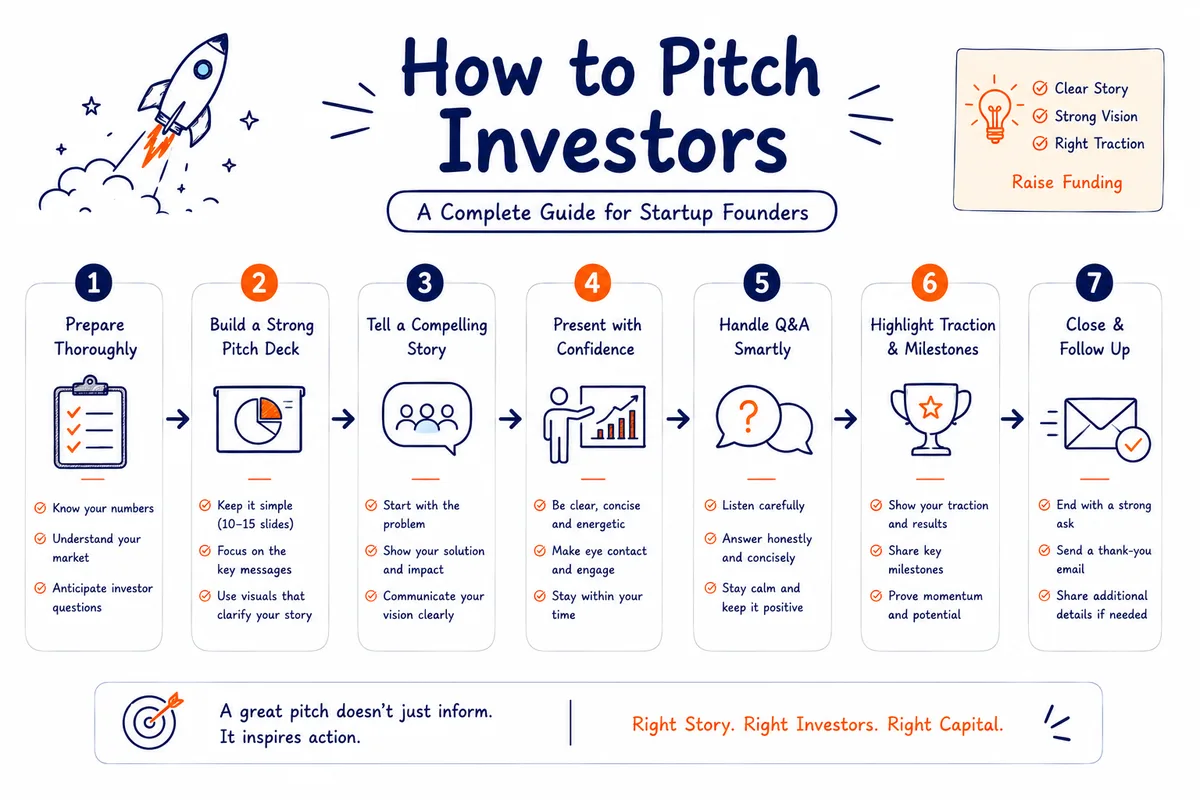
Pitching investors is a skill. And like every skill, it can be learned, practised, and dramatically improved. This guide gives startup founders the complete framework: what investors want to hear, how to structure a pitch that converts, how to handle the questions that trip founders up, and what separates the pitches that get term sheets from the ones that get polite passes.
Quick Answer
A strong investor pitch lasts 10–20 minutes and covers problem, solution, market, traction, business model, team, and funding ask — in that order. The goal is not to explain everything. The goal is to make investors want to learn more.
3 min 44 sec
Average time investors spend reading a pitch deck before deciding — DocSend 2024
~0.5%
Of pitched startups receive funding from top-tier VC firms — NVCA 2024
20–30
Targeted, matched investor meetings needed on average to close a seed round — First Round Review
37%
Of investors say weak storytelling is the primary reason they pass on pitches — DocSend 2024
Why Most Investor Pitches Fail
The data on pitch failures is consistent across DocSend's annual research, Y Combinator's founder feedback, and First Round Capital's partnership notes. Most pitches fail for the same five reasons — and none of them are about product quality.
Top Reasons Investors Pass on Pitches — DocSend 2024 & First Round Review
Sources: DocSend Annual Pitch Deck Report 2024 · First Round Review
The pattern is clear: founders over-invest in product slides and under-invest in market framing, traction presentation, and narrative structure. The investor is not evaluating the product — they are evaluating whether your company can become a large, high-return business. Those are fundamentally different questions.
What Investors Actually Want to Hear
Every investor pitch covers the same seven dimensions. What differs is not the topics — it is the depth, the evidence, and the sequence. Here is what each dimension actually means to the investor sitting across from you:
Problem
Is the pain real, frequent, and expensive enough to justify a venture-scale solution? Investors want founder empathy with the customer — not a technology solution in search of a problem.
Solution
Is your answer 10x better than the status quo — not 10% better? Incremental improvements don't attract venture capital. Genuinely different approaches do.
Market
Is the TAM large enough to build a billion-dollar company? Investors need to see a credible path to a market leadership position, not just a niche opportunity.
Traction
What have you proven with real users and real money? Revenue, retention, growth rate, and NPS scores are the language investors speak. Promises are not traction.
Team
Why are you and your co-founders the right people to win this market? Relevant experience, domain expertise, and demonstrated execution ability are what investors evaluate — not credentials alone.
Investors at early stages are also evaluating something harder to quantify: coachability and self-awareness. Founders who can clearly articulate what they don't know — and have a plan to learn it — score significantly higher than founders who claim certainty about everything.
The Complete Investor Pitch Structure
The most effective investor pitches follow a consistent nine-part structure. Every element earns its place. Nothing is decoration. Here is the framework — with the specific questions each slide or section must answer:
Framework informed by: Sequoia Capital pitch framework · seed-fundraising" target="_blank" rel="noopener" style="color:#7a5cff;text-decoration:underline;">Y Combinator seed fundraising guide
How to Tell a Compelling Startup Story
Data gets investors interested. Story makes them care. The best investor pitches combine hard evidence with a narrative that is genuinely compelling — one that makes the investor feel the problem and believe in the founder's ability to solve it. There are three narrative layers that the strongest pitches weave together:
The Founder Story
Why did you — specifically — decide to work on this problem? The most compelling founder stories connect personal experience with the problem being solved. "I spent eight years in this industry and watched this problem destroy margins for every company I worked at" is a far more convincing origin story than "we saw a market opportunity." Investors back founders with authentic conviction — and conviction that comes from lived experience is the most credible kind.
The Customer Story
Bring one customer to life in your pitch. Name them (with permission), describe their day before your product existed, and show what changed after. Specific, vivid customer stories are more persuasive than aggregate satisfaction statistics. They are also harder to fabricate — which is why investors trust them.
The Market Story
Why is now the right moment for this company to exist? What has changed — technologically, regulatorily, behaviourally — that makes this problem solvable today in a way it wasn't three years ago? The "why now" question is one of the most commonly asked and least well answered in investor pitches. A strong market narrative shows that you understand the forces creating your window of opportunity.
According to Y Combinator's partner feedback compiled in their library, the pitches that advance to partner meetings most reliably are those that make investors feel the problem before explaining the solution — a narrative sequence inversion that the weakest pitches never attempt.
Y Combinator Library — Pitch and fundraising resources
How to Present Your Pitch Deck to Investors
The pitch deck is not the pitch. It is a visual aid for the conversation. Founders who read their slides word-for-word signal inexperience. The deck's job is to anchor key information visually while the founder drives the narrative verbally. Here is how to use it effectively:
Investor Deck Engagement Data — DocSend 2024
Source: DocSend Annual Pitch Deck Report 2024 — aggregated across 1,000+ fundraising pitches
The data reveals a critical insight: investors spend the most time on traction and team — the two slides that carry the most weight in investment decisions. Most founders spend the most time building their product and solution slides. The gap between where founders invest effort and where investors invest attention is one of the most correctable misalignments in the fundraising process. See also: EzFunding's pitch deck library and analysis tool for stage-specific deck reviews.
Deck Format Guidelines
The optimal deck for a seed or Series A pitch contains 10–14 slides. Longer decks do not signal thoroughness — they signal an inability to prioritise. Sequoia's widely cited pitch framework recommends 10 slides covering: company purpose, problem, solution, why now, market, product, business model, team, financials, and competition. Every slide that doesn't make an investor lean forward should be cut.
Sequoia Capital — Pitch and business plan framework
Common Investor Questions — and How to Answer Them
The questions investors ask in pitch meetings are not random. They test for specific things: self-awareness, market understanding, operational thinking, and resilience under pressure. Here are the questions that come up most consistently — and what investors are actually measuring with each one:
| Investor Question | What They're Testing | Strong Answer Signals |
|---|---|---|
| Why now? | Market timing awareness and window-of-opportunity thinking | Specific regulatory, technological, or behavioural shift that creates the window today |
| Why this market? | Domain conviction and market-size ambition | Bottom-up TAM with defensible assumptions, not a top-down percentage claim |
| Why will you win? | Competitive moat and differentiation clarity | Specific structural advantages — data, network effects, distribution, proprietary IP |
| How do you acquire customers? | GTM strategy and scalability of channels | CAC, payback period, and proof that at least one channel is repeatable |
| What are your unit economics? | Financial literacy and business model understanding | LTV, CAC, gross margin, and payback period — with an honest view of where they're heading |
| What's your biggest risk? | Self-awareness and intellectual honesty | A specific, genuine risk — not "execution" or "competition" as a catch-all non-answer |
| Who else are you talking to? | Fundraising process management and leverage | Honest answer that signals active process without creating false urgency |
| What will you do with the capital? | Financial planning and milestone-setting discipline | Specific allocation breakdown and named milestones this round unlocks within a clear timeline |
Sources: First Round Review — Fundraising and pitch resources · OpenVC Blog
Virtual vs In-Person Investor Pitches
The shift to virtual pitch meetings — accelerated in 2020 and now firmly embedded in most VC workflows — changes the dynamics of pitching in ways most founders underestimate. Here is how the two formats compare and what each demands:
In-Person Pitch
Relationship-Building Advantage
Body language, room energy, and informal conversation before and after the meeting are powerful signals. In-person pitches are better for building rapport and reading non-verbal investor reactions in real time. Request in-person for final partner meetings whenever possible.
Virtual Pitch
Efficiency and Reach Advantage
Virtual meetings allow founders to pitch investors across geographies without travel cost. They are now the standard for first and second meetings at most seed and Series A firms globally. Deck control, eye-contact discipline, and audio quality become critical success factors.
Virtual Pitfall
Attention and Distraction Risk
Investors in virtual meetings are more likely to multitask, check email, or disengage after 10 minutes. The opening 3 minutes of a virtual pitch carry disproportionate weight. A weak opening in person is recoverable. In a Zoom meeting, it often ends the conversation.
First Round Capital's partner feedback consistently highlights that virtual pitches require 20–30% more preparation than in-person meetings — because the cues founders rely on to read the room are compressed or absent. First Round Review
Investor Meeting Checklist: How to Prepare
Preparation is the only variable in an investor meeting that founders control entirely. Here is the complete pre-meeting checklist that separates polished pitches from improvised ones:
Mistakes Founders Make During Investor Meetings
The meeting checklist tells you what to do. This section covers what not to do — the specific behaviours that experienced investors flag most consistently as red flags during pitch meetings:
Most Common Founder Mistakes in Investor Meetings — First Round Review & OpenVC Founder Survey
Sources: First Round Review · OpenVC Blog — investor survey aggregated data
The single most consistent feedback from investors is that founders who claim zero competition immediately lose credibility. Every product has competitors — the current way customers solve the problem is a competitor. Acknowledging competition and articulating your specific advantage is a far stronger signal than pretending the field is empty.
How Pitch Expectations Differ by Funding Stage
A seed">pre-seed pitch and a Series A pitch are fundamentally different conversations. The structure is the same — but the evidence required, the depth of financial analysis, and the investor's decision-making criteria all change significantly:
seed">pre-seed-investors" style="color:#7a5cff;text-decoration:none;">seed">Pre-Seed Pitch
10 slides. 10 minutes. Investors are buying the founder and the vision. Traction may be minimal or absent. The narrative and the founder's credibility do most of the work. Lead with the problem and the team.
seed-investors" style="color:#2bb5a0;text-decoration:none;">Seed Pitch
12 slides. 15–20 minutes. Investors expect a live product and early evidence — users, retention signals, or initial revenue. Traction slide becomes critical. Business model must be believable even if not yet proven.
Series A Pitch
14 slides. 30–45 minutes including Q&A. Investors require proven PMF, consistent MoM growth (15–25%), unit economics (LTV/CAC >3x), and a scalable GTM strategy. Financial modelling and cohort analysis will be scrutinised in depth.
See: seed-investors-vs-series-a-investors-which-investors-should-you-target" style="color:#7a5cff;font-weight:600;text-decoration:underline;">Seed investors vs Series A investors — which investors should you target and Startup funding stages explained for a complete breakdown of stage benchmarks.
How EzFunding Helps Founders Improve Their Investor Pitch
Knowing the framework for a strong pitch is one thing. Getting targeted, stage-specific feedback on your actual pitch — and then reaching the right investors with it — is another. EzFunding is built specifically to bridge that gap.
Get feedback on your pitch deck — before you send it to investors
Get Pitch Deck Feedback Find Matching InvestorsReferences
- seed-fundraising" target="_blank" rel="noopener" style="color:#7a5cff;text-decoration:underline;">Y Combinator — A guide to seed fundraising
- Y Combinator Library — Pitch and fundraising resources
- Sequoia Capital — Writing a business plan and pitch framework
- First Round Review — Fundraising, pitch, and founder resources
- OpenVC Blog — Investor and fundraising insights