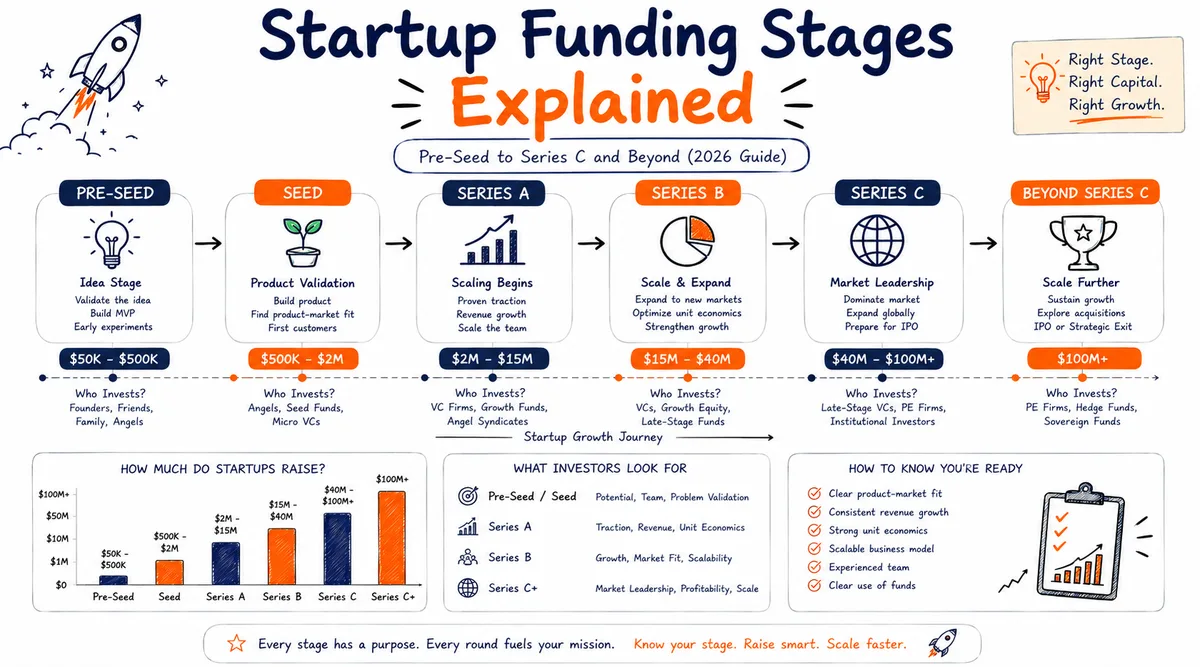
Most startup founders understand that funding comes in rounds. What fewer understand is what each round actually demands — the milestones, the metrics, the investor types, and the signals that separate a fundable startup from one that gets politely declined.
Getting the stage wrong is expensive. Approaching a Series A firm with a three-month-old product wastes your one shot at a first impression. Raising a seed round when you have ₹1.5Cr ARR leaves money on the table. Stage literacy is not a nice-to-have — it is the foundation of every successful fundraise.
Startup funding stages are the sequential capital rounds a startup raises as it grows — from idea validation at
seed">pre-
seed to market leadership at Series C and beyond. Each stage demands different proof, attracts different investor types, and comes with different check sizes and expectations.
$285B
Global venture capital deployed in 2024
Source: NVCA 2025 Yearbook
~$2.8M
Source: Crunchbase 2024
~$12M
Source: Crunchbase 2024
6.7 mo
Average time to close a
seed round in 2024
Source: DocSend 2024
The startup funding lifecycle at a glance
Startup funding stages · Startup funding lifecycle · Startup funding phases
Every startup funding journey follows a broadly predictable arc. Below is the full lifecycle — from the earliest idea-stage capital to growth rounds that prepare a company for public markets.
seed">Pre-seed
Idea validation — build the foundation
₹25L – ₹4Cr raise
1–3 founders
No revenue required
MVP in development. No customers yet. Investors bet entirely on founder quality, problem depth, and market potential. Angels, accelerators, and friends & family are the typical sources.
Seed
Early traction — prove people want it
₹50L – ₹25Cr raise
3–8 team members
Early customers, retention signals
Product is live. Early users exist. The startup is validating product-market fit — not proving it.
Seed investors look for retention, user growth, and a clear path to PMF. Angel investors,
seed funds, and micro VCs lead these rounds.
Series A
Proven growth — build the machine
₹25Cr – ₹120Cr raise
15–40+ team members
₹50L–₹2Cr+ MRR
PMF is demonstrated. Revenue is growing 2–3x YoY. LTV/CAC exceeds 3x.
Series A capital funds scaling the go-to-market engine. Institutional VC firms lead these rounds and conduct deep financial due diligence.
Series B
Market expansion — grow the territory
₹120Cr – ₹400Cr raise
50–200+ team members
Proven unit economics at scale
The model works.
Series B funds expansion into new markets, geographies, and customer segments. Investors expect strong NRR (>110% for
SaaS), low churn, and a clear path to market leadership. Growth equity funds join institutional VCs.
Series C
Market leadership — dominate the category
₹400Cr+ raise
200+ team members
Pre-IPO or strategic M&A path
The company is a market leader. Series C capital prepares the business for an IPO, large-scale M&A, or international expansion. Crossover funds, sovereign wealth funds, and late-stage PE firms participate alongside established VCs.
Series D+ / IPO
Exit or continued private growth
₹800Cr+ raise
Public market readiness
A small percentage of startups reach Series D and beyond before going public. Most exits happen via acquisition between
Series B and Series C. The IPO path requires consistent profitability or a clear path to it.
Most startup funding journeys progress through these stages, though timelines vary significantly by industry, geography, and capital intensity. NVCA 2025 Yearbook · Visible.vc
Startup funding rounds: what each one requires
Startup funding rounds · Startup funding series · Funding round guide
Understanding what each round requires — and what investors measure at each stage — is what separates founders who raise from founders who get ghosted. Here is the breakdown:
Raise size₹25L – ₹4Cr
Equity dilution10–20%
Revenue req.None
Duration3–9 months
InstrumentSAFE / convertible
Angels
Accelerators
F&F
Raise size₹50L – ₹25Cr
Equity dilution15–25%
Revenue req.Early / optional
Duration4–8 months
InstrumentPriced equity / SAFE
Seed funds
Micro VCs
Angels
Raise size₹25Cr – ₹120Cr
Equity dilution15–25%
Revenue req.₹50L–₹2Cr MRR
Duration6–9 months
InstrumentPriced equity
Institutional VCs
Corporate VCs
Raise size₹120Cr – ₹400Cr
Equity dilution10–20%
Revenue req.₹5Cr+ MRR
Duration6–12 months
InstrumentPriced equity
Growth equity
Late-stage VCs
Raise size₹400Cr+
Equity dilution5–15%
Revenue req.₹25Cr+ MRR
Duration6–18 months
InstrumentPriced equity
Crossover funds
PE / Sovereign
Median raise sizes by stage: global vs India (2024)
Startup funding rounds explained · How much do startups raise
Raise sizes vary significantly between global benchmarks and Indian startup market norms. Here is how the numbers stack up across stages for 2024:
Sources: Crunchbase 2024 · Inc42 Annual Funding Report 2024 · Tracxn India 2024
Key metrics investors check at each stage
Startup funding phases · Investor evaluation · Fundraising readiness
The benchmarks investors use shift dramatically as a startup matures. Here is what each stage demands across the metrics that actually determine fundability:
Seed stage — metric benchmarks
MoM user growth
10–15% MoM
Series A — metric benchmarks
YoY revenue growth
2–3x YoY
Series B — metric benchmarks
What comes after Series A? Understanding Series B, C, and beyond
What comes after Series A · Startup funding rounds · Post Series A
Series A is not the finish line — it is the start of a new phase. Founders who raise Series A often underestimate how much more rigorous the expectations become for subsequent rounds. Here is what changes:
From growth rate to growth quality
Series B investors don't just want 3x growth — they want efficient growth. CAC payback periods, NRR, and gross margin become primary screens. Growing fast but burning capital excessively is a
Series B dealbreaker.
From founding team to leadership team
Series B investors expect VP-level or C-suite hires in sales, marketing, and engineering. The question shifts from "can the founders execute?" to "can this organisation scale without the founders in every decision?"
From one market to multiple markets
Series B capital funds expansion — into new geographies, customer segments, or adjacent products. Investors need to see a proven playbook from the first market before they'll fund replication.
From VC-led to institutional-led
Series C and beyond typically attract crossover funds (Fidelity, T. Rowe Price), sovereign wealth funds, and growth-equity PE firms alongside VCs. The due diligence becomes investment-bank-grade in depth and rigour.
From ARR to EBITDA path
Series C investors — especially post-2022 — want a credible path to profitability, not just revenue growth. The "growth at all costs" playbook is no longer sufficient at late stages. Burn multiples matter.
From product to platform
Late-stage investors back category-defining platforms, not point solutions. Series C companies are expected to own a market segment and have defensible moats — network effects, data advantages, or switching costs.
Common mistakes founders make at each funding stage
Startup fundraising · Startup funding process · Fundraising readiness
Stage misalignment is the leading cause of fundraising failure — not weak products. Here are the most common mistakes at each stage:
1
Raising
seed capital before building anything testable
Seed investors in 2024–2025 expect a live product and at least 30–50 active users. Raising on a deck alone — without a demo or prototype — is now a
seed">pre-
seed conversation, not a
seed conversation.
2
Approaching
Series A investors without consistent MoM growth
Series A firms pass on startups growing 5% MoM regardless of how compelling the vision sounds. If your growth is lumpy or declining, you need another 6 months of runway before approaching institutional investors.
3
Raising too little at
seed — and burning through it without milestones
Raising ₹2Cr at
seed when you need ₹5Cr to reach
Series A milestones forces a bridge round at unfavorable terms. Raise what you need to hit the next stage's benchmark metrics with 3–6 months of buffer.
4
Conflating ARR with MRR in investor materials
Presenting ₹1Cr ARR when you mean ₹1Cr MRR (annualised to ₹12Cr ARR) misrepresents your traction. Every sophisticated investor will catch it. Precision in metrics builds trust; sloppiness destroys it.
5
Targeting investors at the wrong stage
A
Series B fund that writes ₹150Cr minimum cheques cannot invest in your ₹8Cr
seed round — structurally impossible. Stage mismatch is an automatic no that no pitch quality can overcome. Use investor matching to filter before you reach out.
Signs you're ready to move to the next funding stage
Fundraising readiness · Startup funding lifecycle
Readiness is not a feeling — it is a checklist. Before approaching investors at any stage, validate that you can answer yes to these questions:
18–24 months of runway post-raise
Your raise amount should give you enough runway to hit the milestones required for the next funding stage — not just survive.
Consistent growth for 3–6 months
One good month doesn't make a trend. Investors need to see sustained, consistent growth — not a spike followed by a plateau.
Clear use of funds mapped to milestones
Investors don't just ask "what will you do with the money?" They ask "what specific milestones will this capital enable, and what is the timeline?"
Stage-matching metrics in your data room
Your MRR, retention, CAC, LTV, and growth rate must meet the benchmarks investors at your target stage actually look for — not the benchmarks from two stages ago.
Investor list filtered by stage and sector
You should be approaching 20–30 investors who actively invest at your stage, in your sector — not 200 investors you found on a generic database.
Pitch narrative that explains the why now
Why is this the right moment for this company? Market timing, regulatory tailwinds, or
technology shifts — investors need to see that the window is open right now.
Startup funding stages in India: what to expect in 2025–2026
Startup funding India · Seed funding India · Series A funding India
India's startup funding ecosystem has matured significantly — and so have investor expectations at each stage. The numbers below reflect verified 2024 data from India-specific funding trackers:
india-grid">
india-card">
india-num" style="color:#534AB7">$11.3B
india-label">Total startup funding in
India, 2024
india-sub">Source: Inc42 Annual Report 2024
india-card">
india-num" style="color:#534AB7">1,200+
india-sub">Source: Tracxn
India 2024
india-card">
india-num" style="color:#1D9E75">₹3–8Cr
india-sub">Source: Tracxn
Indiaindia-card">
india-num" style="color:#1D9E75">₹5–40Cr
india-label">Typical
seed ticket size,
India 2024
india-sub">Source: Inc42
india-card">
india-num" style="color:#378ADD">₹30–100Cr
india-sub">Source: Venture Intelligence
india-card">
india-num" style="color:#378ADD">100+
india-label">Active
seed-stage investors in
Indiaindia-sub">Source: Venture Intelligence 2024
Indian founders increasingly face tighter scrutiny on unit economics and scalability — even at seed. The days of raising on vision alone are largely over for most sectors. Startup India · early-stage-funding-in-india-a-complete-breakdown/" target="_blank" class="src">Seafund — India funding stages
Find investors by funding stage
Find investors · Investor matching · Startup funding platform
Understanding your funding stage is step one. Step two is finding the investors who actively invest at that stage — in your sector, in your geography, at your check size. EzFunding's investor matching platform does exactly that.
References