Investor Matching Explained: How Startups Find the Right Investors in 2026 — a comprehensive blog article
Finding investors is not the hard part. Finding the right investors is.
Thousands of investors actively fund startups every year. Yet most founders still spend months building spreadsheets, sending cold emails, and sitting across from investors who were never a fit in the first place. The result is a fundraising process that burns time, energy, and momentum — often without a term sheet to show for it.
This is the story of why traditional investor research fails, how investor matching actually works, and how founders in 2026 are using structured matching to raise faster and smarter.
What is investor matching?
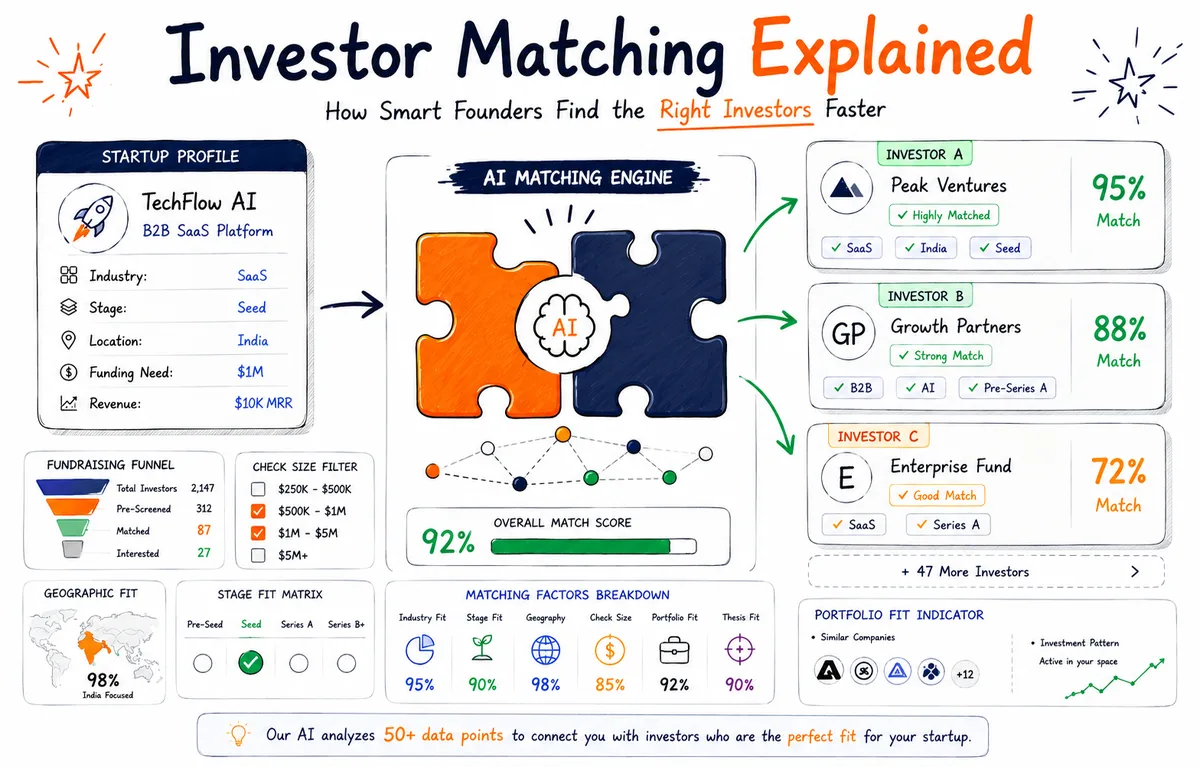
Investor Matching · Investor Matchmaking · Startup Investor MatchingInvestor matching is the process of identifying investors whose stage focus, sector thesis, geography, and check size align with a specific startup's profile — and ranking them by the likelihood of investment. It is fundamentally different from browsing an investor database.
A database gives you a list. Matching gives you relevance. An investor database might return 4,000 VCs active in India. Investor matching narrows that to the 18 who invest at your stage, in your sector, with a check size that fits your round — and ranks them by how closely their portfolio and thesis align with your startup.
Investor matching platforms use structured data about both startups and investors to identify potential fit and reduce fundraising inefficiency. Flippa
Why traditional investor research fails
Find Investors · Investor Database · Investor ResearchThe typical founder fundraising workflow is broken at the source. It optimises for volume over relevance — and pays the price in months of wasted outreach.
The traditional cold-outreach funnel — based on aggregated DocSend and First Round Review data, 2024
This failure rate is not random. It happens for five predictable reasons:
Wrong funding stage
Most investor databases do not distinguish between investors who are actively deploying at seed versus those who only participate in Series B+ rounds. Founders waste time pitching growth-stage investors with a six-month-old product.
Wrong industry focus
Every investor has a thesis. A fintech-focused fund that has never invested in climate tech is not going to start with you. Sector mismatch is the single biggest cause of ignored cold emails.
Wrong geography
Geography remains an underrated filter. Many investors — even supposedly global ones — have a strong preference for startups in their home market or region. Indian founders pitching US-only investors face structural headwinds that no pitch deck can overcome.
Outdated investor lists
The average investor database is 12–18 months out of date. Funds that were active two years ago may have fully deployed their capital and be in a hold period. Reaching out to them is wasted effort.
Generic outreach
A copy-paste email to 200 investors that reads "I'm building the Uber for X" signals that the founder has not done their homework. Personalised, thesis-aligned outreach converts at 8–12x the rate of generic cold emails — but it requires knowing what each investor's thesis actually is.
How investor matching works
Investor Matching Platform · Startup Investor Matching · Investor DiscoveryInvestor matching is a four-step process that uses structured data about both startups and investors to surface high-probability matches. Here is how each step works:
Capture stage, sector, location, traction, revenue, team size, and raise target — the input data that drives matching accuracy
Map each investor's sector focus, active investment stage, typical check size, geography, and portfolio to build a structured investor profile
Score each investor-startup pair across five dimensions: stage fit, sector fit, geography fit, thesis fit, and portfolio fit — weighted by importance
Generate a prioritised investor list with match explanations — so founders know exactly why each investor was surfaced and how to personalise outreach
Investor-startup matching systems increasingly use structured criteria and recommendation algorithms to identify high-fit opportunities — with explainability built in so founders understand why each match was made. MIT/VCWiz — arXiv · Explainable Matching — arXiv
The 5 factors that determine investor fit
Seed Investors · Series A Investors · seed">Pre-Seed Investors · Angel InvestorsNot all investor fit is equal. Some dimensions are hard gates — if you don't match, no pitch deck will fix it. Others are softer signals that influence priority. Here are the five factors that matter:
Research shows that matching solely by sector can be insufficient — investor behaviour, portfolio strategy, and investment patterns also significantly determine fit outcomes. NextView Ventures
Investor matching vs investor databases
Investor Database · Investor Discovery · Find InvestorsThe distinction matters. Using a database to find investors is like using a phone book to find a therapist — technically possible, practically inefficient. Here is how they compare:
| Feature | Investor database | Investor matching |
|---|---|---|
| Investor search | Yes | Yes |
| Stage filtering | Limited | Precise |
| Industry filtering | Limited | Precise |
| Personalised recommendations | No | Yes |
| Match explanations | No | Yes |
| Thesis fit scoring | No | Yes |
| Outreach guidance | No | Yes |
| Fundraising readiness check | No | Yes |
| Portfolio conflict detection | No | Yes |
| Real-time data freshness | Varies | Structured |
What investors actually look for
Startup Investors · Venture Capital Investors · Angel InvestorsMatching surfaces the right investors. But to convert a match into a meeting, founders need to understand how investors actually evaluate startups. These are the seven factors — and how much weight they carry:
Relative investor weight by criterion — based on First Round Capital and DocSend investor survey data, 2024. Weights shift by stage.
Investor matching for different funding stages
seed">Pre-Seed Investors · Seed Investors · Series A Investors · Growth StageInvestor matching is not one-size-fits-all. The criteria, investor types, and benchmarks that matter differ significantly at each stage. Here is how matching should be calibrated:
How AI is changing investor matching in 2026
AI Investor Matching · AI Fundraising · Startup Fundraising SoftwareManual investor matching — building spreadsheets, reading fund websites, cross-referencing Crunchbase — was the state of the art five years ago. In 2026, AI-powered matching systems are changing what is possible at every step of the process.
Recent investor-startup matching systems increasingly incorporate AI and explainability to improve recommendations and transparency — enabling founders to understand not just who to approach, but why each match was made. Explainable Investor Matching — arXiv · VCWiz Matching Study — arXiv
Why investor matching matters for startup fundraising
Startup Fundraising · Startup Funding · Investor DiscoveryThe ROI on investor matching — relative to traditional research — is measurable across every dimension that matters to a founder in a live fundraise.
Investor matching platforms are designed to reduce manual sourcing and help founders spend more time on fundraising conversations rather than research — directly improving both efficiency and deal close rates. Flippa
How EzFunding helps founders find matching investors
EzFunding is built specifically for the investor-stage alignment problem. Every feature is designed to help founders identify, evaluate, and reach the right investors — faster and with higher confidence.