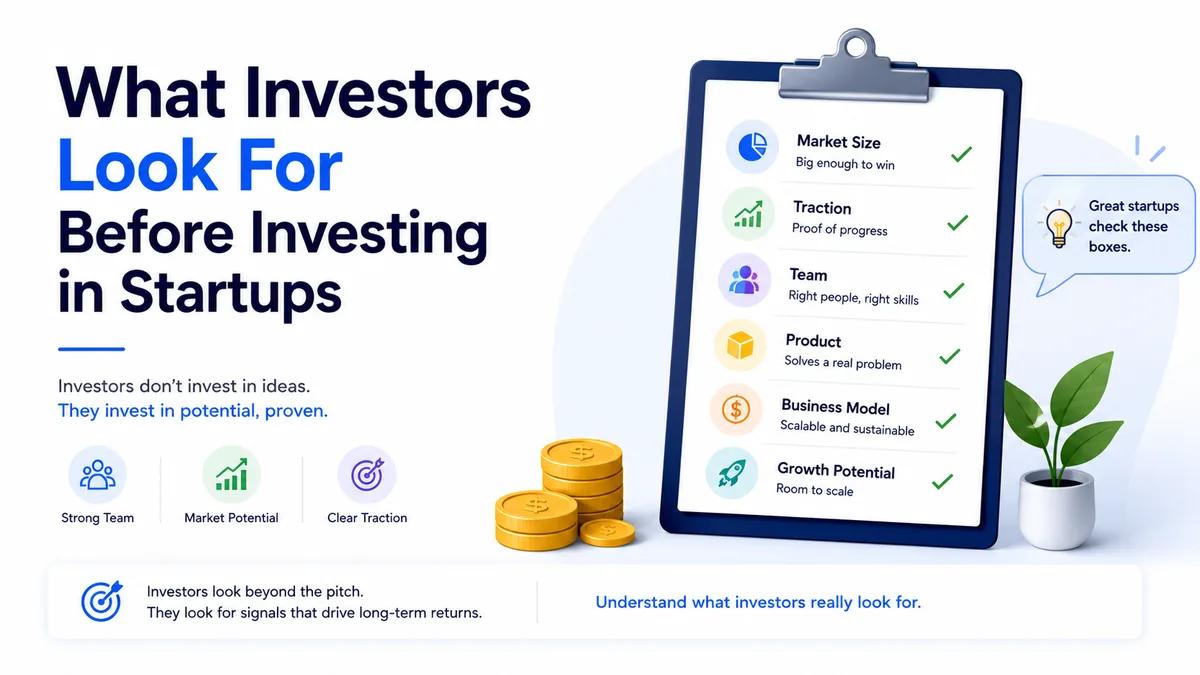
Most founders spend months searching for investors. Few spend enough time understanding how investors actually decide. By the time you're in the room, the outcome is often already determined — not by your charisma on the call, but by whether your market, team, traction, and numbers hold up to the same checklist every investor runs in their head.
Founders ask "how do I find investors?" Investors ask "why should I invest?" This is the gap that decides who raises efficiently and who spends a year getting nowhere.
How Investors Evaluate Startups
Every investor runs their own process, but nearly all of them are scoring the same eight dimensions in some order: market, team, product, traction, business model, competition, financials, and growth potential. The startups that understand this evaluate themselves first — before an investor ever does.
The Investor Funnel: How Few Proposals Get Funded
Source: NVCA; startup financing research compiled by Fundera/LLC.org.
Market Opportunity
Before anything else, investors are sizing the ceiling. A great team in a tiny market still produces a small outcome.
What investors are checking:
- Market size: is the addressable market big enough to support a venture-scale outcome?
- Market growth: is this category expanding or shrinking?
- Customer demand: is there evidence people actually want this, beyond the founder's conviction?
The two questions behind every market slide: Is this market large enough? and Can this become a meaningful company?
Founder & Team Quality
Investors say it often because it's true: team matters more than idea. Ideas pivot constantly; teams either can or can't execute through that change.
Why Team Composition Shows Up in the Data
Source: Startup Genome; CB Insights post-mortem research.
What investors are checking:
- Founder experience: have you built or operated something before?
- Domain expertise: do you understand this market more deeply than an outsider would?
- Ability to execute: is there evidence of shipping, not just planning?
- Team completeness: are the critical functions (product, growth, technical) covered?
The investor question underneath all of it: Can this team build and scale the company?
Product & Problem Validation
What investors are checking:
- Problem importance: is this a real, painful problem, or a nice-to-have?
- Solution quality: does the product actually solve the problem well?
- Product differentiation: why this, and not an existing alternative?
- User adoption: are people using it without being pushed to?
The underlying question: Does this solve a real problem?
Traction & Growth Signals
Traction is the evidence layer — the part of the pitch that turns belief into proof.
What investors are checking:
- Customers: how many, and how were they acquired?
- Revenue: is anyone actually paying, and how much?
- Retention: do customers stick around, or churn quietly?
- Growth rate: is the trajectory accelerating or flattening?
- Engagement: are users actually using the product, not just signing up?
The investor question: Is the market validating the product?
Business Model
What investors are checking:
- Revenue model: subscription, transaction, usage-based — and does it fit the buyer's behavior?
- Pricing: is it tested, or guessed?
- Gross margins: does the unit economics math actually work at scale?
- Scalability: does revenue grow faster than cost as you add customers?
The investor question: Can this become a large business?
Competitive Advantage
What investors are checking:
- Moat: what stops a well-funded competitor from copying this in six months?
- Network effects: does the product get better as more people use it?
- Data: do you accumulate an advantage competitors can't easily replicate?
- Distribution: do you have a channel advantage, not just a product advantage?
- Technology: is there genuine technical depth, or is this a thin wrapper?
The investor question: Why will this startup win?
Financial Readiness
What investors are checking:
- Runway: how many months of cash remain at current burn?
- Burn rate: is spending disciplined or reactive?
- Capital efficiency: how much output is the business generating per dollar raised?
- Fundraising plan: is there a clear use of funds tied to specific milestones?
Common Reasons Investors Reject Startups
Most rejections trace back to a handful of repeating patterns. Here's what shows up most often in post-mortem research on failed fundraises and failed startups.
What Founders Cite as the Cause When Fundraising Fails
Multi-cause data; categories overlap. Source: CNBC/DemandSage research, CB Insights startup post-mortems.
No Market Validation
Conviction is not evidence. Investors want proof someone outside the founding team has voted with their time or money.
Weak Team
Gaps in critical functions, no relevant domain experience, or visible founder misalignment all read as execution risk.
No Traction
Without usage, revenue, or retention signals, investors are being asked to bet on a hypothesis rather than a result.
Poor Business Model
A product people like isn't the same as a business that scales. Margins and unit economics have to work on paper before they work in practice.
Unclear Story
If an investor can't repeat your pitch back to their partners in two sentences, it doesn't move forward internally — no matter how good the underlying business is.
Weak Pitch Deck
Roughly 89% of venture capital firms expect a pitch deck during fundraising, and investors spend under four minutes reviewing one before deciding whether to take a call — so clarity in the first few slides carries almost all the weight.
Wrong Timing
Some startups aren't bad ideas — they're early or late relative to the market and macro conditions, and no pitch can fully overcome that.
Startup Investment Checklist
Use this as a self-scorecard before you ever get in front of an investor. Be honest with each rating — the goal is to find the weak spot before they do.
How Founders Can Improve Investor Readiness
Investment readiness isn't a feeling — it's a set of fixable gaps. Four areas move the needle fastest:
- Investor research: know an investor's thesis and portfolio before you ever email them.
- Pitch deck feedback: get outside eyes on your deck before it reaches an investor's inbox, since you rarely get a second look.
- Fundraising readiness: stress-test your financials, story, and data room before going outbound.
- Investor matching: spend your limited outreach capacity on investors who actually fit your stage, sector, and check size.
Go deeper on each step in How to Find Investors for Your Startup, Investor Matching Explained, seed-investors-vs-series-a-investors" style="color:#7a5cff;font-weight:600;text-decoration:underline;">Seed Investors vs. Series A Investors, Startup Funding Stages Explained, and Startup Funding Sources Every Founder Should Know.
How EzFunding Helps Founders Become Fundable
Becoming fundable is a process, not a single document. EzFunding supports each stage of it:
Investor Matching
Surfaces investors that fit your stage, sector, geography, check size, and thesis.
Readiness Scoring
Benchmarks your team, traction, and financials against the checklist investors actually use.
Pitch Deck Analysis
Flags the clarity gaps that cost you attention in the first four minutes.
Investor Discovery
Replaces hours of manual research with a filtered, relevant shortlist.
Outreach Intelligence
Helps you prioritize and time follow-ups instead of guessing when to reach out again.
Browse investors directly by the round you're raising: seed">pre-seed-investors" style="color:#7a5cff;font-weight:600;text-decoration:underline;">seed">pre-seed investors, seed-investors" style="color:#7a5cff;font-weight:600;text-decoration:underline;">seed investors, or Series A investors.
Want to know exactly where your raise will get questioned?
Get Personalized Investor Matches →