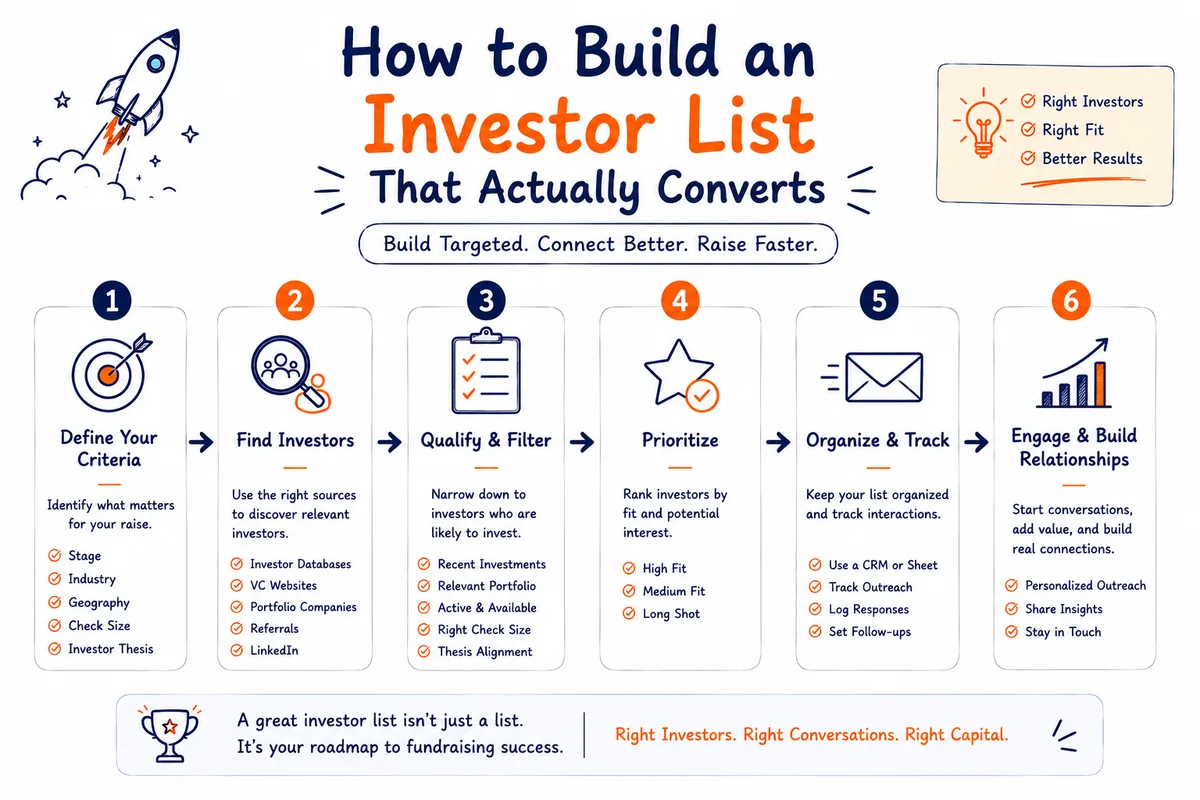
Most founders don't have a fundraising problem. They have a targeting problem. Sending 500 emails to the wrong investors is less effective than contacting 25 investors who actively invest in your stage, sector, and geography — and the data backs that up almost embarrassingly clearly.
The quality of your investor list often determines the quality of your entire fundraising outcome, long before your pitch deck ever gets opened.
Fewer, Better-Targeted Contacts Beat Volume
Source: investor outreach benchmark data compiled by Prospeo, 2026.
Why Most Investor Lists Fail
Random Investor Selection
Pulling names from a generic "top VC" list with no regard for whether they invest at your stage or in your sector.
No Stage Filtering
Pitching a $250K seed">pre-seed round to a fund whose smallest check is $5M wastes both sides' time before the conversation even starts.
No Sector Filtering
An investor with zero history in your category is statistically far less likely to convert, no matter how strong your traction is.
Outdated Databases
Investors change firms, funds close, and theses shift. A list that's a year old is already partly wrong.
Generic Outreach
Even a well-targeted investor will ignore a copy-pasted email. Average cold email reply rates have fallen from 8.5% in 2019 to 3.43% in 2026 — and the founders still getting replies are the ones combining tight targeting with real personalization.
What Makes a Great Investor List?
A great investor list isn't longer. It's filtered against six dimensions before a single email goes out.
Stage Fit
Sector Fit
Geography Fit
Check Size Fit
Portfolio Fit
Thesis Fit
Step 1: Define Your Startup Profile
Before you research a single investor, write down five things about your own company:
- Funding stage: seed">pre-seed, seed, or Series A
- Industry: the specific category, not just "tech"
- Geography: where you're incorporated and where you operate
- Revenue: current traction, even if it's early
- Funding goal: the specific amount and what it buys you
Step 2: Identify Relevant Investor Types
- Angel investors: individuals writing smaller, faster checks, typically seed">pre-seed and seed
- Seed funds: institutional but early-stage focused, good for startups with early traction
- Venture capital firms: larger checks for startups ready to scale
- Family offices: patient, often more flexible capital
- Strategic investors: corporates investing for industry alignment, not just returns
Step 3: Research Investor Activity
For every name on your list, answer four questions before you reach out:
- What have they invested in recently?
- How recently have they made a new investment?
- What stage do they actually write checks at?
- What sectors do they consistently come back to?
Step 4: Create an Investor Scoring Framework
Score every investor on your list against weighted criteria instead of a gut feeling. A simple, effective weighting looks like this:
Sample Investor Scorecard Weighting
Step 5: Prioritize Investors
Tier 1
Perfect Match
High score across every criterion. These get your most personalized outreach and a warm intro if you have one.
Tier 2
Good Match
Strong on most criteria, weaker on one or two. Worth pursuing once Tier 1 outreach is underway.
Tier 3
Long Shot
Marginal fit on key criteria. Low priority — don't let these crowd out the list above them.
Common Investor Research Mistakes
- Contacting investors who never write checks at your stage
- Ignoring geography and pitching investors with no presence or interest in your region
- Using outdated lists pulled from old articles or stale databases
- Not researching portfolio companies before reaching out
- Mass outreach: emailing 10+ contacts at one firm drops reply rates to roughly half of what 1–2 targeted contacts achieve
Investor Matching vs. Manual Investor Research
| Factor | Manual Research | Investor Matching |
|---|---|---|
| Time to build a list | Days to weeks | Minutes |
| Data freshness | Often outdated | Continuously updated |
| Scoring consistency | Subjective, varies by founder | Consistent criteria across the list |
| Discovery of lesser-known investors | Limited to what you already know | Surfaces relevant funds you'd never have found |
See exactly how the matching process works in Investor Matching Explained.
How AI Helps Build Better Investor Lists
- Pattern matching: identifies investors whose past deals resemble your company
- Investor recommendations: surfaces names you wouldn't have found manually
- Similar investor discovery: expands your list from a handful of known names into a fuller, relevant set
- Investor scoring: applies consistent weighting across stage, sector, geography, and check size
- Fundraising intelligence: flags when an investor's activity or thesis changes, so your list doesn't go stale
Why Targeting Matters More Than Volume
Source: Instantly 2026 cold email benchmark report; Evalyze.ai founder outreach research.
Building an Investor List for Different Funding Stages
seed">Pre-Seed
Lean toward angels, friends-and-family networks, and accelerators — investors comfortable with conviction over data.
Seed
Add seed funds and angel syndicates that expect early traction but not yet a fully proven business model.
Series A
Shift toward institutional venture capital firms that expect demonstrated product-market fit and repeatable growth. Compare what changes between rounds in seed-investors-vs-series-a-investors" style="color:#7a5cff;font-weight:600;text-decoration:underline;">Seed Investors vs. Series A Investors.
Growth
Target growth equity firms and later-stage funds focused on scaling proven unit economics rather than validating a model. For a full breakdown of what changes at each round, see Startup Funding Stages Explained.
Investor Outreach Preparation Checklist
Before your list goes anywhere, make sure these six things are ready:
Follow-ups matter more than most founders assume: roughly 70% of cold emails never get a single follow-up, yet sending just one more message lifts reply rates by close to 66%. Make your sequence non-negotiable, not an afterthought.
How EzFunding Helps Founders Build Investor Lists
Investor Matching
Filters investors against your stage, sector, geography, check size, and thesis automatically.
Investor Discovery
Surfaces relevant investors you wouldn't have found through manual research alone.
Investor Profiles
Centralizes portfolio history, check size, and recent activity in one place.
Investor Intelligence
Flags thesis or activity changes so your list stays current, not stale.
Fundraising CRM
Tracks every conversation so nothing falls through the cracks mid-raise.
Outreach Intelligence
Helps you time and sequence follow-ups instead of guessing.
Once your list is built, make sure your story can carry it — revisit How to Find Investors for Your Startup and What Investors Look For Before Investing in Startups, or explore funding paths beyond equity in Startup Funding Sources Every Founder Should Know.
Stop guessing who to email next.
Get Your Personalized Investor List →