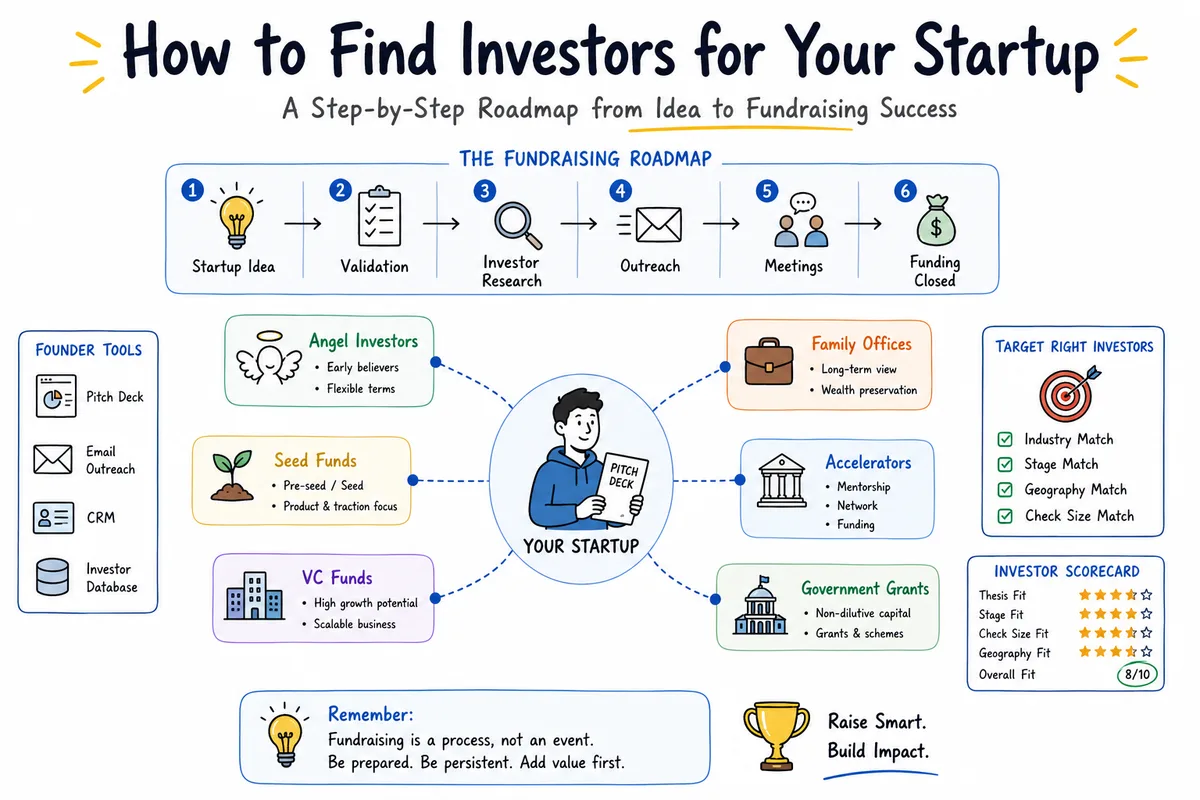
You've built the product. You've got early users who actually love it. Now comes the part most founders dread more than building the thing itself: finding people willing to write you a check. Here's the truth — there's no shortage of investors in 2026. There's a shortage of founders who know how to find the right ones, at the right stage, with the right thesis fit.
Quick Answer
To find investors for your startup in 2026, identify your funding stage, build a strong pitch deck, research investors aligned with your sector, and use investor matching platforms to discover relevant angel investors, seed funds, and venture capital firms. Focus on investor fit rather than investor quantity.
Why Finding the Right Investors Matters
Most first-time founders treat fundraising like a numbers game: email 200 investors, hope five reply. It rarely works, and even when it does, it's exhausting and slow. The founders who raise efficiently treat it like a sales funnel with a narrow, well-qualified target list.
An investor who isn't a fit for your stage, sector, or geography won't convert no matter how good your pitch is. Worse, a mismatched investor who does invest can create friction later — wrong expectations on growth speed, exit timelines, or follow-on support. The data below shows just how unforgiving the math gets when targeting is loose.
The Seed-Stage Outreach Funnel
On average it takes pitching 58 investors and holding 40 detailed meetings over roughly 12+ weeks to close a single seed round. Source: Harvard Business School / DocSend (Tom Eisenmann research).
Types of Startup Investors
Angel Investors
Individuals investing their own money, usually at seed">pre-seed or seed stage. Checks tend to be smaller, decisions are faster, and many angels bring hands-on mentorship or industry connections rather than just capital.
Venture Capital Firms
VC firms invest pooled money from limited partners. They typically enter from seed stage onward, write larger checks, and run a structured diligence process. The average VC firm receives more than 1,000 funding proposals a year, according to NVCA data — which is why warm introductions and sharp targeting matter so much more than volume outreach.
Seed Funds & Micro-VCs
Smaller funds that specialize in early-stage bets. They often move faster than large VC firms and can be a useful bridge between angel money and a full Series A.
Corporate & Strategic Investors
Companies investing for strategic value — access to your technology, customer base, or market position — rather than purely financial return. Useful, but weigh any strings attached, such as exclusivity terms.
Accelerators & Incubators
Programs offering a small initial check plus mentorship and curriculum — and, most valuably, a demo day audience of investors already primed to look at your cohort.
How Much Are Startups Actually Raising in 2026?
Benchmarking your ask against current round sizes is one of the most overlooked steps in finding the right investor — pitching a Series A fund for a $300K seed">pre-seed wastes everyone's time. Here's where 2026 rounds actually land, based on Carta and Crunchbase data.
Median Round Size by Stage
Source: Carta, Crunchbase (2026 round-size data).
Valuation Snapshot: Seed vs. Series A
Series A post-money valuation is up 37% year-over-year. Source: Carta (2026).
How to Find Investors for Your Startup
1. Define Your Funding Stage
Be precise about whether you're raising seed">pre-seed, seed, or Series A, and benchmark your ask against the round sizes above. This single decision filters out most irrelevant investors before you send a single email.
2. Build a Pitch That Withstands Scrutiny
Decks with 11–20 slides are reported to be more successful in raising funds than longer ones, and investors typically spend under four minutes reviewing a deck before deciding whether to take a call. Clarity wins over volume of detail.
3. Research Investor Thesis and Portfolio Fit
Look at what each investor has funded before. An investor with three competitors in your space already isn't a real lead, no matter how prestigious their fund is.
4. Prioritize Warm Introductions
A short intro from a mutual founder, advisor, or existing investor converts at a far higher rate than cold outreach. Map your existing network before building a cold list.
5. Use Investor Matching Tools to Scale Outreach
Once you've exhausted warm paths, matching platforms can surface investors actively funding your stage and sector — turning a guessing game into a filtered shortlist instead of a 200-name spreadsheet.
Where to Find Startup Investors
- Accelerator and incubator networks (demo days, alumni intros)
- Founder communities and Slack/Discord groups in your industry
- LinkedIn, used for targeted outreach rather than mass messaging
- Investor databases such as Crunchbase, for researching check size and past deals
- Dedicated investor matching platforms built specifically for fundraising founders
- Referrals from your existing advisors, lawyers, or accountants
How Investors Evaluate Startups
While every investor weighs things slightly differently, most diligence processes circle back to the same core criteria:
- Team: domain expertise, coachability, and ability to execute
- Market: size, growth rate, and timing
- Traction: for seed-stage SaaS, many investors now expect $300K–$500K in ARR before committing — up sharply from the $50K–$100K bar common a few years ago
- Business model: a believable path to margin and scale
- Competitive position: what makes this hard to copy
The Numbers Founders Underestimate
Fundraising feels personal, but the odds are structural. These figures shape how long your raise will realistically take and why investor fit matters more than investor count.
90%
of startups ultimately fail — Startup Genome research
1,000+
proposals the average VC firm receives per year — NVCA
Common Fundraising Mistakes
- Approaching investors outside their stage or sector focus
- Sending the same generic pitch to every investor on the list
- Starting outreach only after the bank balance gets uncomfortable
- Setting a seed valuation too high relative to traction, which risks a down round at Series A — about 19% of all rounds in early 2026 were down rounds
- Ignoring follow-up: deck sessions that end with a clear next step generate roughly 22% more booked meetings than those that don't
Investor Matching: A Smarter Way to Raise Capital
Manually researching hundreds of investor profiles doesn't scale for a founder who also has a company to run. Investor matching tools cross-reference your stage, sector, and metrics against investor criteria, turning weeks of research into a short, relevant list — leaving you to focus your energy on building real relationships instead of cold-emailing into the void.
If you want a tighter shortlist, explore investor matching, or get your materials investor-ready first with pitch deck feedback.
Browse investors by the stage you're actually raising at: seed">pre-seed" style="color:#7a5cff;font-weight:600;text-decoration:underline;">seed">pre-seed, seed" style="color:#7a5cff;font-weight:600;text-decoration:underline;">seed, or Series A. You can also explore the full investor directory or learn why founders use EZ Funding to manage their raise.