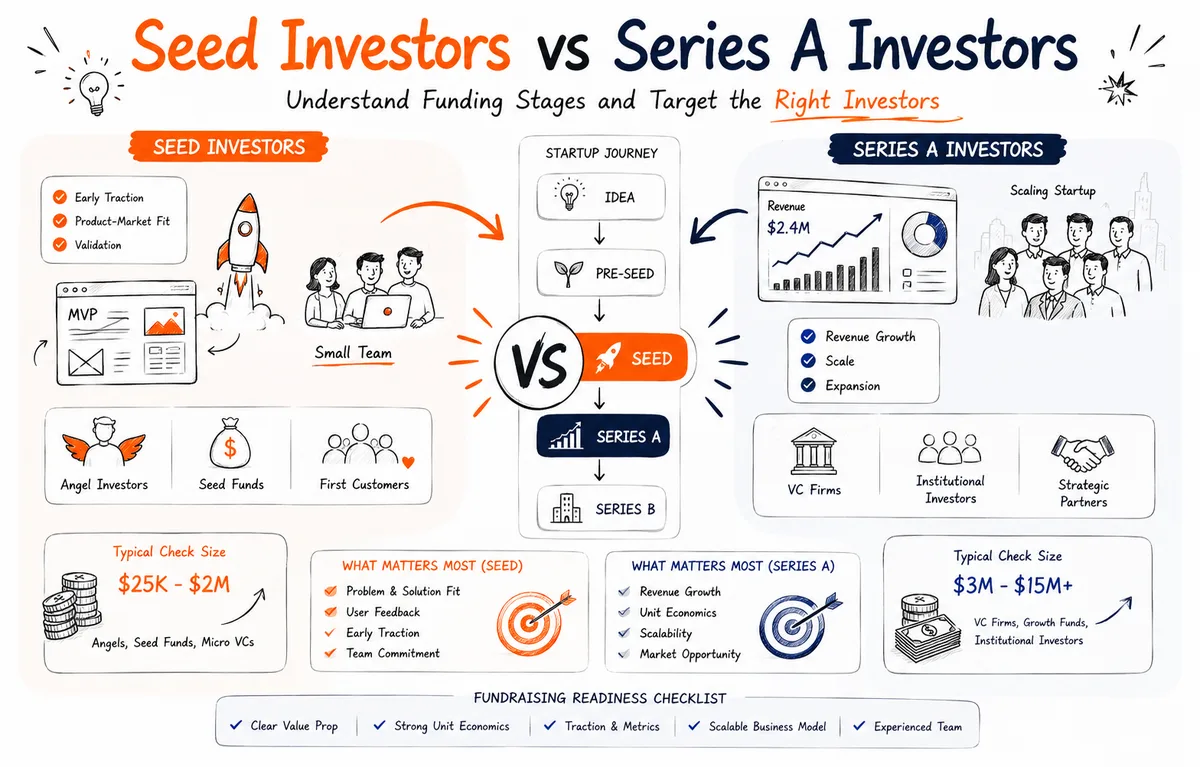
Seed Investors vs Series A Investors: Which Investors Should You Target?

Seed Investors vs Series A Investors: Which Investors Should You Target?

By EzFunding Team | July 09, 2026

AI Executive Summary

This post explains the differences between seed and Series A investors, highlighting their distinct expectations, investment criteria, and the stages at which they typically invest. It also provides guidance on how founders can align their startup's stage with the appropriate investor type to maximize their chances of securing funding.

Most founders spend hours building investor lists. Very few pause to ask the more important question: am I approaching the right type of investor for my current stage?

Pitching a Series A firm when your startup has ₹12 lakh in MRR and six months of traction is one of the fastest ways to collect polite rejections. Pitching a seed angel when you've already hit ₹1 crore ARR and strong retention leaves money on the table. Investor-stage alignment is not a formality — it is the single biggest filter that determines whether you get a meeting, a term sheet, or a door closed in your face.

Venture funding typically progresses through seed">pre-seed, seed, Series A, Series B, and later stages — each representing a different level of company maturity and investor expectation.

Silicon Valley Bank ↗

Startup Funding Stages Explained

Startup Funding Stages · Funding Rounds · Funding Phases

Every startup funding journey follows a broadly predictable arc — from an idea on a napkin to a market-leading company. While timelines vary by industry and geography, the stages below represent how capital flows into startups as they mature. For a full breakdown of every stage, see our startup funding stages guide, or browse investors by stage directly.

Pre
seed">Pre-Seed
Idea validation, MVP build
$50K–$500K
First product, early traction
$500K–$3M
A
Proven model, scaling GTM
$3M–$15M
B
Market expansion, team growth
$15M–$50M
C+
Series C+
Market leadership, IPO prep
$50M+

Most startup funding journeys progress through these stages, though the exact path varies by industry, geography, and business model. Visible.vc ↗

What Are seed">Pre-Seed Investors?

seed">Pre-Seed Investors · seed">Pre-Seed Funding

seed">Pre-seed is the earliest formal capital a startup raises. At this point, the product usually does not exist — or exists only as a rough prototype. Investors at this stage are essentially betting on founders and the problem they're solving, not on proven metrics. Browse the full list of seed">pre-seed-investors" style="color:#4F46E5;text-decoration:none;font-weight:600;">seed">pre-seed investors active right now.

🌱
Typical startup profile
seed">Pre-Seed stage
ProductMVP in development
Team1–3 founders
RevenueNone or negligible
TractionEarly interest, waitlist
Check size₹25L – ₹4Cr
Angels Accelerators Friends & Family
🔍
What they look for
seed">Pre-Seed evaluation criteria
Founder qualityHigh weight
Problem depthCritical
Vision & narrativeCritical
Market sizeLarge TAM needed
Revenue proofNot required
Proven PMFNot required

seed">Pre-seed funding is typically used to validate ideas, build MVPs, and prove early demand. Antler ↗

What Are Seed Investors?

Seed Investors · Seed Funding · Startup Seed Funding

Seed funding is the first formal milestone in a startup's fundraising journey. By the time a founder approaches seed investors, they should have a live product, early users, and signals — however nascent — that people want what they're building. Explore active seed-investors" style="color:#4F46E5;text-decoration:none;font-weight:600;">seed investors matched to your sector.

🚀
Typical startup profile
Seed stage
ProductLaunched & live
Team3–8 people
Revenue₹0 – ₹25L MRR
TractionEarly customers, retention
Check size₹50L – ₹25Cr
Angel Investors Seed Funds Micro VCs Early-Stage VCs
📊
What they look for
Seed evaluation criteria
PMF signalsHigh weight
User growth rateKey metric
RetentionImportant
Early revenuePreferred not required
Founder qualityCritical
Scalable modelEmerging

Seed funding is generally considered the first formal fundraising stage and is used to refine the product, hire early team members, and validate market demand. Visible.vc ↗

What Are Series A Investors?

Series A Investors · Series A Funding · Venture Capital Investors

Series A is where venture capital enters the picture in a significant way. These investors are no longer betting on potential — they are paying for proof. They need to see that your startup's growth is not a lucky streak but a repeatable, scalable engine. See active Series A investors, or explore Series B and Series C investors if you're planning further ahead.

📈
Typical startup profile
Series A stage
ProductRefined, market-tested
Team15–40+ people
Revenue₹50L – ₹2Cr+ MRR
TractionConsistent MoM growth
Check size₹25Cr – ₹120Cr
Venture Capital Firms Institutional Investors Corporate VCs
🎯
What they look for
Series A evaluation criteria
Proven PMFNon-negotiable
Revenue growth2–3x YoY expected
Scalable GTMCritical
Unit economicsLTV/CAC > 3x
NRR / Retention>100% preferred
Market leadershipClear path needed

Series A is generally considered the first major venture capital round. Investors expect evidence that the startup can scale and turn early traction into a repeatable growth engine. Investopedia ↗

Seed Investors vs Series A Investors: Side-by-Side

Seed vs Series A · Startup Investors · Funding Rounds

Here is how seed investors and Series A investors fundamentally differ across the criteria that matter most to founders:

Criteria 🌱 Seed Investors 🚀 Series A Investors
Startup stageEarly tractionProven growth
Investor typeAngels, Seed Funds, Micro VCsVenture Capital Firms, Institutional
Primary focusValidationScaling
Product-market fitEmerging signalsDemonstrated clearly
Revenue expectationsLimited or early (₹0–₹25L MRR)Meaningful (₹50L–₹2Cr+ MRR)
Team size3–8 people15–40+ people
Typical check size₹50L – ₹25Cr₹25Cr – ₹120Cr
Risk appetiteHigh (betting on founders)Moderate (betting on model)
Due diligence depthLight to moderateDeep financial & operational
LTV/CAC expectationEarly evidence> 3x (non-negotiable)

Series A investors typically require significantly more evidence of market validation and scalability than seed investors. Startups.com ↗

🎯 FOUNDER TIP

Check the LTV/CAC row above before your next outreach round. If yours sits below 3x, seed investors may still be more receptive than Series A firms — lead with that stage instead of forcing a premature Series A conversation.

How Investors Evaluate Startups at Each Stage

Startup Investor Evaluation · What Investors Look For

Investors at every stage run startups through the same fundamental lens — but the weight given to each criterion shifts dramatically as the company matures. Here is how each factor is weighted. See what else investors look for before investing in a startup.

👥
Team
Seed — 90% weight
Series A — 60% weight
At seed, team quality is the primary bet. Series A assumes competence and looks for execution.
📦
Product
Seed — 70% weight
Series A — 75% weight
Series A checks differentiation, defensibility, and retention more rigorously.
📊
Traction
Seed — 55% weight
Series A — 95% weight
MoM growth, churn, NRR — Series A lives or dies on these numbers.
💰
Unit Economics
Seed — 30% weight
Series A — 90% weight
LTV/CAC ratio, payback period, gross margins are critical at Series A.
🌍
Market Opportunity
Seed — 75% weight
Series A — 80% weight
Both stages want a large TAM — but Series A wants proof you can capture it.
🔁
Business Model
Seed — 45% weight
Series A — 88% weight
Repeatability, predictability, and scalability of revenue are Series A requirements.

Series A investors place increasing emphasis on business-model scalability and measurable growth metrics compared with seed-stage investors. Qubit Capital ↗

How to Know If You're Ready for Series A

Series A Funding · Fundraising Readiness

Series A readiness is not a gut feeling — it is a specific set of conditions your startup must meet before institutional VCs will take you seriously. Check honestly against each signal below, or run a full diagnostic with fundraising-readiness" style="color:#4F46E5;text-decoration:none;font-weight:600;">EzFunding's fundraising readiness tool.

Consistent revenue growth
15–25% MoM or 2–3x YoY for at least 6 consecutive months
Revenue visibility
₹50L–₹2Cr ARR with predictable pipeline and low churn
Demonstrated product-market fit
NPS > 40, retention > 80%, organic word-of-mouth
Repeatable customer acquisition
Proven CAC payback < 12 months and scalable GTM channel
Strong unit economics
LTV/CAC ratio > 3x; gross margin > 50% for SaaS. Check yours with the LTV calculator and CAC calculator.
Scaling team in place
Sales, marketing, and product leadership hired or imminent

Series A rounds are intended for startups that have moved beyond experimentation and can demonstrate repeatable, scalable growth. Investopedia ↗

Common Fundraising Mistakes That Kill Deals

Startup Fundraising · Startup Funding Process

Most fundraising failures are not due to a bad product. They happen because founders violate the basic rules of investor-stage alignment and outreach. Avoid these five mistakes:

1
Approaching investors too early
Contacting Series A VCs before hitting any revenue or retention milestones burns your one chance at a first impression. Most VCs track your progress — coming back later with better metrics is harder than waiting until you're ready.
2
Targeting the wrong funding stage
A seed startup pitching a growth-stage fund wastes both parties' time. Every investor has a stage mandate. Approaching the wrong stage signals that you haven't done basic research on who you're talking to.
3
Weak fundraising narrative
Data without story doesn't land. Investors need to understand why this market, why this team, and why now. A pitch with strong metrics but no compelling narrative leaves VCs unexcited.
4
No traction evidence in the deck
Claiming traction without backing it with specific numbers — active users, MRR, retention cohorts, CAC — is an instant red flag. Investors expect to see the data, not summaries of the data.
5
Generic, mass investor outreach
Sending the same cold email to 200 investors signals desperation and laziness. Personalised, targeted outreach to investors with thesis fit and sector experience dramatically increases your response rate.

⚠️ WARNING

Once an investor passes on your startup, they rarely re-engage without a materially different story. Get your stage-fit right the first time — read how to find investors for your startup in 2026 before you send a single cold email.

How Investor Matching Helps Founders Target the Right Investors

Investor Matching · Investor Fit · Startup Investor Matching

Instead of building a list of 300 investors and hoping for the best, investor matching helps founders identify exactly who is most likely to invest — saving months of wasted outreach. Read more in our investor matching explainer.

🎯
Stage fit
Match investors who actively invest at your exact funding stage
🏭
Sector fit
Find investors with portfolio companies and thesis in your space
🌏
Geography fit
India-focused, regional, or global investors relevant to your market
💵
Check size fit
Align your raise size with what each investor's fund typically writes
📜
Thesis fit
Target investors whose stated investment thesis aligns with your category

Instead of contacting hundreds of investors, founders who use investor matching can prioritise the 20–30 investors most likely to invest — dramatically improving conversion from cold outreach to first meeting. For a wider view of where that capital comes from, see our early-stage-capital-sources" style="color:#4F46E5;text-decoration:none;font-weight:600;">founder's guide to early-stage capital sources.

Startup Funding in India: Stage Expectations

Startup Funding India · Seed Funding India · Series A Funding India

The Indian startup ecosystem has matured significantly, but 2025 brought a noticeably tighter funding environment. Capital is more selective than it was a year earlier, and investor expectations at each stage — particularly around traction quality and unit economics — have sharpened.

$10.5B
Total startup funding raised in India in 2025 (down 17% from 2024)
Source: Fortune India, Jan 2026
$452M
Seed-stage funding in India, H1 2025 (down 44% YoY)
Source: Business Standard / Seafund
$1.6B
Combined seed + Series A funding in India, H1 2025 (down 16% YoY)
Source: Seafund, 2026
$3–15M
Typical Series A ticket size for Indian startups
Source: Seafund, 2026
12–30 mo
Typical time from seed to Series A for Indian startups
Source: Seafund, 2026
$3.9B
Early-stage deals that stayed resilient through 2025 despite the broader slowdown
Source: Fortune India, Jan 2026

📊 MARKET INSIGHT

India's early-stage funding held up better than the overall market in 2025 — a signal that investors are still writing checks for genuine traction, just fewer of them and with more scrutiny attached. Founders who can show real unit economics are the ones cutting through the slowdown.

Indian startups increasingly face stricter expectations around traction, scalability, and unit economics as funding markets tighten. early-stage-funding-in-india-a-complete-breakdown/" target="_blank" rel="noopener noreferrer" style="color:#4F46E5;text-decoration:none;font-weight:500;">Seafund ↗ · Startup India ↗ · Fortune India

How EzFunding Helps Founders Find the Right Investors

EzFunding is built specifically to solve the investor-stage alignment problem. Instead of spending weeks researching investors manually, founders can use EzFunding's tools to identify, evaluate, and reach out to investors who match their exact stage, sector, and geography.

🎯
Investor matching
AI-powered matching surfaces investors aligned to your stage, sector, and geography in minutes
📋
Funding stage analysis
Understand objectively which funding stage your startup is ready for before you approach investors
🔍
Investor discovery
Browse a curated database of seed funds, angel networks, and VC firms with verified investment history
📊
Pitch deck feedback
Get structured feedback on your deck calibrated to what investors at your specific stage expect to see
Fundraising readiness
Run a pre-fundraise diagnostic — know your gaps before investors find them
📧
Outreach intelligence
Personalised investor outreach templates based on each investor's thesis and recent investments

Find investors that match your stage

Stop sending cold emails to the wrong investors. Let EzFunding surface the right ones for you.

Match me with investors →

Keep Reading

References & Credible Sources

Silicon Valley Bank — Stages of Venture Capital Visible.vc — Startup Funding Stages Guide Antler — From seed">Pre-Seed to IPO Investopedia — Series A, B, C Funding Startups.com — Series Funding Explained Qubit Capital — Funding Rounds seed">Pre-Seed to Series E early-stage-funding-in-india-a-complete-breakdown/" target="_blank" rel="noopener noreferrer" style="font-size:0.75rem;color:#4F46E5;background:#EDE9FE;padding:4px 12px;border-radius:20px;text-decoration:none;font-weight:500;">Seafund — Early Stage Funding in India (2026) seed">pre-seed-series-a" target="_blank" rel="noopener noreferrer" style="font-size:0.75rem;color:#4F46E5;background:#EDE9FE;padding:4px 12px;border-radius:20px;text-decoration:none;font-weight:500;">OpenVC — Funding Stages Overview Startup India — Funding Resources Fortune IndiaIndia's 2025 Funding Winter

Frequently Asked Questions

What is seed funding?

Seed funding is the first formal capital a startup raises to build its product, hire an early team, and validate market demand. It typically ranges from ₹50 lakh to ₹25 crore and comes from angel investors, seed funds, or micro VCs. Unlike pre-seed, seed funding usually requires some evidence that people want your product — early users, waitlists, or initial revenue.

What is Series A funding?

Series A is the first major venture capital round a startup raises after demonstrating product-market fit and consistent growth. Series A rounds in India typically range from ₹25 crore to ₹120 crore and are led by institutional VC firms. Investors at this stage expect proven traction, repeatable customer acquisition, and a scalable business model.

What is the difference between seed funding and Series A?

Seed funding bets on founders and early signals — investors accept high risk for high potential. Series A bets on proven growth — investors need evidence of product-market fit, consistent revenue growth (2–3x YoY), strong retention, and unit economics (LTV/CAC > 3x). The check sizes, due diligence depth, and expectations around metrics are significantly higher at Series A.

How much do seed investors typically invest?

Seed investors typically invest between ₹50 lakh and ₹25 crore per startup. Angel investors may write smaller cheques (₹10L–₹2Cr), while seed funds and micro VCs usually invest ₹2Cr–₹10Cr per deal. The round size depends on the startup's capital requirements, geography, and sector.

How much do Series A investors typically invest?

Series A rounds in India typically range from ₹25 crore to ₹120 crore ($3M–$15M). Global Series A rounds can be larger, averaging $10M–$20M according to Crunchbase 2024 data. The round size depends on the growth plan, sector, and capital intensity of the business.

What do seed investors look for?

Seed investors primarily evaluate founder quality, the depth of the problem being solved, early product-market fit signals, user growth and retention, and market size. Revenue is preferred but not always required. The founding team's ability to execute and their understanding of the customer are the most critical factors at this stage.

What do Series A investors look for?

Series A investors require demonstrated product-market fit, consistent revenue growth (15–25% MoM or 2–3x YoY), strong retention (>80%), positive unit economics (LTV/CAC > 3x, CAC payback <12 months), a scalable go-to-market strategy, and a growing team capable of executing at scale. Traction evidence must be backed by specific, verifiable numbers.

How do I know if I'm ready for Series A?

You are likely ready for Series A if you have achieved ₹50L–₹2Cr ARR, demonstrated 2–3x YoY growth, proven product-market fit with strong retention, repeatable customer acquisition with a scalable GTM channel, and unit economics showing LTV/CAC > 3x. If your growth is inconsistent or your model is still being validated, seed extension funding may be more appropriate.

What is product-market fit?

Product-market fit (PMF) is the point at which a product satisfies a strong market demand. Indicators include: NPS score above 40, monthly retention above 80%, organic word-of-mouth growth, low churn, and users expressing they would be "very disappointed" if the product went away. PMF is an emerging signal at seed and a demonstrated reality at Series A.

What are startup funding stages?

Startup funding stages are the sequential rounds through which startups raise capital as they grow. The typical progression is: Pre-Seed (idea validation, ₹25L–₹4Cr) → Seed (early traction, ₹50L–₹25Cr) → Series A (proven growth, ₹25Cr–₹120Cr) → Series B (expansion, ₹120Cr–₹400Cr) → Series C+ (market leadership, ₹400Cr+). Each stage demands higher proof of traction and scalability.