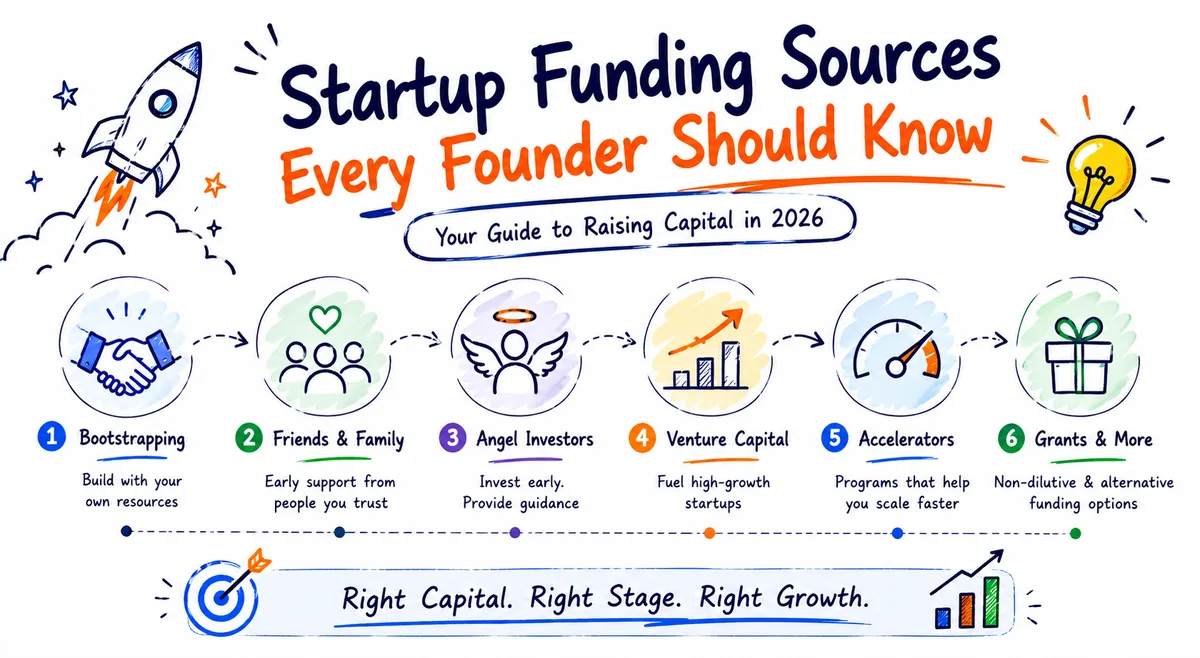
Most founders believe startup funding means one thing: raising money from venture capital firms. In reality, VC is only one lane on a much wider highway. Depending on your stage, business model, and how much control you want to keep, the right funding source could be an angel check, a government grant, a revenue-based facility, or your own customers' invoices.
Raising capital isn't about finding investors. It's about choosing the funding source that actually fits your business — and most founders never see the full map of options before they start asking for money.
Understanding Startup Funding Sources
Not all startups need venture capital. Not all startups should raise venture capital. A profitable e-commerce brand and a deep-tech AI lab have completely different capital needs, even if they're both "startups." Every funding source falls into one of five broad categories:
Founder Capital
Your own money and revenue
Community Capital
Your network and crowd
Investor Capital
Angels, funds, and firms
Non-Dilutive Capital
Grants and equity-free money
Alternative Capital
Debt and financing structures
Founder Capital: Funding Your Startup Yourself
This is where almost every founder actually starts, whether they planned to or not.
How Founders Actually Fund Their First Stretch
Source: Gallup small-business and entrepreneurship research.
Bootstrapping
Funding growth from your own savings and early revenue keeps full ownership, no dilution, and fast decision-making, since there's no board or cap table to negotiate with. The trade-off is slower growth and limited resources for hiring or marketing ahead of revenue.
Personal Savings
The most common starting point for founders, as the data above shows. It's the fastest capital to access, but it puts personal financial risk directly on the line, which is worth weighing honestly before going further.
Revenue-Funded Growth
Reinvesting customer revenue back into the business instead of raising outside capital. It's slower than venture-backed growth, but it forces capital discipline early and keeps every funding decision tied to what customers are actually paying for.
Community Capital: Funding From Your Network
Friends and Family Funding
Fast and flexible, but it mixes money with personal relationships. Put terms in writing even when the investor is your uncle — especially when the investor is your uncle.
Crowdfunding
Reward-based and equity crowdfunding platforms let you raise small amounts from a large number of backers, which also doubles as market validation. It works best for consumer products people can visualize and get excited about before launch.
Community Syndicates
Founder communities and angel syndicates pool smaller checks from multiple individuals into one round, giving early-stage startups access to a broader, faster-moving investor base than a single angel could offer alone.
Investor Capital: Traditional Startup Funding
Angel Investors
Individuals investing personal capital, best suited for seed">pre-seed and seed-stage startups that need a fast yes and hands-on mentorship more than a structured process.
Seed Funds
Best for startups with early traction that need a larger check than an angel can write but aren't yet ready for a full institutional Series A process.
Venture Capital Firms
Best for startups ready to scale aggressively. Capital is heavily concentrated right now: AI companies alone accounted for 63.5% of all U.S. venture capital deal value in 2025, which means non-AI startups need sharper proof points to stand out for the remaining share.
Family Offices
Long-term, patient capital from wealthy individuals or families. Less standardized than a fund, but often more flexible on timelines and terms.
Strategic Investors
Corporate investors providing industry-aligned capital for strategic value, not just financial return. Useful for distribution and credibility, but review exclusivity terms carefully.
Non-Dilutive Capital: Funding Without Giving Up Equity
This is one of the most underused funding categories, simply because most founders don't know it exists at the scale it now operates.
Government Grants
Equity-free funding tied to innovation, research, or sector priorities. Slower to access than private capital, but it costs you nothing in ownership.
Innovation Programs
Research-linked funding for technical and scientific innovation, often paired with access to labs, testing facilities, or technical mentorship.
Startup Accelerators
A small initial check bundled with structured mentorship and a demo day audience of investors already primed to look at your cohort.
University and Research Programs
Academic innovation grants for startups spinning out of university research, often bundled with IP support and lab access.
Startup Funding Sources in India
India now has one of the most active non-dilutive funding ecosystems in the world, run primarily through the Startup India initiative under the DPIIT. Here's what the three flagship schemes actually look like on the ground.
India's Government Funding Stack (2026)
2,15,000+
DPIIT-recognised startups in India
₹10,000 Cr
Fund of Funds corpus, invested in 1,370+ startups via 140+ AIFs
₹20 Lakh
Maximum equity-free SISFS grant for proof-of-concept
₹20 Cr
Maximum collateral-free loan under the Credit Guarantee Scheme
Source: DPIIT / Startup India, Press Information Bureau (2026).
Government Programs
Startup India, SIDBI, and DPIIT anchor the national funding stack. SIDBI manages the Fund of Funds, channeling capital into SEBI-registered AIFs that invest directly in startups, while DPIIT recognition is the gateway credential that unlocks tax holidays and most other scheme eligibility.
Innovation Funds
The newly notified Fund of Funds 2.0 carves out dedicated, larger allocations for deep tech and manufacturing startups, recognizing that these categories need longer-duration, more capital-intensive support than typical software startups.
State-Level Startup Programs
States increasingly run their own startup policies and dedicated VC funds on top of the central schemes, so it's worth checking your state's startup policy alongside the national programs.
Sector-Specific Funding Programs
Beyond the flagship schemes, sector-specific challenges and innovation grants target categories like deep tech, climate, and manufacturing where private capital is historically thinner.
Alternative Capital Sources
Debt and financing structures have moved from the margins of startup funding to a core part of the capital stack — especially for startups that already have revenue and don't want more dilution.
U.S. Venture Debt Market Growth
Median venture debt deal size: $5.5M, with the 75th percentile reaching $27.7M. Source: Runway Growth Capital / PitchBook, 2025–2026 Venture Debt Review.
Revenue-Based Financing
Repayments are tied to a percentage of monthly revenue rather than a fixed schedule, which makes it more flexible when revenue fluctuates — but it requires predictable, recurring revenue to qualify.
Venture Debt
Term loans, often paired with warrants, that extend runway without the dilution of a new equity round. Roughly 60% of venture debt now goes to later or growth-stage companies with established revenue, since lenders favor predictability over hyper-growth.
Equipment Financing
Debt secured against the equipment itself, useful for hardware and manufacturing startups that need to preserve cash for R&D and go-to-market instead of capex.
Invoice Financing
Borrowing against unpaid customer invoices to bridge cash flow gaps, common for startups with longer enterprise sales and payment cycles.
Strategic Partnerships
Distribution, co-development, or licensing deals that bring in capital or guaranteed revenue without touching the cap table at all.
Which Funding Source Is Right For Your Startup?
| Startup Stage | Best Funding Sources |
|---|---|
| Idea Stage | Bootstrapping, Friends & Family |
| MVP Stage | Angel Investors, Accelerators |
| Early Traction | Seed Funds |
| Product-Market Fit | Venture Capital |
| Growth Stage | Venture Capital, Venture Debt |
| Expansion | Growth Equity |
The Advantages and Risks of Each Funding Source
| Funding Source | Advantages | Risks |
|---|---|---|
| Bootstrapping | Full control, no dilution | Slower growth |
| Angel Investors | Speed, mentorship, expertise | Dilution at an early stage |
| Venture Capital | Capital for aggressive scale | Growth pressure, board oversight |
| Government Grants | No dilution, no repayment | Competitive, slower disbursement |
| Venture Debt | Ownership retained | Fixed repayment obligations |
Common Funding Mistakes Founders Make
Assuming Venture Capital Is the Only Option
VC fits a narrow profile of business: high growth, high risk, high ceiling. Most startups don't fit that profile, and that's fine.
Choosing Capital Too Early
Taking dilutive capital before you need it locks in a valuation and a set of expectations before you have the traction to justify either.
Ignoring Non-Dilutive Funding
Grants and credit guarantee schemes can cover meaningful early costs without touching your cap table, yet most founders never apply because they assume the process is reserved for academic research.
Raising Before Fundraising Readiness
Going to investors without a clear narrative, financials, or data room wastes the limited number of serious conversations you'll get.
Targeting the Wrong Investors
Pitching a Series A fund for a seed">pre-seed round, or a generalist fund with no history in your sector, burns time on conversations that were never going anywhere.
How Investor Matching Helps Founders Choose the Right Funding Source
Investor matching isn't only about finding investors — it's about finding the right ones, fast. A strong match considers:
- Stage fit: does this investor actually write checks at your stage?
- Sector fit: have they backed companies like yours before?
- Geography fit: do they invest in your region?
- Check size fit: does your ask match their typical range?
- Thesis fit: does your business align with what they're actually trying to invest in?
Once you've identified that equity capital is the right path for your stage, the next step is finding investors who match on all five. Learn more in How to Find Investors for Your Startup, see how the matching process works in Investor Matching Explained, or compare what changes at each round in seed-investors-vs-series-a-investors" style="color:#7a5cff;font-weight:600;text-decoration:underline;">Seed Investors vs. Series A Investors and Startup Funding Stages Explained.
Before you reach out, make sure your materials hold up to scrutiny with pitch deck feedback, or browse investors directly by stage: seed">pre-seed-investors" style="color:#7a5cff;font-weight:600;text-decoration:underline;">seed">pre-seed investors, seed-investors" style="color:#7a5cff;font-weight:600;text-decoration:underline;">seed investors, and Series A investors.
Startup Funding Trends in 2026
Efficiency Over Growth-at-All-Costs
Investors are underwriting capital efficiency and clean unit economics ahead of raw growth rate across every stage.
Investor Selectivity
AI captured 63.5% of all U.S. venture deal value in 2025, concentrating capital and raising the bar for non-AI categories.
Non-Dilutive Capital Growth
U.S. venture debt hit a record $68.8B in 2025, while India's government-backed schemes continue expanding their corpus and reach.
Founder Readiness Matters More
With fewer but larger deals across most funding types, founders who show up prepared are capturing a disproportionate share of available capital.