Picture this: you've spent eighteen months building a product, you have real users, some early revenue, and a team that believes in what you're creating. But the next stage of growth — hiring, expanding distribution, accelerating product development — needs capital you simply don't have. Bootstrapping got you here. It won't get you there.
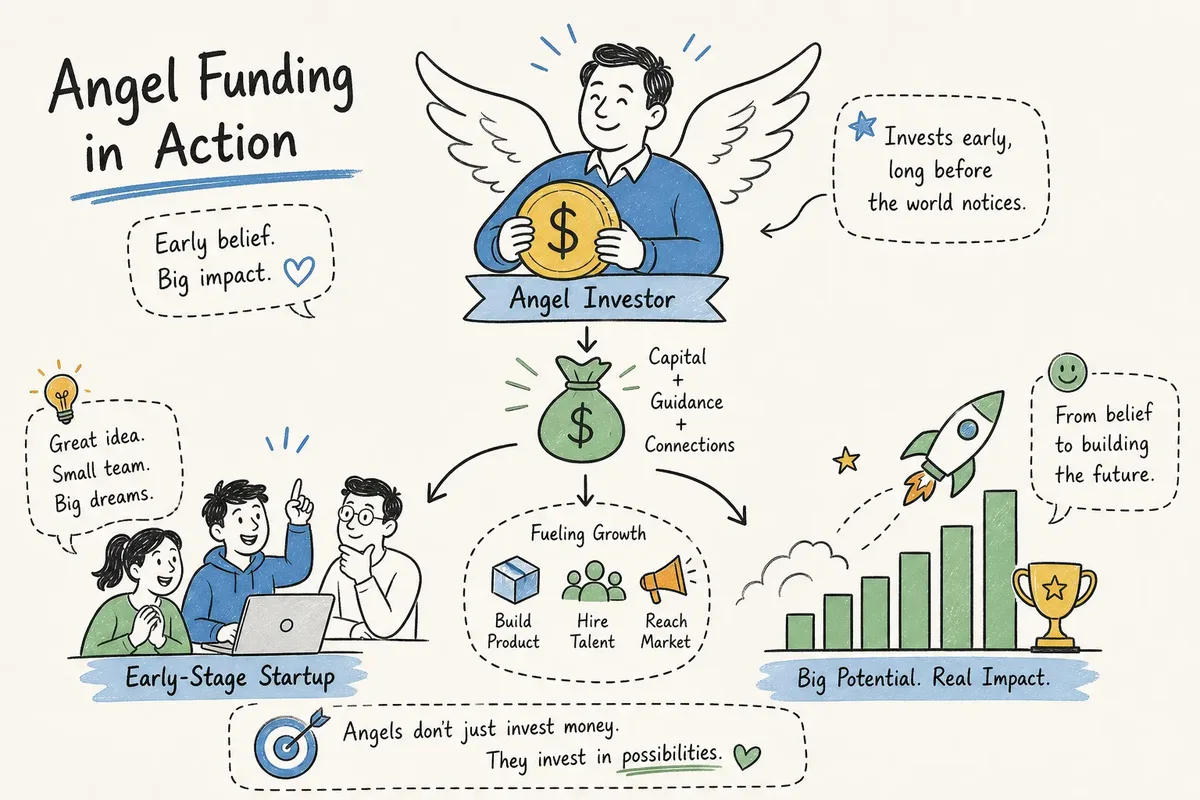
Angel investment is often the most logical next step: structured risk capital from individuals who have walked this road before and are willing to back founders at the earliest, most uncertain stage. An angel investor is a high-net-worth individual who deploys their own personal capital into early-stage startups in exchange for equity or a convertible instrument. Unlike institutional venture capital, angels move fast, take smaller positions, and often bring hard-won operating experience alongside their cheque.
The Indian angel ecosystem has grown steadily and become more distributed across major cities and sectors, with structured networks now active in Bengaluru, Mumbai, Delhi-NCR, Chennai, Hyderabad, and beyond. Platforms like EzFunding now make it possible for founders to find matched angel investors without relying entirely on warm introductions or proximity to major tech hubs.
🔑 Key Insight
This article covers five areas every first-time founder needs to understand: what angel investment actually is, what angels look for, where to find them in India, how to pitch effectively, and how deals are structured and documented.
What Angel Investment Actually Means
Angels vs. VCs: Why the Source of Capital Matters
The distinction between a business angel and a venture capital firm is more than semantics. It determines the pace, flexibility, and expectations of your fundraising process. A VC deploys pooled institutional money on behalf of limited partners, which means strict mandate requirements, longer diligence cycles, and a minimum return threshold that often makes early seed">pre-seed cheques uneconomical for the fund.
An angel invests personal capital, answers to no one else's investment committee, and can make a decision in days rather than months. Angels are frequently founder-operators themselves — they've built and sold companies, navigated product-market fit, and managed teams under pressure. This makes them the natural first institutional backer for a startup that has outgrown friends-and-family money but isn't yet ready for the scrutiny of a formal VC process.
| Dimension | Angel Investor | Venture Capital Firm |
|---|---|---|
| Capital source | Personal wealth | Pooled institutional / LP funds |
| Decision speed | Days | Months |
| Typical check size | ₹10L – ₹5Cr | Higher, mandate-driven |
| Operating input | Often hands-on, founder-operator background | Board-level, governance-focused |
Angel funding is not charity; it is risk capital with real return expectations, and founders who treat it that way build stronger long-term relationships with their backers.
Check Sizes, Equity, and Instruments Used in India
Individual angels in India typically write cheques of ₹10 to ₹25 lakh per deal, while organised angel syndicates and networks pool member contributions to deliver ₹1 to ₹5 crore in a single round. SEBI mandates a minimum investment of ₹25 lakh per angel investor — a threshold that effectively limits participation to accredited individuals and keeps the market structured around experienced backers.
₹10–25L
Typical individual angel cheque
₹1–5Cr
Syndicate / network round size
2–20%
Effective founder dilution range
Equity stakes at the angel stage have historically ranged from 2% to 10%, though effective ownership after accounting for current valuations and round sizes can reach 10% to 20% depending on how the deal is structured and what the pre-money valuation reflects.
Founders have three primary instruments available to document the deal: direct equity, convertible notes, and iSAFE notes. The iSAFE (Indian Simple Agreement for Future Equity) is issued as Compulsorily Convertible Preference Shares under FEMA NDI Rules, carries no interest and no maturity pressure, and has gained meaningful traction among early-stage founders because it keeps the balance sheet clean and defers the valuation conversation to the next priced round. Many practitioners now favour it specifically for seed-investors" style="color:#0B5FFF; text-decoration:none;">seed investor rounds where both parties want to avoid an early valuation standoff.
💡 Founder Tip
For a practical primer on iSAFE notes in India, founders often consult specialised legal guides when deciding on early-stage instruments — see this india-significance-and-advantages/" style="color:#1D4ED8; text-decoration:underline;">iSAFE notes explainer before choosing your instrument.
What Angels Actually Look For Before Writing a Cheque
What Every Angel Evaluates
Angels apply a consistent framework when evaluating early-stage deals, and understanding it is the single most useful thing a founder can do before approaching any investor.
- Addressable market: angels in India typically look for a TAM of ₹500 to ₹1,000 crore at minimum, with a credible path to global scalability.
- Founding team: whether founders have genuine domain expertise and a demonstrated ability to execute under uncertainty.
- Traction: doesn't have to mean revenue, though revenue is ideal — active users, signed pilots, or validated customer intent through paid proof of concepts all count.
- Business model clarity: a coherent path to unit economics, not a hand-wavy assertion that "monetisation will come later."
Founder-market fit is a genuine deciding factor at this stage, because when everything else is uncertain, the one variable an angel can assess with confidence is whether this specific team is uniquely equipped to solve this specific problem.
The Return Logic Behind an Angel Cheque
Angels are not philanthropists, and founders who pitch as though they are will lose credibility immediately. A typical angel expects a realistic path to 20 to 25% annual return over a five to seven year horizon, which means they need to believe your startup can achieve a significant exit through acquisition, secondary sale, or an IPO.
📊 Market Insight
This is not about profitability on day one; it's about trajectory and the credibility of your milestones. When you understand this logic, your pitch changes — structure your ask around specific milestones, not a lump sum to keep the lights on.
Instead of asking for a lump sum, structure your ask around what this capital allows you to achieve, and how that positions the company for the next round at a higher valuation. That framing shows an angel that you think like an investor, not just an operator. If you're weighing whether to target angels or move straight to Series A investors, this comparison of seed-investors-vs-series-a-investors-which-investors-should-you-target" style="color:#0B5FFF; text-decoration:none;">seed vs. Series A investors breaks down which stage to target first.
Where to Find Angel Investors in India
Angel Networks, Syndicates, and Platforms Active in 2026
The Indian angel ecosystem is distributed across city-specific groups, national platforms, and sector-focused syndicates.
| Network / Platform | Focus Area |
|---|---|
| Indian Angel Network (IAN) | 20+ sectors incl. healthtech, SaaS, fintech |
| Inflection Point Ventures | 3,300+ CXO network; early-stage SaaS & fintech |
| AngelList India | Deal-by-deal SPVs |
| LetsVenture | SPV-based model, wide early-stage coverage |
| Mumbai Angels | Fintech, consumer tech |
| Chennai Angels | SaaS, healthtech |
| Hyderabad Angels | Tech, SaaS |
| Venture Catalysts | Incubation + angel funding; deep tech, SaaS |
Syndicates such as Marwari Catalysts and PointOne Capital are also active across sector-specific deals. Most networks are nominally sector-agnostic but show consistent preference for SaaS, fintech, edtech, healthtech, and climate tech, reflecting both investor expertise and current market sentiment.
If you want a short, practical walkthrough of how angel investment networks operate and how to join them, there are several concise guides that explain the membership and SPV models used by these groups; beginners often find them useful when deciding where to apply.
A Faster Way to Shortlist Matched Investors
Manually researching dozens of networks and individual angels is time-consuming and imprecise. Most founders spend weeks building spreadsheets of investors, only to discover that half the names are outside their sector or stage.
How EzFunding shortlists faster
EzFunding addresses that friction by letting founders search a curated investor database filtered by stage, sector, geography, and cheque size in a single workflow, purpose-built for founders who want signal, not noise.
EzFunding's AI matching surfaces the investors most likely to be aligned with your specific startup profile, drawing on historical investment patterns and stated investor preferences — with compatibility scores that explain the rationale behind each recommendation.
How to Approach and Pitch to Angels Effectively
Building Your Pitch Deck and Outreach Toolkit
A strong angel pitch deck tells a story first and presents data second. It needs:
- A compelling problem statement
- A clear and specific solution
- Data-driven market sizing
- Traction metrics (CAC, LTV, and revenue milestones where available)
- A realistic financial ask tied to named milestones
- A closing slide with direct contact details
Keep it to 10 to 13 slides. Every slide that does not advance the narrative is a slide that weakens your position. Pair the deck with a one-page teaser for initial outreach and a data room ready for follow-up diligence requests, covering corporate structure, financials, IP assignments, and the founders' agreement.
⚠ Warning
Never present a range for the funding ask. State the exact amount and show specifically how it will be deployed. Ranges signal uncertainty about your own business model — the last impression you want to leave with a potential backer.
For more detail on deck structure, see how to structure a pitch deck that gets investor meetings.
Running a Focused Outreach Campaign
Target 15 to 20 angels simultaneously and compress your meetings into a two to three week window. This creates social proof: when angels know others are evaluating the same deal, the psychology of the conversation shifts from passive to active. Warm introductions convert significantly better than cold outreach, so begin with mentors, advisors, and peer founders who can refer you into networks.
For cold outreach, personalisation is non-negotiable. A generic email referencing "your investment portfolio" without specifics gets deleted. Read more on building an investor list that actually converts.
🔑 Key Insight
EzFunding's AI-powered outreach generation produces personalised investor messages based on each angel's known portfolio and sector thesis — particularly valuable for solo founders who lack an existing network. According to EzFunding's platform data, a significant proportion of matched introductions progress to substantive conversations within the first 48 hours.
Understanding the Deal: Term Sheets and Equity Basics
Key Clauses Founders Must Read Carefully
- A 1x non-participating liquidation preference is the standard in Indian angel rounds. It protects the investor at exit without over-penalising the founder — push back on anything beyond this.
- Weighted average anti-dilution is the accepted norm and protects angels in a down round without the founder-punishing mechanics of full ratchet provisions.
- A four-year founder vesting schedule with a one-year cliff is now common practice and signals professional deal structure to all subsequent investors.
💡 Founder Tip
For a deeper, practical explanation of common angel term sheet clauses, see this walkthrough of seed-investing-angel-term-sheets-for-startups/" style="color:#1D4ED8; text-decoration:underline;">angel term sheets for startups — a useful supplement to your legal advice.
Most term sheet provisions are non-binding, but confidentiality and no-shop clauses are binding from the moment you sign. Treat every clause as negotiable, but prioritise your energy on liquidation preferences, anti-dilution mechanics, and board composition, since these have the most material impact on founder control and exit economics.
Valuation Mechanics in Indian Angel Rounds
Angel-stage valuations in India are largely subjective, driven by traction, sector sentiment, and the current funding climate rather than detailed financial modelling.
Worked example
A startup raising ₹50 lakh at a ₹2 crore pre-money valuation gives the investor a 20% stake at a ₹2.5 crore post-money valuation. The maths is straightforward; the negotiation is about what the business is worth relative to comparable deals in the market today.
Many founders and angels now use convertible notes or iSAFE instruments to defer the valuation conversation entirely to the next priced round. Run your own numbers with the pre/post-money calculator or the startup valuation calculator before you negotiate.
Legal and Compliance Basics Before You Close
What SEBI, FEMA, and DPIIT Mean for Your Deal
To claim Section 80-IAC benefits, DPIIT recognition alone is not sufficient: you also need an Inter-Ministerial Board (IMB) certificate and must file Form-1 with supporting financial documents. Getting this paperwork in order before you begin fundraising removes a significant friction point in the diligence process.
Documents to Prepare Before Due Diligence Begins
- Corporate structure documents
- Audited or management financials
- IP assignment agreements assigning all intellectual property to the company, not individual founders
- A founders' agreement covering equity distribution, vesting, and exit clauses
✓ Best Practice
Having all of these organised in a secure, accessible data room before your first investor meeting signals operational maturity. It also shortens the time between term sheet and close — deals that drag through diligence carry a meaningfully higher attrition rate, and readiness is one of the few variables entirely within your control.
Check your overall readiness with the fundraising-readiness" style="color:#0B5FFF; text-decoration:none;">fundraising readiness tool, and model your runway with the burn rate calculator before you set your ask.
Angel Investment Is a Relationship, Not Just a Transaction
Angel investment bridges the gap between a promising idea and the institutional capital that accelerates it to scale. The process is more structured than most first-time founders expect, but that structure works in your favour when you understand it. Knowing what angels evaluate, where to find them, and how to pitch professionally removes the guesswork that slows most early fundraising journeys by months.
EzFunding's AI-powered pitch deck analysis gives founders a concrete starting point: upload your deck, receive a slide-by-slide fundraising readiness score, and surface a matched investor pipeline based on stage fit, sector fit, geography, and cheque size. Instead of spending months researching networks and writing generic cold emails, you move from startup profile to personalised investor outreach in a fraction of the time.
The right angel is not just a source of capital. They have seen the road ahead, understand the mistakes founders make at your stage, and are willing to back the person navigating it. Finding that match efficiently is now a solvable problem, and the founders who solve it first are the ones who spend their time building, not searching.
Ready to find your matched angel investors?
Search EzFunding's curated database by stage, sector, geography, and cheque size — and get an AI-matched investor list in minutes.
Start Matching on EzFunding →Related reading
- Find Angel Investors: A Founder's Complete Guide
- early-stage-capital-sources" style="color:#0B5FFF; text-decoration:none;">A Founder's Guide to Early-Stage Capital Sources
- Startup Funding Sources Every Founder Should Know in 2026
- How to Pitch Investors: A Complete Guide for Startup Founders