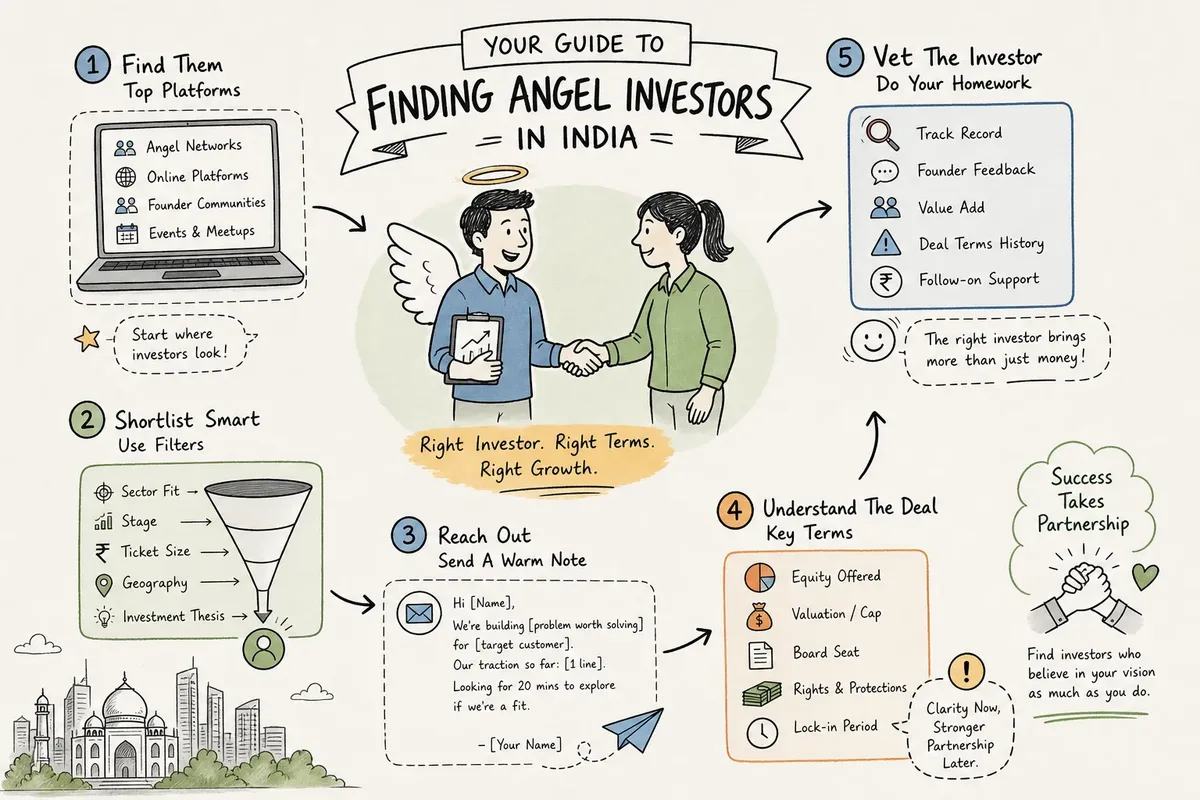
Most founders don't lack a great idea. What they lack is a clear map for finding the right capital partner at the right moment. India's angel ecosystem has grown considerably — but most founders still spend months knocking on the wrong doors, pitching misaligned angels before a single term sheet appears.
This is a structured playbook: the platforms worth your time, the filters that actually determine fit, the outreach sequences that generate replies, the deal mechanics you need before any negotiation, and the checks that protect you before you sign anything.
125+
Active angel networks and syndicates in India
800+
Deals backed by these networks in 2025 alone
Where Active Angel Investors in India Actually Look for Deals
AngelList India, LetsVenture, and Inflection Point Ventures (IPV) represent the three platforms with the highest deal volume. The ecosystem is fragmented — no single platform covers every active investor, so founders relying on just one network will miss a significant share of compatible angels.
Most Active Platforms by 2025 Deal Count
LetsVenture accepts direct submissions with no cold email required — the most accessible entry point for first-time founders without an existing network. AngelList India enables filtering by sector, stage, and location, functioning as both directory and deal-flow channel.
Beyond these three, the Indian Angel Network (IAN) remains the largest horizontal early-stage network in the country, operating multiple arms including BioAngels with a formal review process that provides real social proof once accepted.
Angel Networks vs. Individual Angels: Who to Target First
Structured networks like IAN, Mumbai Angels, and Venture Catalysts have formal review processes and investment committees — social proof and co-investment momentum once you're in, but a slower process. Individual angels like Kunal Shah (287+ investments, fintech/consumer/health) or Anupam Mittal (245+ investments, consumer/D2C) move faster, though warm introductions materially improve conversion with either route. Run both paths in parallel rather than choosing one.
Regional and Niche Networks Worth Adding to Your List
Chennai Angels backs startups earlier-stage than most national networks. Mumbai Angels Network has deep Maharashtra ties. We Founder Circle operates as a curated directory filtered by recent investment history and startup similarity. If you're outside the metro mainstream, these networks often provide a more relevant entry point.
Building a Targeted Shortlist: The Four Filters
A platform listing is a starting point, not a shortlist. Apply four filters to every investor you're considering before a single message goes out.
Investment Stage
Sector Thesis
Check Size
Geography
An angel who backs only fintech startups in Mumbai is the wrong contact for a cleantech founder in Hyderabad, regardless of how prominent they are. Manually cross-referencing these filters across six platforms can take weeks — and the output is often outdated by the time you finish.
How AI-Powered Matching Accelerates This Process
Founders without an existing network can gain a genuine structural advantage through AI-driven investor matching that analyses a startup profile against a verified database simultaneously across all four filters. For solo founders or those building outside major tech hubs, this compresses months of manual research into days. Explore the mechanics in Investor Matching Explained and How AI Helps Startups Find and Win Investors Faster.
What an Angel Round in India Actually Looks Like
The tier of angel you're targeting changes how you frame your ask, your valuation conversation, and what governance rights to expect.
Angel Check Size Tiers
Term Sheets, SAFEs, and the Standard Discount Structure
Most Indian angel rounds in 2025–2026 use capped convertible notes or YC-style SAFEs adapted for Indian law (iSAFEs), issued as Compulsorily Convertible Preference Shares. Fully uncapped instruments remain uncommon; most include a valuation cap alongside a standard 20% discount rate on conversion, plus a Most Favoured Nation clause protecting early investors if better terms appear later.
Typical Dilution by Round
Fixed equity percentages at signing are increasingly rare. Knowing these instruments before negotiations begin signals fundraising maturity.
Outreach That Actually Converts to Meetings
Warm Intro vs. Cold Outreach Response Rates
Identify a mutual connection, craft a short forwardable message, and state your key milestone and why this specific angel's portfolio makes them relevant. The message does the work; the introducer just forwards it.
Cold Outreach That Works: LinkedIn and Email
For LinkedIn, keep it to five sentences: who you are, what the startup does, why this specific angel, one compelling data point, and a low-commitment ask like "Can I send you a one-pager?" For email, open by referencing a portfolio company, state the problem and solution briefly, include one milestone, attach a teaser deck, and close with a single clear ask — always from a professional company address. Personalised cold emails reach response rates well above baseline; generic ones rarely clear 1%.
The Follow-Up Sequence and Timing Window
First Send
15–20 angels, 2–3 week window
Follow-Up 1
Day 3–5: reiterate the ask
Follow-Up 2
+1 week: add a data point
Follow-Up 3
+1 week: progress update
The most effective pre-warming strategy is sending monthly investor updates before you formally begin your raise. Angels who've followed your progress over time are far more likely to take a first meeting than those receiving a cold introduction to your round.
How to Vet an Angel Before You Accept Their Money
A credible angel enhances your standing with every subsequent investor. The wrong one does the opposite, and the damage compounds across future rounds, customer relationships, and team credibility.
The Reference Check That Reveals True Character
Map an angel's last two companies via LinkedIn, identify former managers and direct reports, and contact them independently. Ask: "On a scale of 1–10, how would you rate them? What would make them a 10?" Within five conversations, consistent patterns emerge — weight independently sourced references more heavily than ones the investor provides directly.
Red Flags That Should Give You Pause
Only personal references offered — no former managers or direct reports
Contradictory claims about investment history or reported exits
No visible due diligence on their end, no questions about your business
Reluctance to use standard iSAFEs, or unusual governance demands
Pressure to close quickly before you can verify their background
Any one signal warrants a pause. Two or more is a clear reason to walk away, regardless of the cheque size on offer.
Building Your Pipeline Systematically
Map the platforms and networks relevant to your sector and stage — build from six to ten sources rather than defaulting to one. Apply the four compatibility filters to construct a shortlist of angels who are genuinely aligned, not merely prominent. Understand the deal mechanics before negotiating. Execute outreach in a compressed window with warm introductions as the priority. Then verify every investor's credibility independently before you sign.
A shortlist of 10 genuinely compatible angels is worth more than 100 spray-and-pray contacts. Before accepting any commitment, also confirm whether the investor needs to be SEBI-accredited for the structure you're using — see What Is an Accredited Investor and Why It Matters for Your Startup. For the broader playbook, revisit How to Find Investors for Your Startup in 2026 and How to Build an Investor List That Actually Converts.
Skip months of manual research.
Get Your Angel Investor Shortlist →