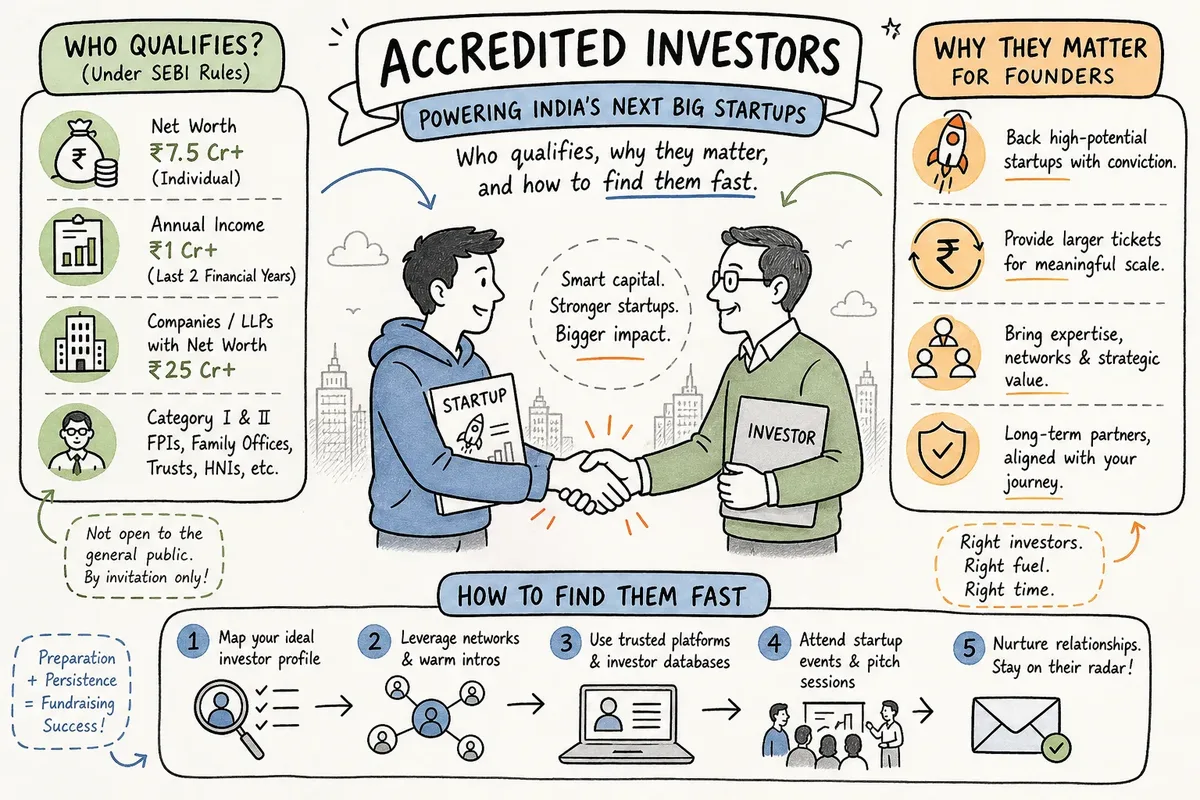
Most founders treat investor conversations as a numbers game: pitch widely, follow up relentlessly, accept capital from whoever says yes first. That works until it doesn't — and in India's regulatory environment, it can create serious problems. Accredited investors are a defined legal category under SEBI's framework, not simply wealthy individuals who express interest in startups.
SEBI draws a firm line between investors who can legally participate in private equity raises and those who cannot, based on verifiable, documented status — not enthusiasm. Founders who understand this distinction save months of back-and-forth with the wrong people and avoid the compliance exposure of accepting capital without checking eligibility first.
What SEBI's Framework Actually Says
SEBI gives individual investors three separate routes to qualify. Meeting any one of them is sufficient.
Three Routes to Individual Accreditation (Any One Qualifies)
Route 1: Income + Net Worth
₹1 Cr annual income and ₹5 Cr net worth (₹2.5 Cr in financial assets)
Route 2: Income Alone
₹2 Cr annual income, no net worth requirement
Route 3: Net Worth Alone
₹7.5 Cr net worth (₹3.75 Cr in financial assets)
The primary residence is explicitly excluded from net worth in every route. A founder courting an investor who owns a ₹4 Cr apartment and claims the rest in savings may find the numbers don't clear the bar once the property is stripped out.
The 2026 procedural update simplifies documentation: net worth certificates no longer require a detailed asset breakdown — a CA's statement confirming the threshold is met is now sufficient.
Who Else Qualifies: Corporates, Trusts, and Deemed Investors
Body corporates and non-family trusts qualify at a net worth of ₹50 crore. Partnership firms are treated differently: each partner must independently meet the individual criteria — a firm cannot aggregate partner wealth to clear the bar. This matters when approaching family offices or syndicates structured as partnerships.
A category of deemed accredited investors requires no certificate at all: institutional buyers, Category I Foreign Portfolio Investors, sovereign wealth funds, and multilateral development agencies are automatically recognised. For everyone else, the certificate is non-negotiable.
Accredited Investor Checklist (India)
The CVL Certification Process
SEBI has designated CDSL Ventures Limited (CVL) as the sole recognised accreditation agency in India. Investors apply through CVL's portal, submitting identity documents, three years of income tax returns, and a CA-issued net worth certificate (statutory auditor for corporates). CVL typically issues the certificate within three business days once documentation is complete.
CVL Certificate Fees
Fees are subject to revision — confirm the current schedule directly with CVL. An expired certificate carries the same legal weight as no certificate at all.
Why Equity Fundraising in India Legally Requires Accredited Investors
SEBI introduced the accreditation framework to create a regulation-light environment where sophisticated capital partners can access higher-risk private securities without retail-level protections. If an investor has the financial depth to absorb a loss and the experience to evaluate a private placement, they don't need the same guardrails as a retail mutual fund investor. Founders raising through AIF structures, angel funds, or other private placement vehicles must verify investor eligibility before capital enters the scheme corpus.
AIFs, Angel Funds, and the Minimum Investment Architecture
Minimum Investment Thresholds by Fund Structure
In Accredited Investors-only schemes, there's no fixed minimum at all — the amount is agreed between manager and investor and disclosed in the placement memorandum.
Deadline to know: angel funds — the structure most relevant to early-stage founders — are now restricted entirely to accredited investors. From September 2026, angel funds must onboard only accredited investors, with September 8, 2026 as the transition deadline for existing funds to formalise investor eligibility.
What Founders Risk by Skipping the Accreditation Check
Capital from a non-accredited investor cannot be included in an AIF or angel fund's scheme corpus. That compromises the fund's regulatory standing, can trigger SEBI scrutiny, force a return of funds, and delay the entire raise. The consequences land primarily on the fund manager, but founders still face committed capital that can't be deployed, reputational damage with other investors, and a disrupted timeline.
The Real Strategic Advantages of Pitching Only to Accredited Investors
Compressed Timeline
Sophisticated investors don't need a foundational education on term sheets, so more time goes to actual diligence and deal terms.
Cleaner Cap Table
Larger cheque sizes mean fewer investors are needed to close a round, reducing coordination overhead at every later stage.
Regulation-Light Access
Accredited-only schemes skip the 30-day pre-filing rule, the ₹20 Cr minimum corpus, and standard sponsor interest obligations.
Portfolio Concentration Caps
These exemptions translate directly into faster fund deployment and lower administrative costs.
How to Verify an Investor's Status Before You Pitch
The CVL certificate specifies accreditation as of a given date and carries a 2- or 3-year validity period. Any investment provider, including a startup's fund manager or legal counsel, must verify current validity directly through CVL before entering a client agreement. An expired certificate is legally equivalent to no certificate.
Watch for investors offering verbal confirmation without documentation, or referencing the US SEC definition of accredited investor — the two frameworks are entirely distinct. In India, self-declaration is not sufficient under SEBI rules; only a valid CVL certificate meets the standard.
Finding Pre-Verified Accredited Investors Without the Manual Grind
Searching LinkedIn, attending demo days, or buying access to generic directories doesn't tell you whether an investor has current accreditation, is actively deploying capital at your stage, or has a sector thesis that includes your vertical. Weeks of outreach produce meetings with unqualified leads because targeting criteria were never applied before the first message went out.
Folding accreditation and fit into the matching process as a pre-filter — rather than a late-stage check — changes the economics of the entire process. Founders can configure matching criteria to surface only verified investors, eliminating the document-chasing phase from later in the conversation. Pair this with a clean pitch deck audit so you arrive at meetings with answers, not improvised responses — see fundraising" style="color:#7a5cff;font-weight:600;text-decoration:underline;">How to Get Actionable Pitch Deck Feedback Before Fundraising and Find Angel Investors: A Founder's Complete Guide.
Skip the document-chasing phase entirely.
Request Your Verified Investor Shortlist →