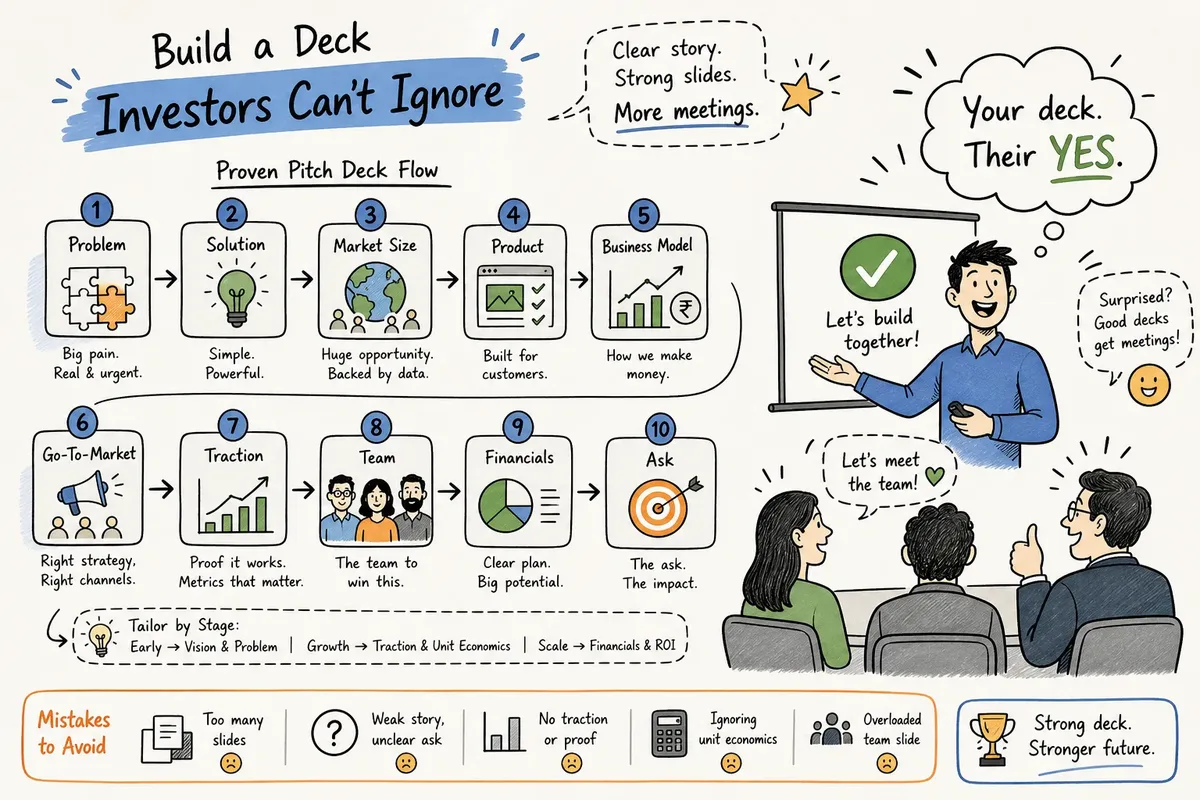
Most founders who get rejected after a first pitch didn't have a bad idea — they had a poor pitch deck structure that told the story in the wrong order. Investors receive hundreds of decks every year, and most report spending under two minutes on an initial review. In that window, they're not reading every word; they're scanning for a narrative logic that builds confidence. If the structure doesn't hold up in those first few slides, the deck rarely survives past the opening sequence.
In 2026, investor expectations have sharpened considerably by funding stage. A seed">pre-seed deck is evaluated differently from a seed deck, and a seed deck looks nothing like what a Series A investor expects to see. Founders who understand this distinction and validate their pitch deck structure before sending it out are more likely to secure initial meetings than those who rely on instinct alone. Platforms like EzFunding now allow founders to run an automated, slide-by-slide audit before a deck ever reaches an investor's inbox, removing a significant source of costly guesswork from the process.
💡 KEY INSIGHT
Investors decide within the first few slides whether to lean in or tune out. The order of your slides matters as much as their content — structure is what earns the next few minutes of attention.
Pitch Deck Structure: The Slide Order Investors Actually Expect
Investors follow a specific narrative logic when they read a pitch deck: problem, solution, market, product, business model, traction, team, ask. This sequence is not merely a convention; it mirrors the order in which investors build conviction. Each slide earns the right to exist by answering the question the previous one raised. Opening with the problem earns attention because it grounds the deck in a real pain point before anything else is introduced. Jumping to the solution or product first forces the investor to do mental work they simply won't do.
Why the Problem Slide Must Come First
The problem slide does more than explain a pain point. It establishes that a market exists and that someone is willing to pay for a fix. It should include data or a concrete scenario that makes the scale and frequency of the problem undeniable. Investors decide within the first few slides whether to lean in or tune out, and sharp problem framing is what earns those next few minutes of attention.
A strong problem slide in 2026:
- Names the specific customer archetype
- Quantifies the cost of the pain in lost time or revenue
- Briefly shows why current solutions fall short — giving investors the context they need to appreciate whatever comes next
Where Traction and the Ask Fit in the Sequence
Traction placement depends on funding stage. For Series A, traction belongs near the front of the deck, where investors expect hard proof before they engage further. At earlier stages, traction typically sits in the middle: by the time an investor reaches the financials and the funding ask, they should already believe the business is working.
The ask slide closes the narrative and should state the round size, use of funds, and current runway. Valuation context or a brief note on runway can be added where relevant, but the closing slide works best when it is focused and concise.
What Each Core Slide Needs to Communicate
Understanding slide order is step one. Knowing what belongs on each slide is where most founders underdeliver. Every slide has exactly one job. When a slide tries to do two or three things at once, it dilutes both the message and the investor's attention. A pitch deck format that works keeps each slide focused on a single idea, supported by one or two specific data points rather than a wall of text.
Think of it as a pitch deck checklist in visual form: each slide must pass or fail on a single, clearly defined criterion. For guidance on which slides to prioritise and why, resources that list the essential slides you need in a fundraising deck can be a helpful reference.
The Slides That Carry the Most Investor Weight
🎯 FOUNDER TIP
The solution slide must mirror the problem slide directly, using the same language and addressing the same scale of pain. Consistency between these two slides is what makes the narrative feel inevitable rather than assembled.
- Solution slide: Mirrors the problem slide directly, using the same language and addressing the same scale of pain.
- Market size slide: Should show a bottom-up estimate of the serviceable market, not a generic "$50 billion TAM" figure pulled from an industry report without context.
- Team slide: Should answer one question — why are these specific people the ones who will win this market? Credentials alone are insufficient; domain insight and relevant execution history are what matter to investors at every stage.
What Financials Early-Stage Investors Actually Look For
Even pre-revenue founders are expected to show a two to three year projection, a monthly burn rate, and current runway. For seed-stage founders already generating revenue, the deck should include CAC, LTV, and an LTV:CAC ratio, with a target of 3:1 or higher signalling viable unit economics. In 2026, investors are particularly sensitive to payback speed and retention quality alongside these ratios.
LTV:CAC Ratio
3:1+
Target signalling viable unit economics
CAC Payback
< 12 mo
Demonstrates financial discipline
Projections
2–3 yrs
Expected even pre-revenue
Showing a CAC payback period under twelve months alongside a 3:1 LTV:CAC ratio demonstrates financial discipline and grounds the projections in operational reality, not just aspiration. For a practical checklist of the key metrics to include in your pitch deck, founders should ensure CAC, LTV, churn and payback are all clearly calculated and presented.
Stage-Specific Adjustments Every Founder Needs to Make
A seed pitch deck is not a shortened Series A deck. The startup pitch deck format shifts meaningfully by stage because what investors are underwriting changes completely. At seed">pre-seed, they are funding insight and vision because hard data does not yet exist. At seed, they want evidence that the founder understands the market deeply and has early signals. At Series A, traction must lead the conversation, and the deck must provide detailed data to back it up.
| Stage | Slide Count | Traction Placement | Competition Slide |
|---|---|---|---|
| seed">Pre-Seed | 10–12 slides | Not central — vision and "why now" lead | Back of the deck |
| Seed | Market sizing + early signals emphasised | Middle of the deck | Middle, after market opportunity |
| Series A | 14–16 slides | Near the front — hard proof expected first | Middle, after market opportunity |
seed">Pre-Seed and Seed: What Belongs in the Deck and What Doesn't
A seed">pre-seed deck should run ten to twelve slides and anchor on the problem, the solution, and a compelling "why now" argument. Detailed financials are not expected, but projections and a clear use-of-funds narrative are. The competition slide belongs at the back of the deck at this stage.
A seed deck shifts emphasis toward market sizing done bottom-up and early traction signals: even ₹25 lakh ARR or a growing active user base is worth front-loading. At seed, the competition slide moves to the middle, after the market opportunity has been established. If you're unsure about how many slides your deck should have, that guidance can help you avoid padding or over-collapsing critical narrative elements.
Series A: When the Deck Must Lead With Proof
By Series A, the slide sequence changes materially. Traction moves toward the front of the deck, and investors expect cohort analysis, retention metrics, and unit economics alongside a fourteen to sixteen slide format. The team slide becomes less about credentials and more about execution track record. A startup that pitches Series A with a seed-style deck signals it hasn't matured its fundraising strategy — an impression that is difficult to recover from once an investor has already formed it.
For founders debating classic formats, concepts like the only 10 slides you need are useful to simplify thinking but must be adapted to stage-specific expectations. If you're deciding whether to prioritise seed-investors" style="color:#2563eb;text-decoration:none;font-weight:600;">seed investors or Series A investors for your next raise, matching your deck format to their expectations matters as much as the round timing itself.
Common Ordering Mistakes That Quietly Sink Your Chances
The most damaging pitch deck mistakes are not on individual slides; they're in how slides are sequenced. Investors recognise these patterns quickly, and a deck that opens with the team slide, buries the problem, or ends with traction reads as structurally unprepared. These errors signal that the founder may not yet understand what investors are trying to evaluate, which raises a broader question about how the founder thinks about the business.
Leading With the Team or Product Before Establishing the Problem
⚠️ WARNING
Opening with a team slide tells the investor nothing they can anchor to yet — it's a credibility signal that lands flat without context. Similarly, jumping to a product demo before the problem is established forces the investor to guess why the product matters.
Decks that consistently earn meetings always build need before presenting the solution, letting the investor feel the weight of the problem before the fix is revealed. Folding this principle into your pitch deck outline from the outset is far easier than restructuring after rejection.
Putting the Competition Slide in the Wrong Place
The competition slide is one of the most commonly misplaced elements in a founder's deck. At seed">pre-seed, it belongs near the end of the deck. At seed and Series A, it belongs in the middle, after the market opportunity has been established and before the go-to-market strategy. A competition slide placed too early, before the investor understands the market, lands without impact. Placed correctly, it reinforces the founder's grasp of the competitive field and sharpens the differentiation argument.
Auditing Your Pitch Deck Structure Before It Reaches an Investor
Sending a deck without a structural review is one of the most avoidable mistakes in fundraising. Most founders receive feedback only after a rejection, which means the structural damage has already been done across multiple investor conversations. A slide-by-slide audit before outreach — examining slide order, content depth, and missing elements — can be the difference between a first meeting and a form rejection. Investors don't typically explain why they passed; they simply move on.
What a Proper Deck Review Actually Catches
A structured audit checks whether each slide fulfils its specific purpose and whether the narrative logic holds from the first slide to the last. It also confirms whether stage-appropriate content is present and whether critical slides — the ask, financials, and traction — are positioned correctly. Many decks that fail an initial investor review have structural gaps that a founder review alone won't surface. Having a second set of eyes, whether human or AI-powered, often improves the outcome meaningfully.
What EzFunding's Slide-by-Slide Analysis Surfaces for Founders
✅ BEST PRACTICE
Run your deck through a structured audit before outreach — not after a round of rejections. Catching structural gaps early preserves your credibility with every investor you approach afterward.
EzFunding's pitch deck analysis feature runs a systematic audit of a founder's deck across eight critical dimensions, scoring each slide against what investors at the relevant funding stage expect to see. Rather than waiting for investor feedback to surface structural problems, founders upload their deck, receive a fundraising-readiness" style="color:#2563eb;text-decoration:none;font-weight:600;">fundraising readiness score, and identify exactly which slides need restructuring before the deck goes out. It is a practical way to validate pitch deck structure before it's tested in the market, and it is particularly valuable for first-time founders who don't have an advisor network available to run a manual review.
Build the Deck That Earns the Meeting
A pitch deck that gets investor meetings is not the most polished one in the inbox. It's the one that builds the clearest case in the right order. The problem leads. The solution follows. Traction validates. The ask closes. Every funding stage has its own version of that sequence, and getting the pitch deck structure right dramatically improves the quality of conversations a founder is able to have with investors.
Before sending your next deck:
Confirm the slide order matches your funding stage.
Check that each slide has a single, clear job.
Verify your financials match stage expectations: projections and burn rate at seed">pre-seed, unit economics and retention at seed, cohort data at Series A.
Run your deck through a structured audit tool before outreach.
📊 MARKET INSIGHT
If you are targeting specific investors or platforms, tailor the slide order and emphasis to their focus. Firms such as Marwari Catalysts, PointOne Capital, or syndication and platform partners like LetsVenture will each expect slightly different evidence depending on stage and thesis.
Running your deck through a structured audit tool like EzFunding's slide-by-slide analysis before outreach is one of the highest-return steps any founder can take early in the fundraising process. The founders who do this work before outreach, not during it, are the ones who walk into rooms worth being in.
Ready to see how your deck actually holds up?
Get a slide-by-slide fundraising readiness score before your deck reaches an investor's inbox.
Audit Your Pitch Deck on EzFundingKeep Reading
- fundraising-ezfunding" style="color:#2563eb;text-decoration:none;font-weight:600;">How to Get Actionable Pitch Deck Feedback Before Fundraising
- Step-by-Step Guide to Fixing Your Pitch Deck Before Investor Outreach
- seed-investors-vs-series-a-investors-which-investors-should-you-target" style="color:#2563eb;text-decoration:none;font-weight:600;">Seed Investors vs. Series A Investors: Which Should You Target
- How to Build an Investor List That Actually Converts