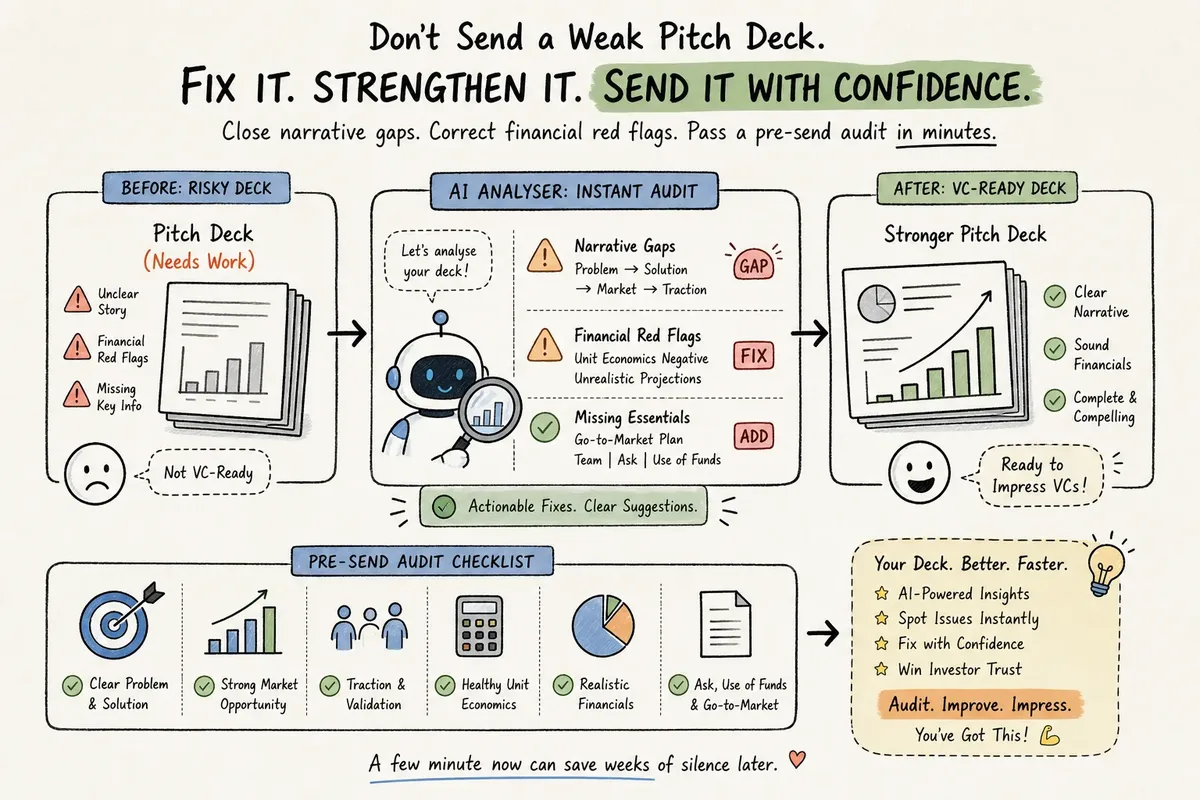
Investors spend an average of 2 minutes 14 seconds reviewing a pitch deck on the first pass — roughly the time it takes to read three paragraphs. Most decks waste every second of it. Many decks that get rejected aren't rejected because the business is bad. They're rejected because the presentation of the business breaks down before the investor reaches slide 5.
This is a practical diagnostic, not a design tutorial. Nine concrete fixes, organized across three layers — narrative, financials, and slide structure — plus a pre-send checklist that tells you exactly when the deck is ready to leave your outbox.
The 2-Minute Test Every Deck Faces
Source: DocSend pitch deck analytics. In that window, a VC is scanning for exactly four things: problem clarity, a traction signal, team credibility, and a clear ask. Bury any one of them and the deck fails before it has a real chance.
How to Tell Your Pitch Deck Is Weaker Than You Think
Most founders evaluate their deck by asking the wrong question: "does this make sense to me?" That's not the same as "does this hold up in two minutes to someone who has never heard of my company?" You already carry the context the deck is failing to communicate — which is exactly why self-review misses the gaps.
The Rejection Reasons That Appear Before Slide 3
Most first-pass rejections are visible within the opening two or three slides: the startup is out of scope on stage, sector, or cheque size; the value proposition reads as a "vitamin" rather than a "painkiller"; or there's no clear differentiation from solutions the investor has already seen that week. The opening narrative carries enormous weight, and most decks waste it.
Why Founders Miss Their Own Blind Spots
A common blind spot: founders spend three slides explaining how the product works but never articulate why this market, at this scale, is the right place to deploy capital. Investors notice that omission within the first sixty seconds. What you need is a perspective that applies investor criteria, not founder criteria — and it needs to be in place before the deck reaches a single inbox.
Layer 1: Narrative Gaps That Make VCs Stop Reading
The pitch deck isn't a product brochure. It's a story with a clear problem, a credible protagonist, a specific solution, and a logical reason this company wins.
The Story Arc That Holds From Slide One to the Ask
Problem
Why Now
Solution
How It Works
Market
Traction
Business Model
Team
Financials
Ask
Skipping or reordering these elements forces investors to work too hard to follow the logic — and they won't do that work.
Fix 1: Build a Story Arc That Holds From Slide One to the Ask
Each slide should answer an implicit question the investor is already asking as they advance through the deck. The arc above is the order that does that.
Fix 2: Sharpen the Value Proposition So It Survives a Single Sentence
If you can't explain the value proposition in one sentence without jargon, neither can the investor repeat it to their partners. Replace "we revolutionise the future of enterprise connectivity" with "we cut last-mile logistics costs by 30% for mid-market retailers using AI routing." The solution slide's headline should carry the entire message by itself.
Fix 3: Add the "Why Now" Signal Investors Are Looking For
VCs are timing-sensitive. A strong solution with no clear market catalyst raises immediate red flags. Add specific evidence: regulatory shifts, infrastructure inflections, cost curve changes, or concrete demand signals. One crisp "why now" slide removes a major objection before it's raised in the room.
Layer 2: Financial Red Flags VCs Find in the First Two Minutes
A significant majority of pitch decks arrive without financial projections at all. To an investor, that absence signals the founder either hasn't modelled the business or is hiding numbers they aren't confident about. Neither interpretation moves a deal forward.
Fix 4: Add a 3-to-5-Year Financial Projection (Even a Simple One)
VCs use projections to test how founders think about the business, not to hold them to a forecast. The slide must show current burn rate, runway, a revenue model, and a three-year forward view tied to specific milestones. For seed">pre-seed, a simple operating plan is enough. For seed and Series A, the projection must show when unit economics turn positive.
Fix 5: Show the Metrics VCs Actually Benchmark
Vanity metrics kill decks. Presenting total registered users or app downloads without operational numbers signals you don't know your business at the level investors expect.
3x
Year-on-year ARR growth benchmark for B2B SaaS
1:1
Sales efficiency ratio — new ARR divided by sales & marketing spend
<2
Burn multiple — capital converting to durable revenue
NRR
Net revenue retention as the core customer loyalty signal
If these numbers aren't on the deck, the investor assumes they don't exist or aren't favorable.
Fix 6: Clean Up Unit Economics Before the Deck Leaves Your Hands
LTV:CAC ratio, gross margin, and payback period tell a growth-stage investor whether the business scales profitably. Unrealistic hockey-stick charts with no data backing are more damaging than conservative numbers — investors will push on every assumption in every follow-up call, so only present figures you can fully defend.
Layer 3: Slide-Level Fixes That Shift Perception
Design and slide structure aren't vanity concerns. Inconsistent design, weak visual hierarchy, and decks that run well past 15 slides materially reduce engagement on the first pass — often before the investor reaches your financials at all.
Fix 7: Rewrite Slide Titles to Carry the Full Message
Most decks use label titles: "Market Size," "Solution," "Team." Investor-ready decks use message-first titles: "Our addressable market is $4.2B and growing at 18% annually." The investor should understand the key point of every slide just by reading the title, even if they skip the body content entirely.
Fix 8: Fix Visual Hierarchy and Design Consistency
Inconsistent fonts, mismatched colours, and cluttered layouts signal disorder before a single word is read. The fix doesn't require a designer: one font family, one consistent colour palette, one key message per slide, and whitespace used deliberately to guide the eye.
Fix 9: Cut the Deck to 11–13 Slides for the Initial Outreach Version
Every slide that doesn't answer "what's the problem, why us, how do we make money, or why now" is a candidate for removal or consolidation. Detailed appendix slides can hold supporting data for diligence conversations, so nothing of value is lost.
Outreach Deck Length: Target vs. Typical
The outreach version has one job: earn the next conversation. Appendix slides absorb the rest.
Why Advisor Feedback Is Too Slow and Too Biased
Most founders rely on a warm contact for deck feedback: a mentor, an operator friend, a fractional CFO. The wait is often a month or more, and when it arrives, it reflects that person's experience rather than a live investor's current criteria. By the time feedback lands, the outreach window for that fund's current cycle may have already closed.
There's a deeper problem: friends and advisors are often too polite. They soften critical feedback in ways that leave the deck's core problems unaddressed. The result is a deck that feels refined on the surface but still fails the investor's 2-minute test when it counts.
How EzFunding's Slide-by-Slide Analyser Works
EzFunding's AI analyses your pitch deck slide by slide across eight key startup dimensions, producing a fundraising readiness score and specific, actionable callouts at the slide level. The analysis draws on investor preferences logged across a broad network of VCs, angel investors, family offices, and accelerators — rather than reflecting any single advisor's perspective. You get an investor-perspective audit in minutes, with no scheduling delays and no softened feedback driven by politeness.
The score identifies which dimensions scored lowest and which slides are generating the most issues. It's not a gatekeeping tool — it's a diagnostic that shortens the iteration cycle from weeks to days. See how this fits into the wider readiness picture in Startup Investor Readiness: What VCs Actually Look For in 2026 and fundraising" style="color:#7a5cff;font-weight:600;text-decoration:underline;">How to Get Actionable Pitch Deck Feedback Before Fundraising.
The Pre-Send Checklist That Tells You the Deck Is Ready
Before the deck reaches any investor, run it through these eight questions. Answer each one honestly, not optimistically.
"Investor-ready" doesn't mean perfect. It means the deck removes friction rather than creating it. The deck is ready when it passes all eight questions above and has been reviewed by at least one objective source — an AI-powered audit, a cold read from someone outside the industry, or a deck-review session through a platform like EzFunding.
Once your deck clears this checklist, make sure the rest of your raise is just as tight: see fundraising-readiness-checklist" style="color:#7a5cff;font-weight:600;text-decoration:underline;">Are You Ready to Raise Funding? The Complete Startup Fundraising Readiness Checklist and How to Find Investors for Your Startup in 2026.
Know your weak points before an investor does.
Run Your Deck Through the Analyser →