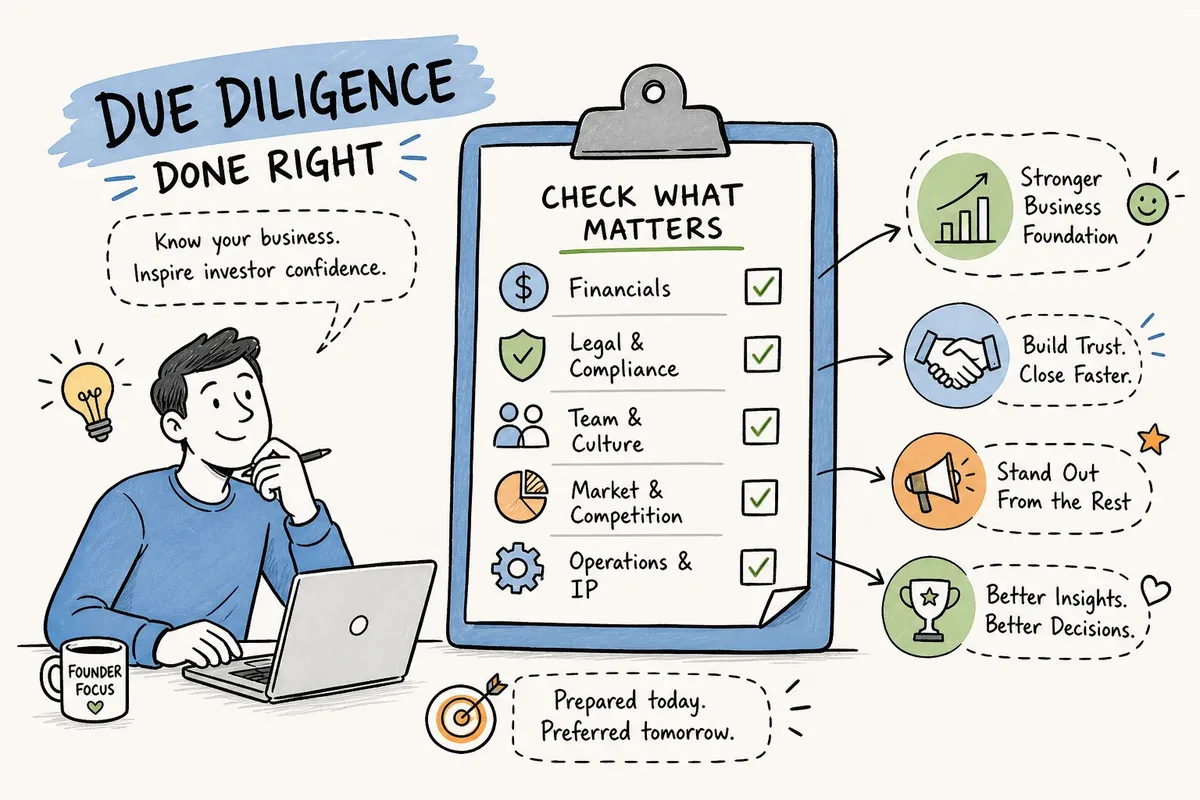
Due diligence begins the moment an investor says "we're interested" — and what founders do next determines whether that interest converts into a closed round. Most founders prepare obsessively for the pitch meeting but treat what comes next as an afterthought. A compelling narrative gets you in the room; what happens in the weeks that follow determines whether you actually close.
Investors are not simply validating enthusiasm. They are confirming that every claim in your pitch deck is supported by verifiable evidence. The founders who close rounds cleanly are often not the ones with the most impressive slides — they are the ones who arrived at the data room stage with nothing to hide and everything organised.
Due Diligence Timelines by Stage
Industry practitioners widely report that a pre-populated, well-organised data room can cut due diligence timelines by several weeks — in some cases meaningfully halving the process. The single biggest controllable factor in timeline length is data room readiness.
Types of Due Diligence Investors Conduct
Financial DD (FDD)
Revenue quality, burn rate, cap table, financial projection defensibility
Legal DD
Statutory compliance, IP ownership, founder agreements, FEMA compliance
Vendor DD
Key supplier contracts, API dependencies, single-supplier concentration risk
ESG DD
Labour practices, environmental obligations, governance — increasingly required by institutional and impact investors
Financial Due Diligence: What Investors Scrutinise in Your Numbers
Revenue Quality and Burn Rate Analysis
Revenue quality is about consistency and sustainability, not just the top line. Investors scrutinise customer concentration closely — a single client accounting for 30% or more of revenue is treated as a structural risk, not a milestone. A burn rate that contradicts your stated runway is one of the most common triggers for a deeper financial verification, often involving the investor's own financial adviser rather than simply accepting management accounts at face value.
Cap Table Clarity and Funding History
A messy cap table is one of the most frequent deal-blockers in Indian seed rounds. Undocumented convertible notes, informal equity agreements, or ex-co-founders holding significant equity without good-leaver clauses all surface here. A clean cap table shows clear ownership structure, documented vesting schedules, and a formal record of every financing event.
Financial Projections and Unit Economics
Unit Economics Investors Focus On
Burn Multiple
LTV:CAC
CAC Payback Period
Net Revenue Retention
Investors don't expect perfect forecasts — they expect defensibility. A three-year model that ties back to historical trends, unit economics, and a credible market-sizing methodology is far more persuasive than an optimistic projection built on round numbers.
Legal Due Diligence: The Paperwork That Determines Deal Fate
Legal DD is where Indian startup deals most frequently stall. Institutional investors review corporate standing under the Companies Act, 2013; MCA filings; FEMA compliance for any foreign investment received; and the completeness of all founder, employee, and contractor agreements. Many first-time founders operate with informal structures that worked during early growth but become serious liabilities the moment a formal investor review begins.
Corporate Structure and Statutory Compliance
Intellectual Property Ownership and Assignments
IP assignment agreements from co-founders, early employees, and contractors are non-negotiable. If your core technology was built by someone who left without signing an assignment agreement, you don't legally own what you're pitching. Unregistered trademarks and disputed code ownership are among the most frequent legal red flags in Indian startup DD — and among the most preventable with basic legal housekeeping before fundraising begins.
Founder Agreements, ESOPs, and Related-Party Contracts
Investors scrutinise founder vesting schedules, related-party transactions, and whether ESOP pools are properly documented and administered under the Companies Act. Ambiguous ESOP terms create both legal and tax complications treated as unresolved liabilities. Any personal loans from founders to the company not approved through a formal board resolution are flagged immediately.
Red Flags That Stall or Kill Funding Rounds
Financial Red Flags
- Unusual revenue spikes immediately before a raise
- Bank statements that don't reconcile with MIS figures
- Burn rate that contradicts stated runway
Legal Red Flags
- Missing IP assignments from early team members
- Unsigned or expired customer contracts
- FEMA non-compliance for informal foreign investment
Operational Red Flags
- Ex-co-founders holding significant equity without good-leaver provisions
- Business relies heavily on one unsecured customer
- Team cannot explain a gap in company history
Building a Due Diligence-Ready Data Room
The Pre-Fundraise Audit Sequence
The sequence matters as much as the individual tasks — each step surfaces issues that may affect the one that follows. Begin 2–3 months before your first investor conversation.
Step 1
Legal audit — corporate docs and MCA filings
Step 2
Cap table documentation and CA review of financials
Step 3
Readiness scoring across the 8 fundraising dimensions
Step 4
Begin investor outreach from a position of informed confidence
Founders who complete this sequence close faster, encounter fewer surprises, and negotiate from informed confidence rather than reactive damage control. For the full fundraising preparation picture, see fundraising-readiness-checklist" style="color:#7a5cff;font-weight:600;text-decoration:underline;">The Complete Startup Fundraising Readiness Checklist, What Investors Look For Before Investing in Startups, and fundraising-process-a-step-by-step-guide-for-founders" style="color:#7a5cff;font-weight:600;text-decoration:underline;">The Startup Fundraising Process Step by Step.
A gap identified by you is a problem you solve on your own terms. A gap found by an investor becomes a negotiating liability.
Run Your Readiness Scoring →