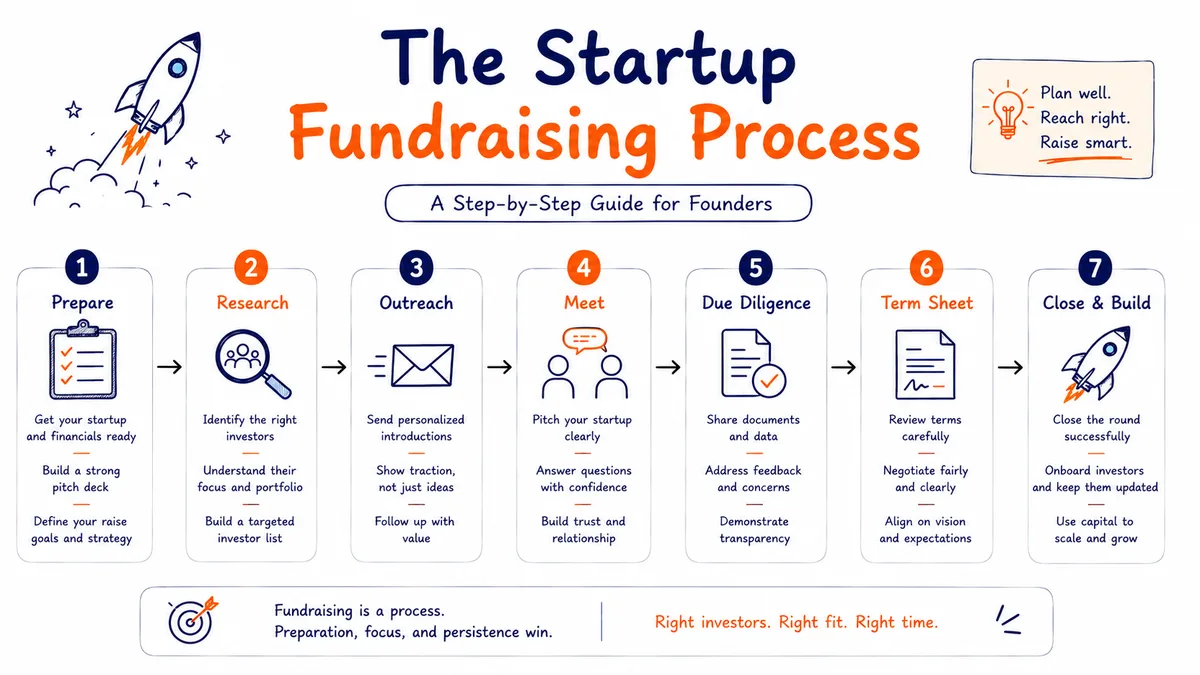
Most founders know they need to "find investors." Very few can tell you what actually happens between the first cold email and the wire transfer landing in their account. That gap is exactly where rounds stall, deals die in due diligence, or founders run out of runway mid-raise because they budgeted three months for a process that realistically takes six.
Fundraising isn't a single event. It's a ten-step process with its own timeline, its own failure points, and its own rhythm — and knowing the map in advance is the difference between running it and being run by it.
Why Most Fundraising Efforts Fail
- No preparation: jumping into outreach before financials, story, and data room are ready
- Wrong investors: pitching funds with no fit on stage, sector, or check size
- Weak deck: failing to communicate the opportunity clearly in the first few slides
- Poor process: running outreach without a system, so momentum and competitive tension never build
Step 1: Assess Fundraising Readiness
Before anything else, score yourself honestly across the same five dimensions investors will: team, market, product, traction, and financials. Most rounds that stall do so because this step was skipped, not because the outreach was weak. Go deeper in What Investors Look For Before Investing in Startups.
Step 2: Define Your Funding Strategy
Answer three questions before you write a single outreach email:
- How much are you actually raising?
- Why are you raising now, specifically?
- What milestones will this capital get you to before the next round?
Step 3: Build Your Pitch Deck
Your deck has to carry the story alone for the first few minutes, before you're in the room to explain it. Get outside eyes on it before it reaches an investor's inbox — you rarely get a second look. Use pitch deck feedback to find the gaps before an investor does.
Step 4: Build an Investor List
A tight, scored list of investors who actually fit your stage and sector consistently outperforms a long, generic one. The full process is in How to Build an Investor List That Actually Converts.
Step 5: Find Matching Investors
Once your list exists, matching tools filter it further against stage, sector, geography, check size, and thesis — the same criteria from Step 4, applied automatically and continuously. See how the mechanics work in Investor Matching Explained.
Step 6: Start Investor Outreach
Outreach runs on three tracks at once:
- Cold outreach: scalable, but lower conversion — treat it as a numbers game with disciplined targeting
- Warm introductions: dramatically higher conversion; prioritize these first
- Follow-ups: non-negotiable; most replies come after the first message, not from it
The Series A Outreach Funnel
Source: Pitchwise 2026 Series A fundraising research.
Step 7: Investor Meetings
Meetings typically escalate through three stages:
- First meeting: usually with an associate or principal, screening for fit and story clarity
- Partner meeting: the deal gets a real internal champion, or it dies here
- Deep dive: financial model, cohort data, and customer references get scrutinized line by line
Step 8: Due Diligence
A signed term sheet is not a closed round. Diligence runs across four tracks — financials, legal, product, and team — and the timeline varies sharply by stage and round structure.
Due Diligence Duration After Term Sheet
Source: SheetVenture and Vakilsearch 2026 due diligence research.
Step 9: Term Sheets
A term sheet sets the headline terms, most of which get negotiated in the 1–2 weeks after issuance if both sides are serious:
- Valuation: pre-money and post-money, and how dilution lands
- Ownership: the resulting cap table after the round closes
- Investor rights: board seats, pro rata rights, liquidation preference, and protective provisions
Step 10: Close the Round
Closing has three parallel workstreams:
- Documentation: definitive agreements get drafted, reviewed, and signed
- Fund transfer: wires get coordinated and confirmed across all participating investors
- Investor updates: the relationship formally begins — set the cadence for updates from day one
Fundraising Timeline
Here's how the full process breaks down for a typical priced seed round in 2026, end to end.
Seed Round Timeline: 12–16 Weeks Total
Preparation
3 weeks
Meetings & Pitching
4 weeks
Term Sheet Negotiation
4 weeks
Diligence & Closing
4 weeks
Source: Capwave 2026 fundraising timeline research.
The Seed-to-Series-A Gap Is Widening
Only 15% of startups now raise a Series A within two years of closing their seed round. Source: Carta Q4 2024 data, via Pitchwise 2026 analysis.
Fundraising Checklist
How EzFunding Helps Manage the Entire Process
Investor Matching
Keeps your list current as you move from outreach into meetings.
Readiness Scoring
Flags weak spots before they show up in someone else's due diligence.
Pitch Deck Analysis
Catches clarity gaps before your deck reaches an investor's inbox.
Investor CRM
Tracks every conversation across outreach, meetings, and diligence in one place.
Outreach Intelligence
Helps you sequence follow-ups and keep competitive tension across the round.
For the steps that come before this process even starts, revisit How to Find Investors for Your Startup, seed-investors-vs-series-a-investors" style="color:#7a5cff;font-weight:600;text-decoration:underline;">Seed Investors vs. Series A Investors, Startup Funding Stages Explained, and Startup Funding Sources Every Founder Should Know.