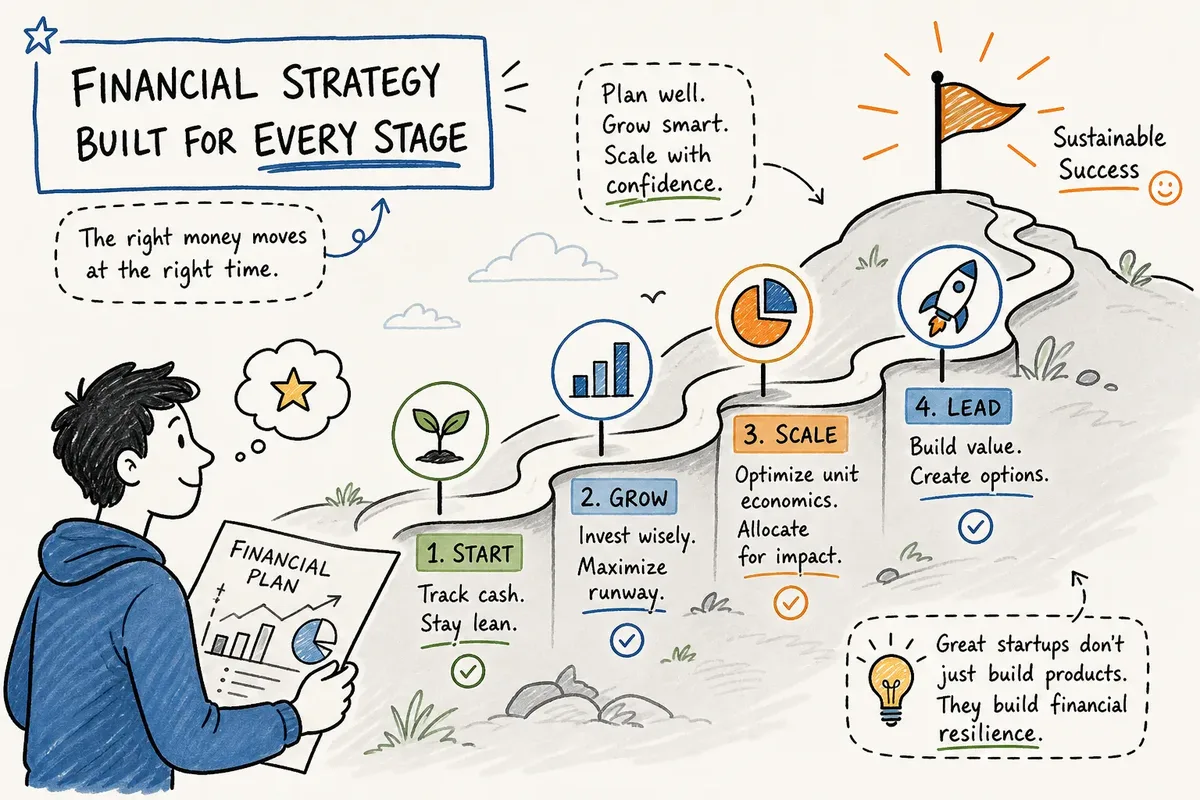
Why the founders who raise faster build their strategy before they build their spreadsheet.
Most founders build a financial model because investors ask for one. That is the wrong reason, and it shows in every conversation that follows. A financial model built to satisfy a due diligence checklist reads like a compliance document: the numbers are there, the tabs are filled, and the investor moves on within minutes.
A clear startup financial strategy lets founders decide what to spend on, in what order, and to hit which milestones — built first, with the model following from it. The founders who raise faster, at better terms, tend to work this way: strategy precedes spreadsheet, not the other way around.
Your startup financial strategy is not a spreadsheet. It is the clearest signal of how well you understand your own business: what to spend on, in what order, to hit which milestone, with what capital.
This guide breaks that down stage by stage — from surviving seed">pre-seed on lean burn to making the growth-versus-profitability call at Series A. It also covers how your financial architecture connects directly to the investors you should be speaking with, and why misalignment there costs founders months of runway they cannot recover.
Why Most Startup Financial Strategies Fail Before They Start
Founders make two consistent mistakes:
- They treat financial modelling as a forecasting exercise rather than a strategic planning tool.
- They build one model for all investors rather than a stage-appropriate narrative.
Both mistakes produce the same result: a document that looks complete and communicates nothing useful. Financial strategy is the foundation of fundraising credibility, not a back-office task to delegate after the pitch deck is done. The model is how you verify the strategy; it is not the strategy itself. Founders who understand this distinction produce models that investors actually read.
The Difference Between a Financial Model and a Financial Strategy
A model is a spreadsheet. A strategy is the set of decisions that explain why each number exists.
Investors fund the strategy and use the model to verify it. A strategy that precedes the model always produces a more coherent document, because every assumption has a rationale and every output has a decision behind it. Founders who build the strategy first can defend every input — which is where most investor conversations actually happen.
Key Insight
When a VC opens a financial model, they are not checking arithmetic. They are reading capital efficiency, founder judgement, and milestone clarity. A model that shows 3x revenue growth with no corresponding increase in customer acquisition costs signals either magical thinking or a misunderstood business — both readings are likely to end the conversation.
Grounded assumptions signal the opposite. They tell investors that the founder knows how their business actually works: how customers are acquired, what it costs, how long they stay, and what margin is left over. That signal is worth more than any particular revenue figure on the page.
Stage 1 — seed">Pre-Seed: Building a Survival Map
At seed">pre-seed, the financial strategy has one job: keep the company alive long enough to prove something. Capital is scarce, burn must be minimal, and every rupee spent should reduce uncertainty rather than signal ambition.
In India, seed">pre-seed startups typically burn between ₹5 and ₹8 lakh per month, with a target runway of 12 to 18 months. These benchmarks reflect how long it actually takes to build, test, and validate an MVP with real users before the next conversation with seed">pre-seed-investors" style="color:#B8863D;font-weight:600;text-decoration:none;border-bottom:1px solid #B8863D;">seed">pre-seed investors becomes credible. For further context on typical burn-rate benchmarks, see the average burn rate for startups.
Target Runway
12–18 mo
To reach a credible proof point
Capital Allocation at seed">Pre-Seed: Where the First Rupees Go
seed">Pre-seed capital allocation is simple in theory and genuinely hard in practice. The priority order is a hierarchy, not a budget line:
- Product first — build the MVP.
- Minimum viable salaries for the founding team.
- Tools required to talk to customers.
Marketing spends, office leases, and headcount beyond the core team are deferred. Founders who understand the logic behind this hierarchy make better decisions when cash gets tight. Salaries and benefits typically consume 50 to 75% of early-stage budgets — the discipline at seed">pre-seed is keeping that number low enough to preserve runway while paying the team enough to stay focused. Everything else is variable and should scale only with evidence, not with ambition.
Runway as a Strategic Asset, Not Just a Metric
Runway is the time available to hit the next proof point before the next fundraise. At seed">pre-seed, 12 to 18 months is the baseline because it takes that long to build a product, get it in front of real users, and extract signal worth presenting to seed-investors" style="color:#B8863D;font-weight:600;text-decoration:none;border-bottom:1px solid #B8863D;">seed investors. A runway below six months at seed">pre-seed means fundraising pressure distorts product decisions — precisely what early investors watch for when assessing founder judgement.
Founder Tip
Runway buys optionality. A founder with 14 months of runway can afford to iterate. A founder with 4 months cannot afford anything except a pitch — and that desperation is visible in every number they present. Track it with a burn rate calculator and a runway calculator before it becomes a crisis, not after.
Stage 2 — Seed: Proving the Model With Numbers Investors Trust
The seed stage startup financial strategy shifts from survival to validation. The model now needs to show that the business has discovered repeatable behaviour: customers are acquired at a known cost, they stay, and the economics make sense at scale.
Indian seed startups in 2026 are expected to show these figures for stronger rounds, with a clear CAC payback under 12 months.
The Unit Economics Every Seed-Stage Founder Must Know
Unit economics is not a single metric; it is a lens. At seed, the three numbers that matter most are CAC, LTV, and gross margin. An LTV:CAC ratio above 3:1 with a CAC payback under 18 months signals a business that can grow without destroying cash. Use a CAC calculator and an LTV calculator to keep both numbers current as your model evolves.
For a SaaS startup, healthy net revenue retention above 100% is the clearest indicator that customers are expanding their spend rather than churning out. For marketplace businesses, the gross margin profile is structurally different, so the benchmark for a healthy marketplace is not the same as for SaaS.
Warning
Founders who apply SaaS benchmarks to a marketplace model, or vice versa, produce unit economics comparisons that immediately lose credibility with sector-specialist investors. Match the lens to the business model before you present the numbers.
Building the Investor-Ready Financial Model at Seed
An investor-ready financial model at seed has one non-negotiable quality: assumptions drive outputs. The essential structure includes:
- A central assumptions sheet
- A bottom-up revenue driver model
- A headcount and expense schedule
- A cash flow statement
- A scenario planning tab
Best Practice
The scenario tab is not optional — it shows investors that the founder has stress-tested the downside, and investor feedback consistently identifies this as one of the strongest trust-building signals a model can contain.
A startup budgeting template is a starting point, not a substitute for understanding your own unit economics. Equally, the startup financial KPIs you choose to feature must be defensible in a live conversation. A downloaded template with generic growth rates tells an investor that the founder has not yet done that work. For practical guidance on building a usable model, see this practical framework on how to build a financial model your startup can actually use. If you're building a B2B SaaS company specifically, EzFunding's seed-b2b-saas" style="color:#B8863D;font-weight:600;text-decoration:none;border-bottom:1px solid #B8863D;">seed-stage B2B SaaS playbook maps this out in more detail.
Stage 3 — Series A: Making the Growth-Versus-Profitability Call
By Series A, the business has proof of concept and now needs a clear answer to one question: what is the most capital-efficient path to scale? Growth and profitability are not opposites; they are levers.
In high-velocity markets with winner-take-most dynamics, prioritising growth makes sense when unit economics are healthy enough that growth does not widen losses indefinitely. In markets with longer sales cycles or established competition, a credible path to profitability signals execution maturity.
When to Prioritise Growth Over Profitability (and When Not To)
The Rule of 40 — revenue growth rate plus profit margin above 40% — resolves this tension cleanly for most Series A founders. Popularised by Bessemer Venture Partners among others, it acknowledges that early-stage companies will often run negative on profitability while growing aggressively, but sets a threshold at which the combination becomes credible.
The burn multiple — which measures net burn per rupee of net new ARR added — has also emerged as a sharper indicator of capital efficiency: a burn multiple below 1.5 at Series A signals that growth is not being bought at unsustainable cost.
Framework originated by David Sacks, Craft Ventures — source. Rule of 40 popularised by Bessemer Venture Partners.
Market Insight
Indian VCs in 2026 prioritise growth efficiency and capital discipline over raw speed. The expectation is 3 to 5x annual revenue growth at Series A, but investors scrutinise CAC payback and NRR more than absolute ARR size. A startup showing 4x growth with NRR of 130% and a burn multiple of 1.2 will out-pitch one showing 5x growth with NRR of 85% and a burn multiple of 3.0 in almost every institutional conversation.
For a deeper discussion of the trade-offs between growth and profitability, see this analysis on growth vs profitability.
What Your Series A Model Signals to Institutional Investors
At Series A, the financial model is read differently than at seed. VCs are now examining the 18 to 24 month operating plan, not just the three-year forecast. They look for:
- Clearly defined milestones tied to capital deployment
- A headcount plan that scales with revenue rather than ahead of it
- Scenario planning that shows the founder has genuinely modelled the downside
Revenue Growth
3–5x
Founder Dilution
17–24%
Post-Raise Runway
18–24 mo
Founder dilution at this stage typically runs 17 to 24% per round, and the fundraising model should reflect those expectations so that the round size, valuation range, and post-raise runway target are all internally consistent. Model these scenarios with a startup valuation calculator and a pre/post-money calculator before you set a target range with your board.
The Financial Strategy Arc, at a Glance
Minimise burn, protect runway, spend only to reduce uncertainty about the product.
Seed — Validation
Prove repeatable unit economics: known CAC, durable retention, defensible gross margin.
Series A — Capital Efficiency
Choose the growth-versus-profitability lever deliberately, and prove it with Rule of 40 and burn multiple.
How Your Financial Strategy Becomes Your Investor Narrative
The numbers in your model tell investors who you are building for, how fast you expect to grow, what kind of capital efficiency your model allows, and whether your thesis about the market is credible. Investors whose own thesis conflicts with your financial model will pass — not because the numbers are wrong, but because the strategy does not fit their mandate. This is the most common source of fundraising friction that founders misattribute to the quality of the business.
Matching Your Model to the Right Investor Thesis
A capital-efficient B2B SaaS startup with a 24-month path to profitability should not be pitching growth-at-all-costs investors. A marketplace burning aggressively to capture liquidity should not be pitching investors who prioritise unit economics above growth velocity. The mismatch is not a negotiation to win; it is a structural incompatibility.
Warning
Most first-time founders lose months of runway discovering this mismatch in meetings that were never going to close. The financial model itself is the filter — use it before you send the first email, not after the fifth rejection.
Founders who approach investors whose thesis is already compatible with their financial architecture — specifically their stage, burn philosophy, check size requirement, and sector — convert those conversations into introductions at a far higher rate than founders who rely on warm networks alone. It helps to first understand what investors expect at each startup funding stage.
Finding Investors Who Actually Believe in Your Financial Model
The practical challenge is identifying which investors are genuinely aligned before the first email is sent. The right approach is to map your startup's financial architecture — where you sit on the growth-versus-profitability spectrum, your burn philosophy, your stage, and your sector — and then filter for investors whose stated thesis and portfolio history match those parameters. Cold-approaching investors who are theoretically interested in your sector but misaligned on stage or growth model is one of the most common causes of wasted runway.
EzFunding | AI Fundraising Intelligence is built around this alignment problem. The platform uses AI matching to score investors across stage fit, sector fit, check size, and thesis compatibility, drawing from a verified database of VCs, angels, family offices, and accelerators who are actively backing companies at specific financial stages. Founders input their startup profile and receive a prioritised investor list filtered by the criteria that actually predict fit.
EzFunding | AI Fundraising Intelligence helps founders prioritise outreach and focus on conversations that are most likely to convert. Browse curated lists by stage — from seed">pre-seed-investors" style="color:#B8863D;font-weight:600;text-decoration:none;border-bottom:1px solid #B8863D;">seed">pre-seed and seed-investors" style="color:#B8863D;font-weight:600;text-decoration:none;border-bottom:1px solid #B8863D;">seed through Series A, Series B, and Series C — on the investors by stage directory, and check your own readiness first with the fundraising-readiness" style="color:#B8863D;font-weight:600;text-decoration:none;border-bottom:1px solid #B8863D;">fundraising readiness tool.
Build the Strategy First, Then Raise on It
The ideas in this guide connect directly. Startup financial strategy is stage-specific: survival at seed">pre-seed, validation at seed, and capital efficiency at Series A. It is a narrative tool as much as a planning document, because investors fund the logic of your decisions before they fund the numbers. And the investors who fund you should be chosen on the basis of thesis alignment, not just whoever is reachable through existing networks.
A startup financial strategy built with clarity sharpens every investor conversation worth having. It signals founder judgement, business understanding, and the kind of milestone discipline that institutional investors are specifically looking for at each stage.
Founders who treat their financial model as a strategic asset rather than a compliance task consistently raise faster and at better terms, because they enter each conversation having already done the alignment work before the first email is sent. For more detail on whether particular funds have a technology focus, see technology" style="color:#16324F;font-weight:700;text-decoration:none;border-bottom:1px solid #16324F;">EzFunding | AI Fundraising Intelligence.
Ready to find investors aligned with your financial model?
Get a prioritised, AI-matched investor list filtered by stage, sector, check size, and thesis fit — free to start.
Create Your Free EzFunding ProfileOr explore the full investor directory by stage and fundraising playbooks first.
Related Reading
- Startup Funding Stages Explained
- fundraising-readiness-checklist" style="color:#B8863D;text-decoration:none;border-bottom:1px solid #B8863D;">The Complete Startup Fundraising Readiness Checklist
- seed-investors-vs-series-a-investors-which-investors-should-you-target" style="color:#B8863D;text-decoration:none;border-bottom:1px solid #B8863D;">Seed Investors vs. Series A Investors: Which Should You Target
- How to Build an Investor List That Actually Converts
- saas-startup" style="color:#B8863D;text-decoration:none;border-bottom:1px solid #B8863D;">How to Raise Funding for Your B2B SaaS Startup