Every week, founders walk into investor meetings confident about their vision — and walk out with the same polite non-answer: "Come back when you have more traction."
The frustrating part is not the rejection. It is that nobody tells you what "more traction" actually means in numbers, documents, or team composition for your specific stage.
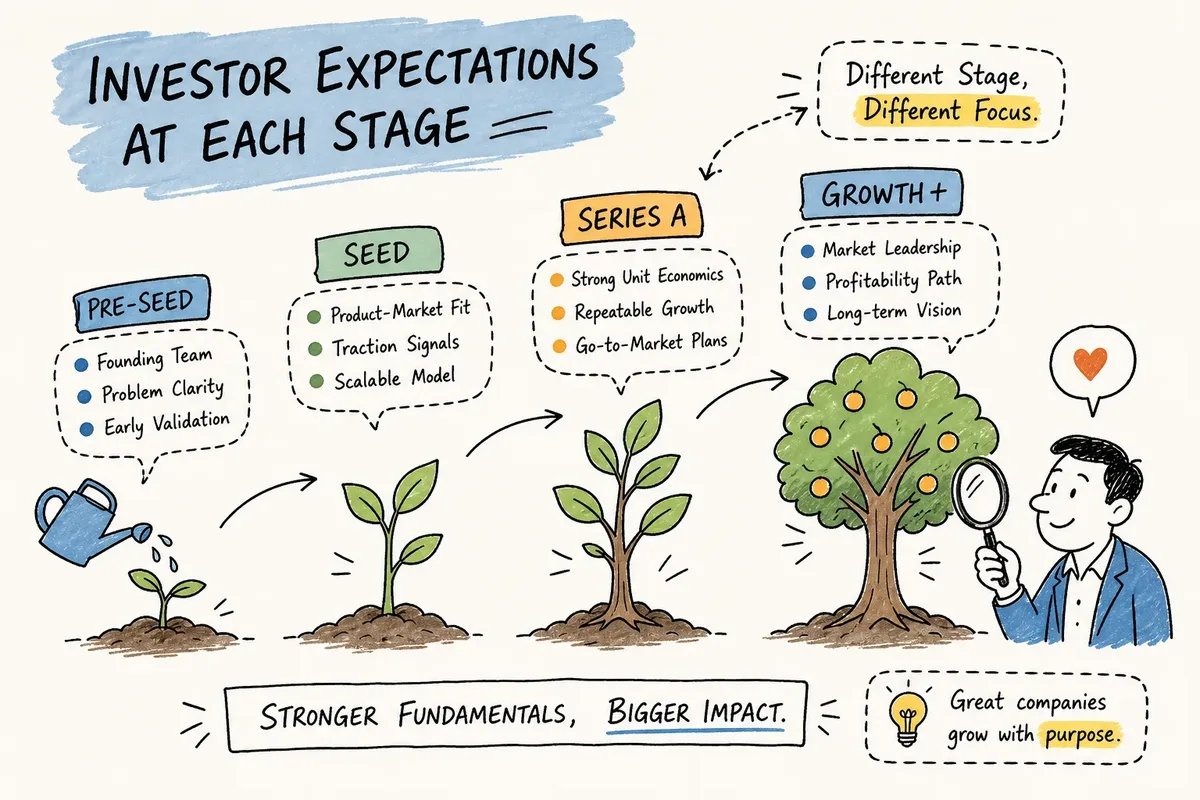
Understanding what investors expect at each startup funding stage is the difference between raising on a predictable timeline and circling the same meetings for twelve months without a term sheet. The truth is that investor expectations are not a mystery. They form a documented, predictable set of thresholds that shifts from founder potential at seed">pre-seed to proven unit economics at Series A and beyond.
The metrics investors screen for, the team signals they weigh, the documents they expect, typical check sizes, and how dilution compounds across rounds — at every stage from seed">pre-seed through Series A. By the time you finish reading, you will know exactly where your startup stands relative to the stage you are targeting.
Seed-stage MRR benchmark for SaaS — translating to $300K to $2.4M ARR with 2–3x YoY trajectory
ARR threshold investors expect before a credible Series A conversation — with 3x YoY growth and 12+ months cohort data
Team composition and founder-market fit
At seed">pre-seed, investors are primarily backing people, not products. They look for domain expertise, relevant operational background, and a balanced founding team — ideally an operator paired with a technical builder. Founder-market fit matters enormously here. A founder with ten years of supply chain experience building a logistics SaaS carries far more weight than a generalist who spotted the same gap.
Solo founders face additional scrutiny at this stage — a commonly reported investor preference, not an insurmountable barrier. Without a co-founder, you need to compensate with a strong advisory bench or unusually deep domain credibility. Every signal of operational credibility counts.
Complementary founding team where commercial and technical functions are covered by people with demonstrated track records in each. This is the most consistently funded team composition at seed">pre-seed.
Prior industry experience directly relevant to the problem — not just research about it. Investors want to understand why you are the person to solve this problem, not just that you identified it.
Strong advisory bench with relevant sector experience and domain credibility, plus unusually strong execution evidence to offset the missing co-founder signal investors typically look for.
Problem validation that replaces a revenue track record
The seed">pre-seed bar in 2026 has risen sharply compared to the zero-traction rounds that closed easily in 2021. A growing share of seed">pre-seed investors — particularly in India — now expect at least one paying customer, an active pilot, or a waiting list with verifiable demand before committing. Pre-revenue is not an automatic disqualifier, but pre-validation is now essential — and the two are not the same thing.
seed">pre-seed-capital" target="_blank" class="lr">Stripe — seed">Pre-seed capital for startups guide · seed">pre-seed-to-series-c" target="_blank" class="li">Startup funding stages explained: seed">pre-seed to Series C
Check sizes, instruments, and dilution at seed">pre-seed
SAFEs and convertible notes are the standard instruments at this stage, chosen for speed over structure. Understanding this range gives you a negotiating baseline rather than leaving you to accept whatever term sheet arrives first.
MVP maturity and product-market signals
By seed stage, a prototype is not enough. Investors expect a functioning MVP in the hands of real users — ideally paying users — with measurable engagement data behind it. What matters more than a polished product is evidence that users come back. A retention curve that flattens rather than drops to zero tells a seed investor far more than a raw download number or total sign-up count.
Cohort behaviour is the signal; the product is just the vehicle. Seed investors are asking three questions: Can you ship the product? Do customers care enough to return? And does the business model repeat at scale? All three need a credible answer before they write a cheque.
Traction benchmarks that seed investors screen against
Sources: Crunchbase 2024 · First Round Review · DocSend Annual Report 2024 · NASSCOM funding data
The shape of the retention curve and the consistency of revenue growth carry more weight than hitting a single specific number. A single strong quarter reads very differently from eight consecutive months of compounding growth.
Investor types and round structure at seed
Seed-stage VCs, super angels, and accelerators. Round sizes in India average $2M to $2.5M, compared to the global median of approximately $3M.
SAFEs, convertible notes, and preferred equity — with preferred equity becoming more common as round size increases above $2M.
seed-investors-vs-series-a-investors-which-investors-should-you-target" target="_blank" class="li">Seed investors vs Series A investors — which should you target?
ARR trajectory and product-market fit proof
Series A is the first institutional VC round, and the expectations shift sharply from traction signals to proven systems. Product-market fit is not a feeling at this stage — it shows up in specific, verifiable metrics. Investors are also watching the source of growth carefully. Revenue pulled by genuine market demand is valued differently from revenue pushed through founder-led sales heroics or unsustainable discounting.
Sources: First Round Review · OpenVC 2024 · Y Combinator Library · Crunchbase India data
Unit economics that Series A investors scrutinise
The underlying question investors ask about unit economics at every stage is the same: do the economics improve as you scale, or do they deteriorate? Clean, auditable data is not optional — investors will model these numbers independently from your deck, and inconsistencies between your slides and their model are an immediate red flag.
Team and operational structure for scale
At Series A, investors assess whether the founding team can lead a substantially larger organisation — not just a scrappy five-person startup. If the answer to "how do you grow revenue?" is "the CEO sells," that is a Series A red flag, not a feature.
seed-investors-vs-series-a-investors-which-investors-should-you-target" target="_blank" class="li">See: Seed investors vs Series A investors — full comparison
Check sizes, valuations, and dilution by stage: global vs India 2026
| Stage | Global round size | India round size | Global post-money valuation | India valuation (2026) | Typical dilution |
|---|---|---|---|---|---|
| seed">Pre-seed | $250K – $1.5M | $200K – $800K | $5M – $10M | $3M – $8M | 10–20% |
| Seed | ~$3M median | $2M – $2.5M avg | $10M – $25M | $8M – $18M | 15–25% |
| Series A | ~$15M median | $8M – $12M | $40M – $120M | $30M – $80M | 15–25% |
Sources: Crunchbase India 2024 · NASSCOM funding data · Dealroom funding stages guide · AI/SaaS India Series A valuations approaching $80M in current cycle
How dilution compounds across rounds
Founders typically give up 10–20% at seed">pre-seed, 15–25% at seed, and another 15–25% at Series A. After three rounds, maintaining above 50% founder ownership requires deliberate cap table management from the very first SAFE.
SAFEs convert at the priced round — which means early SAFE investors dilute founders more than the headline amount suggests if valuation growth between rounds is slow. A slow step-up can quietly cost founders additional percentage points at conversion that were not visible in the original terms. Venture debt at later stages can reduce equity dilution, but it introduces repayment obligations that require explicit cash flow planning.
Dealroom — Funding stages guide · seed">pre-seed-to-series-c" target="_blank" class="li">Startup funding stages explained
Documents and due diligence investors expect at each stage
seed">Pre-seed and seed documentation essentials
Having documentation ready at seed">pre-seed signals operational maturity beyond what the stage strictly requires. Investors notice — and it builds trust early in the relationship. Back-channel reference checks on founders are common at this stage, so professional networks and prior relationships carry real weight.
Series A: building a complete data room
Series A investors run a structured due diligence process. Founders who prepare this package before term sheet discussions shorten the diligence timeline from 6–8 weeks to 3–4 weeks — and signal that the business is already operating at institutional standards.
fundraising-readiness-checklist" target="_blank" class="li">See: The complete startup fundraising readiness checklist · Startup investor readiness: what VCs look for
How EzFunding's fundraising readiness score tells you exactly where you stand
The eight dimensions EzFunding evaluates
EzFunding's fundraising readiness score analyses a startup across eight critical dimensions — team composition, problem validation, product maturity, traction metrics, market size, business model, financials, and investor fit by stage and sector. Each dimension is scored against the benchmarks that investors at the founder's target stage actually use — not a generic checklist, but an assessment drawn from investor criteria across a verified network of VCs, angels, accelerators, and family offices.
Founder-market fit, domain credibility, co-founder balance, and problem validation evidence assessed against seed">pre-seed and seed benchmarks.
MVP maturity, retention curve shape, revenue consistency, and cohort behaviour scored against the exact thresholds investors at your stage screen for.
TAM methodology, SAM/SOM logic, revenue model naming, gross margin path, and scalability structure evaluated against investor pattern-matching criteria.
Unit economics, runway, burn, and cap table health — plus stage, sector, geography, and thesis fit against a verified investor network including VCs, angels, family offices, and accelerators.
Closing gaps before the first meeting
Most founders discover their readiness gaps the hard way: in investor meetings where they get politely declined and receive no useful feedback. The EzFunding readiness score surfaces those gaps before outreach begins — giving founders time to address them with data rather than assumptions.
If the score flags weak unit economics for a seed-stage SaaS startup, a founder can focus on improving CAC payback data or cohort retention before approaching investors who explicitly screen for those metrics. That targeted preparation meaningfully improves the odds that a first meeting leads to a term sheet rather than a request to return in six months.
The readiness score also feeds into EzFunding's AI investor matching, ensuring that every investor the platform recommends is compatible with the founder's current stage, sector, and metrics. The platform covers a broad network of verified investors — including VCs, angel investors, family offices, accelerators, and government grant programmes — so founders can explore non-dilutive funding options alongside equity investors within a single workflow.
How investor matching works · How to build an investor list that converts · fundraising-process-a-step-by-step-guide-for-founders" target="_blank" class="li">The startup fundraising process — step by step
Know the bar before you approach it
Investor expectations shift predictably across rounds: from team quality and problem validation at seed">pre-seed, to MVP traction and early unit economics at seed, to a repeatable growth engine and clean financials at Series A. Every stage has documented financial thresholds, specific team signals, and a defined set of documents that investors expect to see.
None of this is information kept from founders — it is simply information that most founders encounter too late. The founders who raise faster are not the luckiest. They are the most prepared. They know the fundraising milestones for their stage, they have the documentation ready before the first meeting, and they pitch investors whose stage fit, sector thesis, and check size actually align with where they are today.
Know exactly where you stand before your first investor meeting
Run my readiness assessment Get pitch deck feedbackReferences
- seed">pre-seed-capital" target="_blank" class="lr">Stripe — seed">Pre-seed capital for startups guide
- Dealroom — Startup funding stages guide
- Y Combinator Library — Fundraising and investor readiness resources
- First Round Review — Stage benchmarks and investor evaluation frameworks
- OpenVC Blog — Investor expectations and funding stage benchmarks
- fundraising-report" target="_blank" class="lr">DocSend — Annual Pitch Deck and Fundraising Report 2024
- NASSCOM — India startup funding data and ecosystem reports