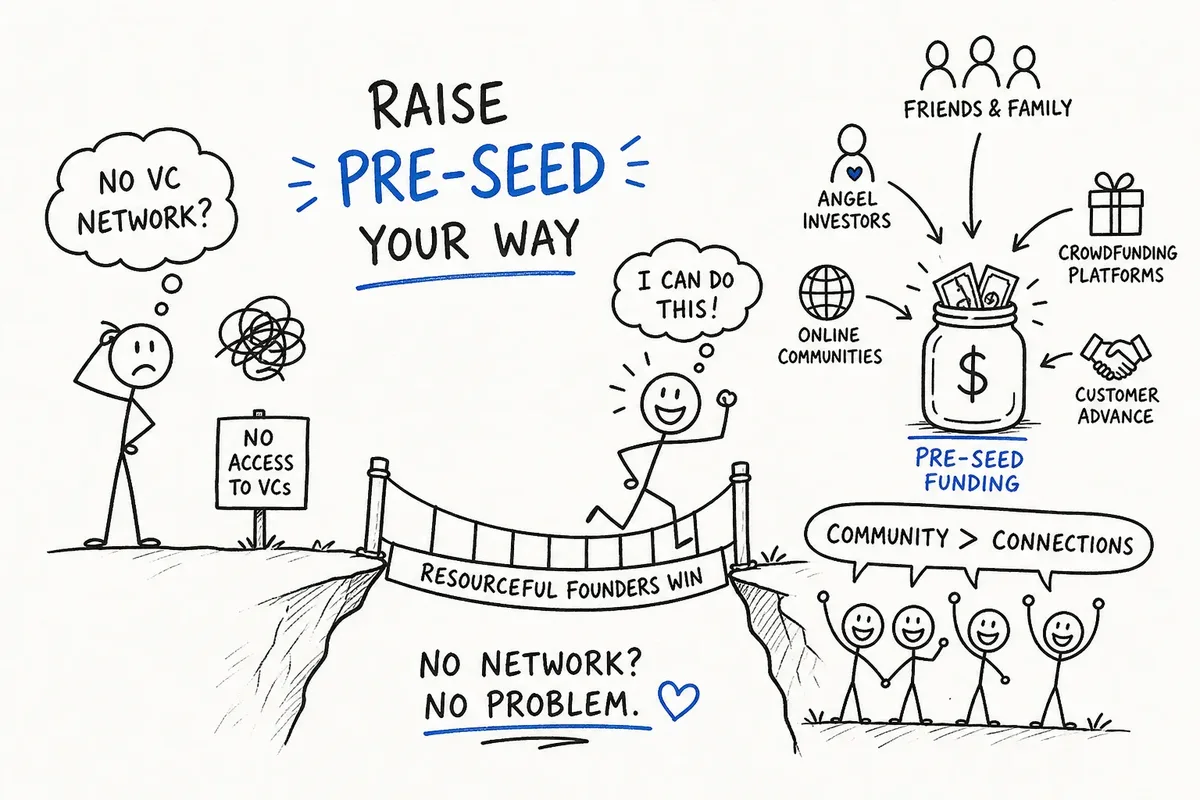
How to Raise seed">Pre-Seed Funding Without a VC Network
Every fundraising guide you find online starts with the same assumption: you have a friend who knows a VC, or a mentor who can make a phone call. Most Indian founders raising seed">pre-seed funding in 2026 don't have that. They have a sharp problem, a credible idea, and no warm introductions. This guide is built for that reality.
By the time you finish reading, you'll know exactly what seed">pre-seed funding is, how much to raise in the Indian context, which instruments to use, what investors are actually looking for at this stage, who the active players are, and how to reach them without a single warm connection. Done right, the entire process takes 3–4 months. Not years, not "when the timing is right."
What seed">Pre-Seed Funding Actually Is (And How It Differs From Seed)
seed">Pre-seed capital is the money you raise before you have a validated product or paying customers. Its purpose is to fund the build, not the scale. In India, this capital typically goes towards developing an MVP, running early pilots, and bringing on the first one or two people who can actually build the thing.
The distinction matters because investors at this stage are not evaluating a business; they are evaluating a founder's conviction and their read on a real problem. Seed funding in India now routinely requires some evidence of traction, a working product, and in many cases early revenue. Many first-time founders conflate the two stages and approach the wrong investors entirely — knowing which stage you are at before you send a single email saves months of wasted effort and protects your reputation in a market where word travels fast.
| seed">Pre-Seed | Seed | |
|---|---|---|
| Bar to clear | Validated problem, credible team, clear plan | Traction, working product, often early revenue |
| What's being funded | Building the MVP and running early pilots | Scaling what already works |
| What investors evaluate | Founder conviction and problem insight | The business itself |
How Much to Raise and Which Instrument to Use
seed">Pre-Seed Funding: How Much Is Realistic in India?
Indian seed">pre-seed rounds in 2026 generally fall between ₹25 lakh and ₹2 crore (roughly $30K to $250K), with most lean startups raising in the ₹25–50 lakh range. Capital-intensive sectors like deep tech or biotech tend to push towards the upper end of both the raise and the dilution range, while software-first startups often need far less to reach their first proof point.
Typical Raise
₹25 lakh – ₹2 crore (~$30K–$250K)
Post-Money Valuation
Typically $3M – $7M
Dilution
Commonly 5–20%; capital-efficient software startups often at 10% or less
Dilution at this stage is commonly reported in the 5–20% range, considerably lower than typical US seed">pre-seed norms. For broader context on funding round norms and what to expect, see this seed">pre-seed-seed-a-and-b" style="color:#7a5cff; text-decoration:underline;">analysis of startup funding rounds.
seed">Pre-Seed Funding Instruments: SAFE vs. Convertible Note
SAFE notes dominate Indian seed">pre-seed rounds for good reason: they carry no interest rate, no maturity date, and close faster than any other structure. A standard SAFE at this stage typically includes a valuation cap of ₹10–30 crore, a discount rate of 15–25% on the next priced round, and pro-rata rights for the investor, though exact terms vary by deal and investor.
| Instrument | Characteristics |
|---|---|
| SAFE Note | No interest, no maturity date, fastest to close; valuation cap ₹10–30 crore, 15–25% discount, pro-rata rights common |
| Convertible Note | Used occasionally when an investor prefers a loan structure; adds legal complexity and slows timelines |
| Priced Equity | Rare at seed">pre-seed in India; usually reserved for founders with unusually strong negotiating leverage |
What seed">Pre-Seed Investors in India Actually Look For
Genuine seed">pre-seed investors are not scanning your deck for MRR or DAU numbers. They are looking for founder-market fit and a sharp, defensible view of the problem. The question in every investor's mind is whether this founder has the domain expertise, the conviction, and the execution ability to build something worth backing.
A founder who has spent five years inside a broken industry and can articulate precisely why existing solutions fail is more fundable at seed">pre-seed than one with a polished slide deck and no real insight. Because hard metrics are not yet expected, investors substitute other signals.
Signals that carry genuine weight in place of hard metrics:
- •Letters of intent from potential customers
- •Waitlist signups or pilot results
- •A working prototype demonstrating technical credibility
- •A clear 12–18 month milestone roadmap showing how the capital moves you towards seed-fundable territory
Founders who can answer the question "what does this money unlock?" in concrete terms close rounds faster than those who present a vague growth narrative built around aspirational numbers. For a deeper look at how VCs actually assess readiness, see this investor readiness guide.
Who Actively Invests in seed">Pre-Seed Startups in India
India's seed">pre-seed ecosystem has matured considerably. Several funds are among the most active at this level, each with a distinct sector or geography thesis:
ajvc
SEBI-regulated, known for closing investments in under three weeks
Eximius Ventures
Active at the pre-product stage, typically writing cheques in the $500K–$1M range
Better Capital
Active at seed">pre-seed with a documented, stage-specific thesis
Sending the same pitch to all of them is ineffective. The right approach is to match your startup's profile to each fund's actual portfolio and stated investment criteria before you reach out. A useful india" style="color:#7a5cff; text-decoration:underline;">directory of funds investing in India can help you narrow the initial list to those who actually write seed">pre-seed cheques.
Individual angel investors remain the fastest source of early-stage funding in India, typically writing cheques of $25K–$100K. Angel networks — for example, Indian Angel Network, LetsVenture, and Ah! Ventures — aggregate these investors and can reduce the cold outreach barrier, though founders should verify each network's current activity and focus areas before approaching them.
Accelerators such as Y Combinator, Techstars, and India-specific programmes like Nasscom 10,000 Startups offer a combination of capital, mentorship, and a built-in investor community that is particularly valuable for founders without existing connections. Government schemes, including the Startup India Seed Fund, provide non-dilutive options worth exploring alongside equity funding, especially for founders who want to preserve their cap table at this early stage.
How to Find Investors When You Have No Warm Network
The standard advice to "get a warm introduction" is simply useless if you are new to the ecosystem. The real problem with cold outreach isn't that it's cold; it's that it's usually untargeted. A founder sending the same email to 200 investors, regardless of stage preference, sector focus, or geography, is generating noise rather than a pipeline. The investors who fund seed">pre-seed rounds in India have specific theses, and reaching them without understanding those theses wastes everyone's time and damages your standing in a market where investor conversations happen in small circles.
Targeted outreach changes the equation. Tools built specifically for early-stage fundraising — including platforms that match founders to verified investors by funding stage, sector thesis, geography, and cheque size — exist precisely to solve this problem. Learn more about how this kind of matching works in this guide to finding investors in 2026.
EzFunding is one such platform: it is designed to help seed">pre-seed founders identify relevant angels, micro-VCs, accelerators, and grant programmes, and to build personalised outreach that reflects each investor's known portfolio and preferences. For founders without a warm network, this kind of targeting is the closest practical substitute for a genuine introduction, compressing weeks of manual research into a structured, prioritised list.
Outreach Cadence: How to Structure Your Investor Conversations
Once your list is built, treat outreach as a campaign, not a one-off:
- •Send in batches of 15–20 per week so you can learn from early responses and refine your messaging
- •Follow up once after seven days if there is no response
- •Two touches per investor is a reasonable limit before moving on; a third follow-up can damage your reputation in a small ecosystem
- •Track every conversation — investor name, stage, last contact, next step — in even the simplest CRM spreadsheet
Pipeline visibility is what separates founders who close quickly from those who stall mid-process. For a structured approach to building that pipeline, see this guide on building an investor list that actually converts.
A Practical Timeline to Close Your seed">Pre-Seed Round
A well-run seed">pre-seed process in India takes 3–4 months from the start of preparation to receiving funds. Founders using a verified investor network can sometimes compress this to 6–8 weeks. For more detail on realistic fundraising timelines in India, review this fundraising-timeline-india-2026" style="color:#7a5cff; text-decoration:underline;">fundraising timeline.
Founders who begin outreach only when they are running low on personal savings have no negotiating leverage and often accept unfavourable terms under pressure. Waiting for one investor to commit before approaching the next eliminates the competitive dynamics that accelerate decisions.
A simple CRM spreadsheet tracking every investor, their stage, the last point of contact, and the next step transforms a chaotic process into a manageable pipeline. The founders who close quickly are not the ones with the best ideas; they are the ones who treat fundraising as a structured sales process.
Pitch Deck Checklist: What to Prepare Before Outreach
Here is what the preparation phase looks like in concrete terms. For a deeper walkthrough of getting the deck itself right, see this guide on structuring a pitch deck that gets investor meetings.
Pitch Deck
10–12 slides covering problem, solution, market size, business model, traction signals, team, and the specific ask
One-Pager
A single-page summary written to earn a reply rather than close a deal
Investor List
50–75 investors filtered by stage, sector, geography, and cheque size before any outreach begins
The Path Forward Is a Process, Not a Network
seed">Pre-seed funding in India is accessible to founders who understand the stage, the instruments, and the investors who are genuinely active at this level. You don't need a warm network to raise a first round of funding; you need a targeted approach, materials that demonstrate founder credibility, and access to investors who are actually looking for what you're building.
The founders who struggle for nine months are not worse than the ones who close in three. They are simply less organised, less targeted, and starting too late. Treat your fundraise as a parallel function to your product work, not something you do when the runway is already short, and the outcomes shift substantially.
Tools built for this purpose exist specifically to close the access gap for founders without established networks. Platforms that match seed">pre-seed startups to verified investors by stage, sector, and geography mean that every outreach you send can be relevant from the first line. EzFunding is designed with exactly this brief in mind: helping Indian founders without a warm network find, prioritise, and reach the right investors for their stage and sector.
Find Your seed">Pre-Seed Investors on EzFunding
Start with a clear problem, a credible team, and a specific ask. The rest is a process you can run.
seed">pre-seed-investors" style="display:inline-block; font-weight:700; font-size:15px; text-decoration:none; padding:14px 28px; border-radius:8px; background-color:#7a5cff; color:#ffffff; font-family:Arial,Helvetica,sans-serif;">Explore seed">Pre-Seed Investors