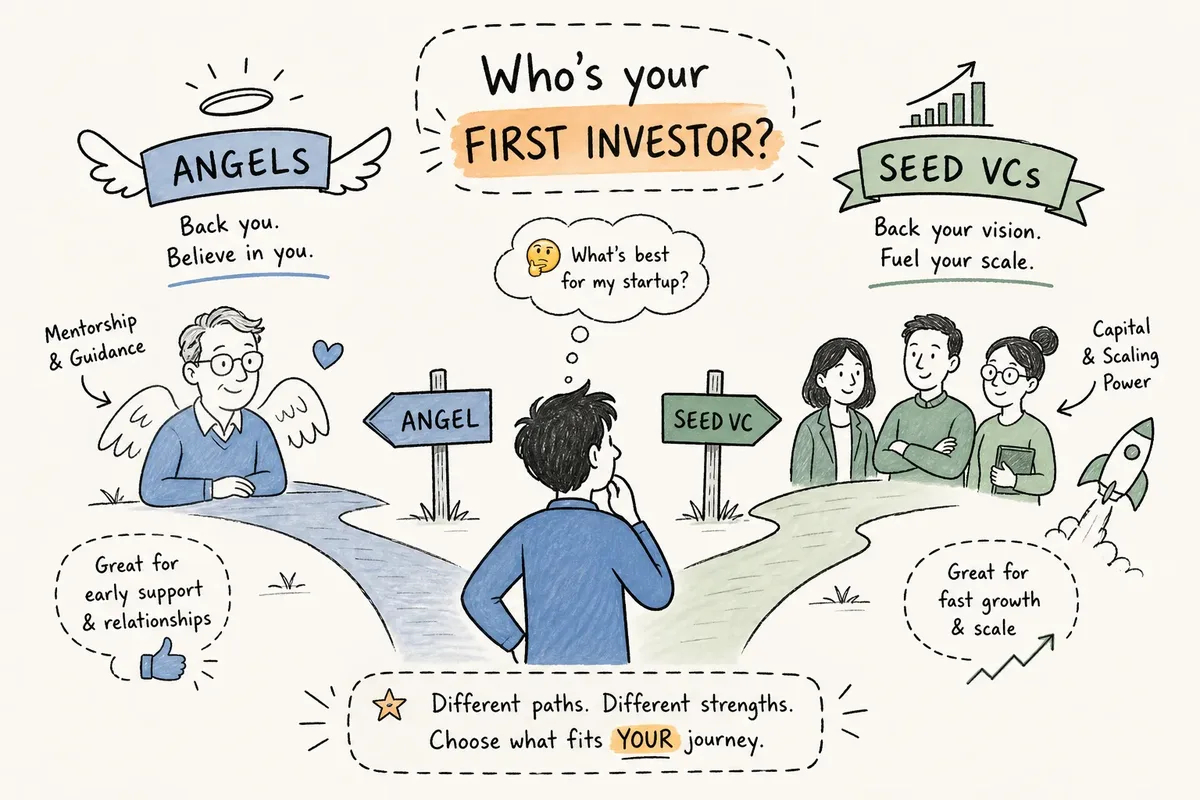
If you are asking "Should I approach angels or VCs for my seed round?", you are already asking the right question — but the answer depends entirely on your specific situation.
One person in your network says go straight to a seed VC. Another says build your angel network first. Both sound credible, both cite founders who did exactly that, and neither gives you a clear reason why one path fits your circumstances.
The choice is not simply about who will say yes fastest. It is about how much you are raising, how much of your cap table you are willing to give away, what kind of support you will need over the next 18 months, and whether you need a named lead investor to make the round work at all. This article answers the angels-versus-VCs question from first principles rather than received wisdom.
If your raise is under ₹4Cr and your sector requires deep domain credibility, lead with angels. If your round requires a single institutional anchor, you have traction data, and your growth will demand follow-on capital within 18 months, target seed VCs first. A hybrid approach — angels filling a SAFE bridge while a VC lead is being cultivated — is often the most pragmatic answer for founders between these two profiles.
Average US angel deal size — representing multiple angels pooling into a single round, not one person writing a single cheque
Seed VC cheque range in India — from micro-VC first cheques to established seed funds, each with different thesis requirements
Absolute dilution ceiling at seed — anything above this creates compounding cap table problems by Series A that are difficult to recover from
Of VC pitch meetings result in a term sheet — making investor-stage alignment before outreach begins a material efficiency driver
Start with cheque size: the fastest filter in this decision
The amount you are raising is the most practical first filter. Individual angels and seed VCs operate in fundamentally different cheque-size ranges — and approaching the wrong type for your round size wastes everyone's time regardless of pitch quality.
Sources: AngelList Global Investment Report 2024 · NASSCOM India Startup Funding Report · Crunchbase Seed Round Benchmarks 2024
If you are raising under $500,000 (roughly ₹4Cr), aggregating angels through a syndicate or rolling close is entirely viable. The numbers only start to favour seed VCs once the round size requires a single institutional commitment to work. The micro-VC trend in India is worth noting: as traditional angels have pulled back from seed">pre-seed, micro-VCs have become the default first institutional cheque for Indian founders — sitting between the traditional angel and the established seed fund in both cheque size and process rigour.
seed-investors-vs-series-a-investors-which-investors-should-you-target" class="li">Seed investors vs Series A investors — which to target · seed">pre-seed-to-series-c" class="li">Startup funding stages explained
Dilution and control: who sets your terms at seed stage
Beyond cheque size, the structural differences between angel rounds and VC-led rounds affect your cap table, governance, and operating autonomy for years after the initial close.
| Dimension | Angel round | Seed VC round |
|---|---|---|
| Typical dilution | 10–20%; most seed">pre-seed rounds 10–15% for sub-₹4Cr | Median ~20%; ceiling at 25% — treat as absolute limit |
| Instrument | SAFE or convertible note — lighter documentation, faster close | Priced round with protective provisions — more structure |
| Board seat | Typically no formal governance rights or board positions | Almost always includes board seat or observer seat |
| Operating autonomy | High — more breathing room for early-stage experiments | Lower — regular reporting cadence expected from close |
| Follow-on signalling | Weaker — no named VC can make Series A harder to attract | Stronger — recognised VC name opens doors with future investors |
| Cap table complexity | Higher if many angels — multiple parties signing separately | Cleaner — single institutional lead simplifies future rounds |
Treat 25% as an absolute dilution ceiling at seed. Anything above that creates compounding cap table problems by Series A that are difficult to recover from — each subsequent round dilutes from a smaller founder base, making it harder to maintain meaningful ownership through to exit. Control now versus signalling strength later is a tension worth naming directly: it shapes every conversation you will have with investors across the life of the company.
india-what-founders-need-to-know" class="li">Angel investors in India — what founders need to know · What investors expect at each funding stage
Speed of close: what actually slows each path down
The common assumption is that angels are faster. This is rarely true in practice — and the reasons are structural, not personal. Understanding the real timeline for each path prevents founders from making decisions based on a myth of angel speed.
The angel aggregation problem
Angel rounds do not close slowly because angels are indecisive. They close slowly because of the aggregation problem. A ₹3Cr angel round at ₹30L per cheque requires ten committed investors, each of whom signs documents and wires separately. The most common failure mode is having no named lead investor to anchor the round — which signals risk to every subsequent angel. Founders should plan for six to eight months minimum from first conversation to fully closed.
The VC funnel is narrow but predictable
Industry data on VC deal conversion rates · Total timeline from first pitch to close: 6–9 months, with formal due diligence taking a minimum of 3 months once a term sheet is issued
The upside is that once a lead VC commits, the round usually closes cleanly — their endorsement brings other investors in quickly, and the process becomes more predictable. The downside is that the path to that first yes is narrow and slow. Founders who understand this build pipeline accordingly: approaching 20–30 well-matched VCs simultaneously rather than sequentially.
fundraising-process-a-step-by-step-guide-for-founders" class="li">The startup fundraising process — step by step · How to build an investor list that converts
What each investor type actually delivers beyond the cheque
Usually former operators or domain specialists. They understand your problem space intuitively and can provide mentorship, customer introductions, and honest strategic feedback without the ROI pressure that makes institutional investors cautious. For founders in niche sectors — deeptech, agri, healthtech — a domain-expert angel with 20 years in the space is often more valuable than a generalist VC with a larger cheque.
Bring resources angels cannot replicate: structured hiring pipelines, warm introductions to future Series A investors, and dedicated portfolio support teams. Established seed VCs typically reserve 40–50% of their fund for follow-on in winning portfolio companies — meaning the capital relationship compounds. A recognisable seed VC name opens doors with customers, enterprise partners, and future co-investors.
Sector-expert angels can compress months of investor education into a single conversation. They have lived through the problems you are solving, know the incumbents personally, and can make customer introductions that a generalist VC simply cannot.
Angels typically do not take board seats or formal governance rights. Founders can engage more openly — including sharing early struggles — without the reporting cadence and governance pressure that accompanies an institutional investor from day one.
Seed VCs reserve 40–50% of their fund for follow-on in winning portfolio companies. For founders who will need significant capital within 18 months, this reserved follow-on is a meaningful risk reducer that no angel network can replicate.
Four founder archetypes and who to call first
When to choose angels vs seed VCs: the decision framework
- Raise is under ₹4Cr and fits within angel cheque aggregation
- Sector requires deep domain credibility to be understood quickly
- Operating autonomy is a priority over institutional signalling
- No named lead investor is required to anchor the round
- Time to next raise exceeds 18 months at current burn
- Round requires a single institutional anchor to be credible
- Traction data (MRR, retention, growth rate) reduces perceived risk
- Growth trajectory demands follow-on capital within 18 months
- Series A signalling from a named VC matters for future rounds
- Hiring pipeline and portfolio network are immediate operational needs
fundraising-readiness-checklist" class="li">Startup fundraising readiness checklist · Startup investor readiness: what VCs look for
How EzFunding helps founders make the right choice — and reach the right investors
The honest problem with the angels-versus-VCs debate is that founders rarely know, before outreach begins, which specific angels or seed VCs are actually aligned with their stage, sector, and geography. A founder in Pune building a B2B SaaS for Tier 2 retailers should not be pitching the same investors as a consumer fintech founder in Mumbai.
EzFunding addresses this by running compatibility scoring across both angel and VC profiles — flagging which investors carry the right sector thesis, cheque size, and stage appetite for a specific startup. Running that analysis before sending outreach emails means the first meetings are with people who are already likely to be interested, not simply available.
Scores alignment across stage, sector, geography, check size, and thesis simultaneously — across both angel and VC profiles in a single workflow.
Surfaces investors who are actively deploying at your exact stage right now — not historical portfolio data or dormant registered accounts.
Generates personalised first emails and follow-up sequences for each matched investor, tailored to their known thesis and recent portfolio history.
Runs a pre-outreach diagnostic to tell you whether your current metrics position you for angels, micro-VCs, or seed VCs — before you approach the wrong investor type.
Investor matching explained · How to find investors for your startup · How AI helps startups find investors faster
The decision that fits your startup — not someone else's
The question of whether to approach angels or VCs for your seed round does not have a universal answer. It has a right answer for a specific founder, at a specific stage, with a specific set of constraints. Cheque size, dilution tolerance, speed requirements, value-add priorities, and founder archetype are not a rigid formula — they are a working framework.
Use them to treat fundraising as an analysis exercise first and a networking exercise second. The founders who raise efficiently are usually the ones who do the compatibility work upfront — whether through careful manual research or a platform like EzFunding that does the matching for them. The goal is not to pick angels or VCs as a category. The goal is to find the right investors, whichever category they fall into, and reach them with a pitch that speaks directly to what they care about.
Find the right investors for your stage — angels or VCs
Match me with investorsGet pitch deck feedback firstReferences
- Y Combinator Library — Seed fundraising and investor type guidance
- First Round Review — Angel vs VC fundraising frameworks
- fundraising-report" target="_blank" class="lr">DocSend — Annual Fundraising Report 2024 (VC conversion funnel data)
- NASSCOM — India startup angel and seed funding benchmarks
- Tracxn — India seed and angel investment data 2024