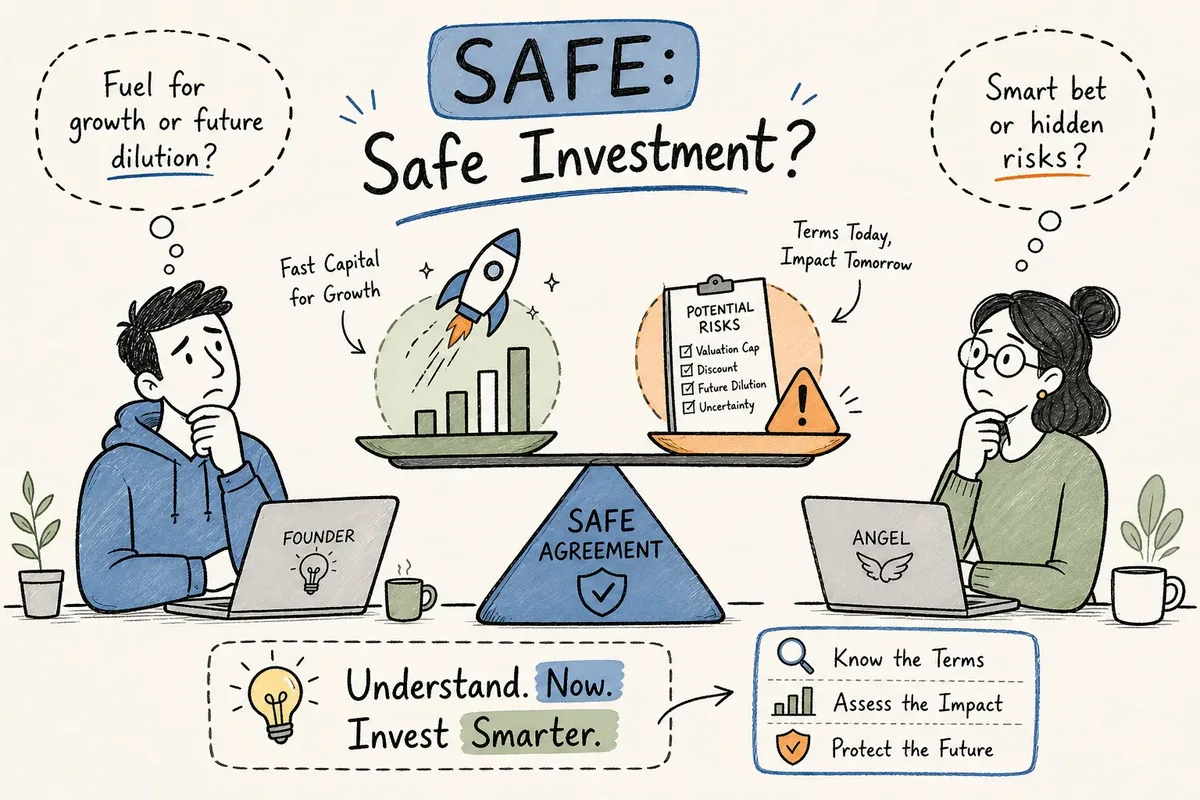
Y Combinator coined the term SAFE — Simple Agreement for Future Equity — and the word "simple" is doing a great deal of work. For founders raising their first round and for angels cutting early cheques, a SAFE is often the first instrument they encounter, and the one most likely to be misread. The name itself creates a quiet assumption: that this is a straightforward, low-risk path to capital.
It is straightforward in structure. But "simple" is not the same as "risk-free" — and the distinction matters enormously by the time a Series A closes. Before treating a SAFE as a safe investment option, both founders and angels need to understand what the instrument actually promises, what it quietly defers, and where the real exposure sits.
The Post-Money SAFE Has Become the Standard
Y Combinator shifted the standard from pre-money to post-money SAFEs in 2018. With post-money, an investor putting in ₹50 lakhs at a ₹5 crore cap holds exactly 10% from day one. With pre-money, ownership remained unknown until conversion because it depended on how much other money was raised. Source: YC / SAFE deal structure analysis, early-stage venture data 2024.
What a SAFE Note Actually Is
A SAFE is not a loan, not equity, and not a binding promise of shares. It is a contractual right to receive equity in a future priced round, triggered by a qualifying financing event. Until that event occurs, the SAFE holder has no ownership stake, no voting rights, and no governance input.
The Case for SAFE: What Founders Actually Gain
No Interest Rate
Every rupee raised stays in the business rather than compounding quietly as debt
No Maturity Date
No hard deadline that forces a conversation about extension or repayment if the next round takes longer than expected
Fast Closing
A few pages of documentation, dramatically lower legal fees than a priced round; individual SAFEs close as each investor signs
Clean Cap Table
No formal equity position until conversion; hires and advisors receive options without negotiating around multiple equity classes
The Angel's Case: Where the Real Upside Sits
How the Valuation Cap Rewards Early Risk
This is how early risk is rewarded: the cap ensures the angel captures the upside from backing the company before it had traction. Without pro-rata rights, however, an angel holding 8% at conversion may see that stake diluted to 3–4% after Series A without the contractual right to put more money in alongside the new lead.
Founder-Side Risks That Often Go Unnoticed
The Cumulative Dilution Trap
Where Multiple SAFEs Leave Founders at Series A
A level that can leave insufficient equity for an institutional Series A lead and derail the round entirely. Founders must stress-test cumulative cap table impact before issuing a second or third SAFE. Source: SAFE deal analysis from early-stage venture data; cap table modelling practitioner guidance.
Low Valuation Cap Surprises at Conversion
A founder grateful for a ₹25 lakh cheque from an angel at a ₹2 crore cap may later discover that conversion at Series A delivers that angel a much larger ownership stake than expected, particularly if the company's valuation has grown significantly in the intervening period. The maths are fixed from the day the SAFE was signed — the founder simply didn't model the outcome at the time.
MFN Clause Compounding Risk
If a subsequent SAFE is signed on better terms, the MFN clause in an earlier agreement entitles the earlier investor to upgrade their terms retroactively, amplifying dilution beyond what the founder anticipated. Cap table complexity from multiple SAFEs with varying terms also creates hesitation among institutional investors conducting Series A diligence, who may require simplification before proceeding.
What Angels Must Evaluate Before Writing a Cheque
Conversion Dependency Risk
A SAFE only converts if a qualifying financing event occurs. If the company never raises a priced round, capital may sit unconverted indefinitely. There is no maturity date to force a resolution.
Liquidation Priority Risk
In a dissolution or acquisition before a priced round, unconverted SAFE holders have no liquidation preference. Capital recovery may be partial or zero.
Cap Negotiation Risk
Set too high: protection is weak; angel converts at essentially Series A price, negating the point of early risk. Set too low: founders resent the dilution at conversion, creating relationship friction at the wrong moment.
Angels should assess whether the startup is on a credible path to a qualifying financing event. Skipping genuine diligence on the team, traction, and fundraising trajectory can leave capital tied up indefinitely in an instrument that never reaches its trigger. For Indian angels in particular, where early-stage exit liquidity remains constrained, this risk deserves careful attention before signing.
How to Find SAFE-Experienced Investors and Founders Worth Backing
Working with a counterpart who understands the instrument removes significant friction. A founder who can explain the post-money mechanics, articulate the cap table at conversion, and model dilution scenarios at Series A is a founder who is thinking about the business seriously. That clarity is itself a signal worth weighting in diligence.
For founders raising a seed">pre-seed SAFE round, identifying angels already comfortable with the instrument — scored against your stage, sector, and geography — removes the education overhead that slows down first-time fundraises. See how investor matching works in Investor Matching Explained and india-what-founders-need-to-know" style="color:#7a5cff;font-weight:600;text-decoration:underline;">Angel Investors in India: What Founders Need to Know, and build the right list first with How to Build an Investor List That Actually Converts.
The Honest Verdict
SAFE: What It Is vs. What It Isn't
What It Is
Simple, fast, debt-free early financing. Removes maturity pressure. Clean documentation. Practical for founders moving quickly at seed">pre-seed.
What It Isn't
Not a safe investment in the capital-preservation sense. Not risk-free for angels. Not a guarantee of equity. Founders carry dilution risk; angels carry conversion dependency and liquidation exposure.
The right counterpart matters as much as the terms on the page.
Find SAFE-Ready Investors →References
- Y Combinator: SAFE Documentation and Templates
- SEBI: CCPS Regulatory Framework (India)
- Carta: SAFE Notes Explained
- Startup India Portal (DPIIT)
- early-stage-investments/" style="color:#7a5cff;text-decoration:underline;">First Round Review: Evaluating Early-Stage Investments