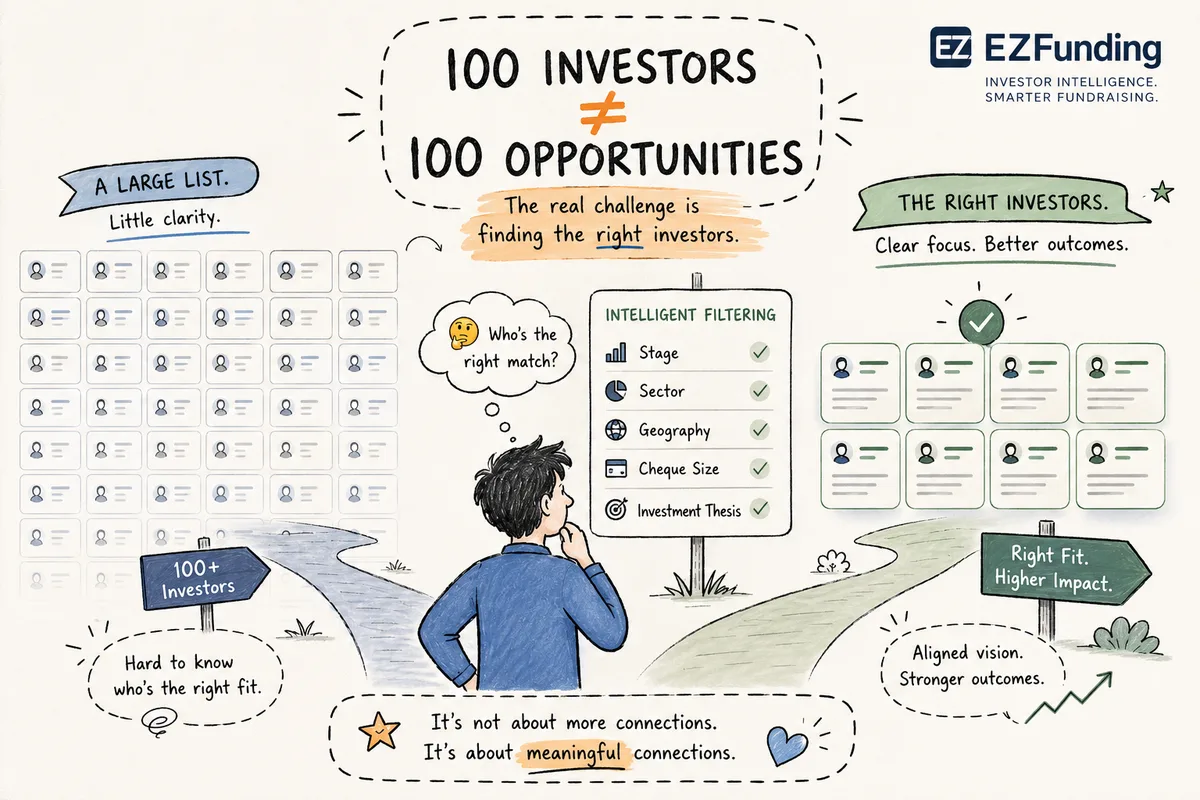
India's startup ecosystem has thousands of investors, but founders don't need thousands of names. They need to understand who is investing, where they're investing, what stage they're targeting, and what types of startups they're backing.
This is a research and insight page, not a directory dump. It walks through the current funding data, what investor activity actually tells us, a preview of investor-level intelligence, and a simple framework for deciding who to approach first.
1. India Funding Landscape — 2026
India's tech startups raised $11.7 billion in FY 2025–26, an 18% decline from $14.3 billion in FY 2024–25, though still 20% higher than the $9.7 billion raised in FY 2023–24, according to Tracxn's India Tech Annual Funding Report 2026. The first half of 2026 alone brought in roughly $7.4 billion across 501+ deals, per Entrackr's H1 2026 tracker — the strongest first half since 2022.
$11.7B Total funding, FY 2025–26 | $7.4B Raised in H1 2026 (501+ deals) | $484M Seed capital, H1 2026 (202 deals) | $1.03B Series A capital, H1 2026 (127 deals) |
Stage | Capital Raised (H1 2026) | Deal Count |
|---|---|---|
$41.3M | 79 | |
$483.9M | 202 | |
Pre-Series A | $175.2M | 64 |
$1.03B | 127 | |
$2.54B | 57 |
Sector-wise, Q1 2026 deal data (Entrackr) shows a clear skew: AI led with $1.48B across 51 deals (38.3% of total capital), followed by fintech ($538.2M, 34 deals), healthtech ($290.3M, 35 deals), e-commerce ($188M, 44 deals), and deeptech ($105.8M, 28 deals). Emerging categories worth watching include climate tech and EV infrastructure, both gaining momentum on the back of government incentives and rising consumer demand, per Startup Reporter's Q1 2026 coverage.
Sources: india-tech-annual-funding-report-fy-2025-2026/__bWhXNDL19uUgmF-ED7axBlmbGfcJ2AEuVTbkQiUWFRM">Tracxn India Tech Annual Funding Report FY 2025–26 · Entrackr H1 2026 Funding Report · early-stage-deals-11445029">Entrackr Q1 2026 Report
2. What Investor Activity Tells Us
The headline numbers matter less than the pattern underneath them:
Capital is becoming more selective. Deal count has fallen even in periods where total dollars rose, meaning fewer startups are absorbing larger cheques rather than capital spreading thin across many bets.
Seed and later-stage funding are moving on different clocks. Seed-stage capital held at roughly $484M across 202 deals in H1 2026 — the highest deal count of any stage — while Series B pulled in $2.54B across just 57 deals. Early-stage investors are writing more, smaller cheques; growth-stage investors are concentrating capital in fewer, larger bets.
Certain sectors are attracting disproportionate attention. AI alone accounted for over a third of all capital deployed in Q1 2026, and unit economics — not just growth rate — now determines whether a SaaS or consumer startup gets funded at all.
🔑 Key Insight
Fewer deals, bigger cheques, sharper sector concentration — the data points to a market where investor fit matters more than investor count. Pitching broadly to whoever is on a list is less effective in 2026 than it was two years ago.
3. Investor Intelligence
Below is a preview of how investor-level intelligence breaks down — stage, sector, cheque range, geography, and recent activity in one view.
Investor | Stage | Sector | Geography | Recent Activity |
|---|---|---|---|---|
Seed–Growth | Active | |||
Consumer Tech, SaaS | Active | |||
Active | ||||
Active |
Preview only — cheque ranges, thesis notes, and portfolio history are available in the full database.
Want the complete investor intelligence database?
Sign up to access the full investor insights — stage, sector, cheque size, geography, and recent activity for every investor in the database.
4. Investor Insights by Stage
seed">Pre-Seed
79 seed">pre-seed deals closed in H1 2026 for $41.3M — the smallest pool by dollars but a critical proof-of-concept stage. Active seed">pre-seed backers look for a working prototype, an initial user cohort, and a founder who can clearly articulate the problem. See who's currently active on the seed">pre-seed-investors">seed">pre-seed investors list.
Seed
Seed held the highest deal count of any stage in H1 2026 — 202 deals for $483.9M — showing that seed capital remains available even as later stages tighten. Investors at this stage weigh early traction and retention data over revenue alone. Explore current activity on the seed-investors">seed investors list.
Series A
Series A brought in $1.03B across 127 deals in H1 2026. The bar has moved: investors increasingly expect $1M–$3M ARR and a repeatable go-to-market motion before they'll engage, and fewer than half of seed-funded startups make this jump on their first attempt. Review who's writing these cheques on the Series A investors list.
✅ Founder Tip
Don't raise a stage ahead of your metrics. Series A investors in 2026 are underwriting fewer, larger bets — showing up early with thin traction slows the process and weakens your terms rather than accelerating them.
5. Investor Insights by Sector
AI — the largest single category by capital in 2026, at 38.3% of Q1 deal value; investors expect a defensible data or distribution advantage, not just a model wrapper.
saas-investors">SaaS — still active, but now gated by unit economics: sub-12-month CAC payback and a 3:1+ LTV:CAC ratio.
fintech-investors">FinTech — the second-largest sector by Q1 2026 capital ($538.2M), anchored by lending, payments, and wealth management.
HealthTech — $290.3M across 35 Q1 2026 deals, with continued consolidation activity through acquisitions in H1 2026.
deeptech-investors">DeepTech — a smaller but growing pool ($105.8M, 28 Q1 deals), often overlapping with AI infrastructure plays.
ClimateTech — an emerging category gaining investor attention on the back of government incentives and rising demand for EV and battery infrastructure.
Consumer / D2C — harder to fund without gross-margin discipline; undifferentiated D2C brands and horizontal marketplaces struggled to attract capital in early 2026.
📊 Market Insight
The gap between AI's 38.3% share of Q1 2026 capital and every other sector isn't a temporary spike — enterprise AI adoption in India has moved from pilots to production, and regulatory clarity is improving. Founders outside AI need a sharper differentiation story to compete for the remaining capital pool.
6. What Founders Should Look For
A simple framework for prioritising who to approach first:
1 | Stage fit — are they actively deploying at your stage right now? |
2 | Sector fit — does your category match their last 10–20 deals? |
3 | Cheque fit — can their typical ticket size meaningfully move your round? |
4 | Geography — do they invest in your market, or would this require a cross-border relationship they don't typically build? |
5 | Thesis — is there a stated or observable investment thesis your startup genuinely fits? |
6 | Portfolio — do their existing portfolio companies signal genuine conviction in your category, or a one-off bet? |
7 | Recent activity — have they closed a deal in the last 6–12 months, or gone quiet? |
For more on building a targeted shortlist rather than a mass list, see how to build an investor list that actually converts and investor matching explained.
7. India Startup Investor List 2026
This is the resource section — a living, continuously updated list spanning angel investors, VCs, and growth-stage funds active in India, filterable by stage, sector, geography, and recent deal activity. You can also track who's leading the market through EzFunding's most active investors ranking and fastest-growing investors ranking.
Want the complete list?
Get access to the investor database and ongoing investor intelligence, updated as the market moves.
Sign Up for Investor Intelligence →
8. About EzFunding
EzFunding helps founders research, identify, and prioritise relevant investors using investor intelligence and startup-specific matching. Explore EzFunding →