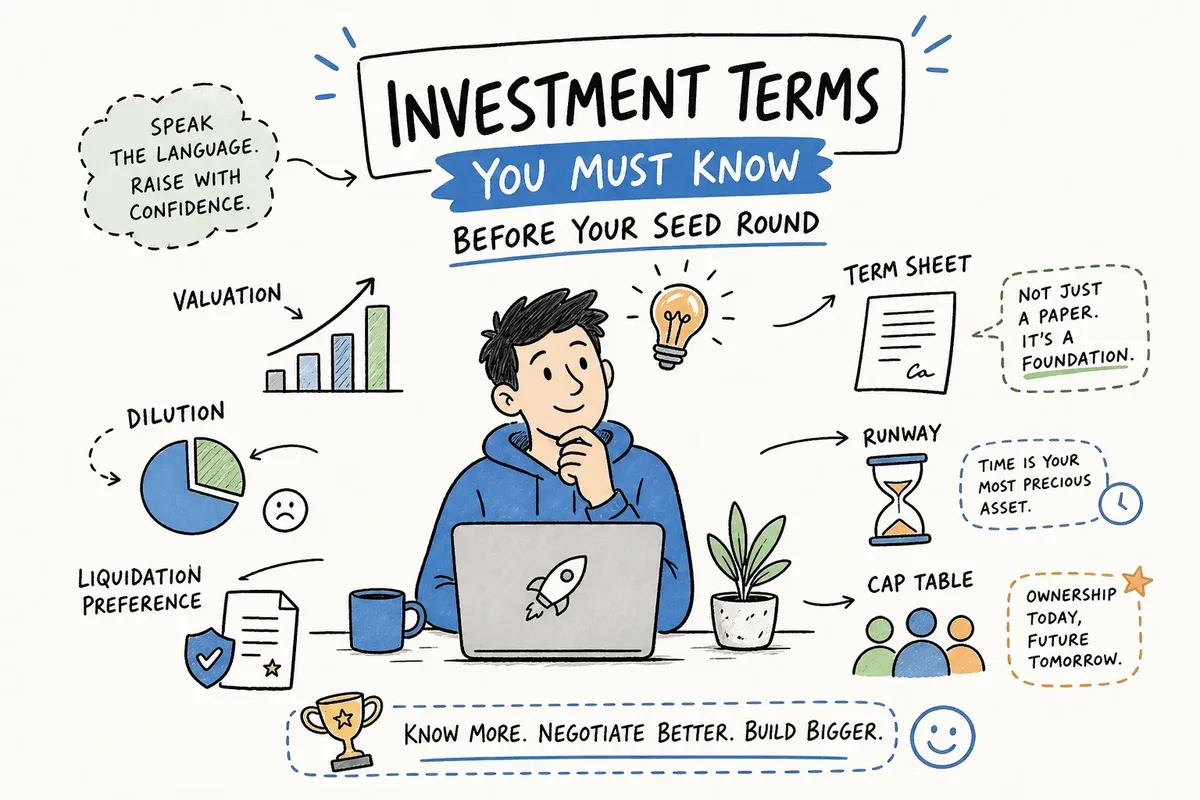
Most founders spend weeks perfecting their pitch deck and almost no time learning the investment terms investors use every day. Walk into a seed round conversation without understanding liquidation preferences or pro-rata rights, and you risk signing terms you don't fully grasp — or appearing unprepared in front of the one investor who might have written a cheque.
These 40 investment terms are grouped by when they typically surface in the fundraising process, so you can build context as you go rather than memorise a flat list of definitions.
Part 1: Valuation Fundamentals
Pre-Money vs. Post-Money: How Ownership Is Calculated
Example
Pre-money = ₹5 Cr + Investment = ₹1 Cr → Post-money = ₹6 Cr → Investor owns 16.7%
The Trap
When you "agree on a valuation," always clarify whether the number is pre- or post-money. Ownership percentage is calculated against the post-money figure.
1. Pre-money valuation — company value before investor capital enters the round.
2. Post-money valuation — pre-money plus the investment amount; investor ownership is calculated against this figure.
3. Valuation cap (SAFE) — ceiling at which an early investor's money converts into equity, protecting them from dilution if valuation rises sharply by the priced round.
4. Discount rate — percentage reduction on the priced round's share price given to a SAFE or convertible note investor at conversion.
5. Cap table (capitalisation table) — complete record of who owns what percentage of the company, including founders, employees, advisors, and all investor classes.
6. Dilution — the reduction in an existing shareholder's ownership percentage when new shares are issued.
7. Fully diluted share count — total shares that would exist if every option, warrant, and convertible instrument were exercised; the basis for investor ownership calculations.
8. Option pool — shares reserved for employee equity plans, typically 10–15% of the cap table; when created pre-money, it comes entirely from founder equity before the round closes.
9. ESOP (Employee Stock Option Plan) — the formal structure through which employees receive equity; must be properly documented under the Companies Act, 2013 in India.
Model Your Cap Table
See how today's round changes your ownership across every future milestone before you sign.
Cap Table Simulator →Part 2: Funding Instruments Before the Term Sheet
| Factor | SAFE Note | Convertible Note |
|---|---|---|
| Structure | Not debt; contractual equity right | Debt that converts to equity |
| Interest rate | None | 2–8% per annum |
| Maturity date | None | Fixed; repayment required if conversion doesn't occur |
| India context | Adoption growing; issued as CCPS | Common where RBI regulations apply to foreign investors |
10. SAFE (Simple Agreement for Future Equity) — contractual right to equity at a future priced round; no interest, no maturity date.
11. Convertible note — debt that converts to equity; carries interest and a maturity deadline.
12. MFN clause (Most Favoured Nation) — in a SAFE or note, ensures earlier investors automatically receive terms at least as favourable as any future investor in the same instrument.
13. Bridge round — small, fast capital raise designed to extend runway until the next priced round; experienced investors will ask pointed questions about what changed since the last round.
14. Tranches — staged capital disbursements tied to specific milestones rather than a single lump-sum transfer.
15. Runway — months of operation remaining at current net burn rate; calculated as cash on hand divided by monthly net burn.
Part 3: Term Sheet Economic Terms — Who Gets Paid First
Liquidation Preference: ₹50 Cr Exit, ₹5 Cr Invested for 10%
1x Non-Participating (Market Standard)
Investor takes ₹5 Cr (preference) OR ₹5 Cr (10% of exit) — same here. Gap widens sharply on larger exits.
Participating Preferred ("Double-Dip")
Investor takes ₹5 Cr preference PLUS 10% of remaining ₹45 Cr = ₹4.5 Cr extra. Compounds badly with multiple participating investors.
16. Liquidation preference — investor's right to receive a minimum return before founders or common shareholders see any exit proceeds.
17. Non-participating preferred — investor receives their liquidation preference OR converts to equity, not both; the market standard at seed in India and the US.
18. Participating preferred — investor receives their preference AND shares proportionally in remaining proceeds; can significantly reduce founder proceeds in modest exits.
19. Liquidation waterfall — the priority order in which different shareholder classes receive proceeds in an exit or dissolution.
20. Anti-dilution provision — protects investors from down-rounds by adjusting their conversion price when new shares are issued at a lower price.
Anti-Dilution: ₹8 Cr Invested at ₹2/Share, Down-Round to ₹1/Share
Broad-Based Weighted Average (Negotiate for this)
Adjusts conversion price proportionally to new shares issued. Significantly less damaging to founders. Market standard.
Full Ratchet (Avoid)
Doubles investor share count (4 Cr → 8 Cr shares) at any down-round size, dropping founder ownership from 55% to 48%.
21. Broad-based weighted average anti-dilution — the market standard; adjusts conversion price proportionally based on the size of the new round relative to total capitalisation.
22. Full ratchet anti-dilution — the harshest version; resets conversion price directly to the new lower price regardless of how few new shares were issued. Rarely seen in modern term sheets.
23. Pro-rata rights — give an existing investor the option to participate in future rounds to maintain their current ownership percentage.
24. Super pro-rata rights — allow an investor to purchase more than their proportional share in a future round, compressing the cap table further; watch for this clause carefully.
Part 4: Governance and Control Terms
25. Board seat — formal governance power over your company; investors commonly seek one seat even at seed stage.
26. Observer rights — non-voting right to attend board meetings; a lighter governance request than a formal seat.
27. Voting rights — attached to preferred shares; can allow investors to approve or block major decisions.
28. Protective provisions — investor veto rights over specific actions (new fundraising, company sale, share issuance, charter amendments). Restrict operational freedom; narrow the scope to material strategic shifts only.
29. Drag-along rights — allow a majority shareholder to compel minority shareholders to approve a company sale on the same terms. Protect investors from minority blocking; can be used to force founders out of a deal they oppose.
30. Tag-along rights — give minority shareholders the right to join a sale on the same terms as the majority. Protect smaller shareholders from being excluded from an acquisition.
Standard Vesting Schedule: 4 Years with 1-Year Cliff
Investors typically require vesting even for founding teams. A co-founder leaving at month 6 with no cliff provision keeps their full equity stake — a structural risk investors will not accept.
31. Vesting schedule — timeline over which equity is earned; protects the company from shareholders leaving early with large stakes.
32. Cliff period — minimum period (typically 12 months) before any equity vests; earn nothing if you leave before the cliff.
Part 5: Due Diligence and Closing Vocabulary
33. Data room — secure, organised folder of company documents reviewed by investors before deal close: incorporation docs, financials, contracts, IP assignments, cap table records.
34. Representations and warranties — formal statements founders make about the legal and financial condition of the company; inaccuracies create post-close liability.
35. Closing conditions — specific requirements both parties must fulfil before funds are transferred.
36. Lead investor — sets the terms for the round and typically contributes the largest cheque.
37. Syndicate — the other investors who join the round on the lead's terms without setting the deal structure.
38. Follow-on investment — an existing investor participating in a later round; generally a positive signal to new investors.
39. Exclusivity clause (no-shop) — legally binding from the moment you sign; prevents approaching other investors for 45–60 days during negotiations. Always negotiate a firm end date and mutual termination right.
40. SHA / SSA — Shareholders' Agreement and Share Subscription Agreement: the definitive legal agreements that follow a signed term sheet and give every commercial term legal force.
Why Financial Vocabulary in Your Pitch Deck Matters
When a founder uses "post-money valuation" incorrectly in their deck, or conflates "dilution" with "liquidation preference," experienced investors notice immediately. It signals the founder may not fully understand the investment terms they are agreeing to, which raises questions about execution risk and negotiating credibility.
Getting the language right is not about impressing investors with jargon — it is about demonstrating you understand your own business and the deal structure you are entering. Pair this vocabulary with What Is a Term Sheet? A Founder's Complete Guide, What Investors Look For Before Investing in Startups, and Finance Terminology Explained for Non-Finance Founders.
Start with the terms. Then let the right platform do the matching.
Run Your Pitch Deck Audit →References
- NVCA Model Legal Documents: Term Sheet and SHA Templates
- Y Combinator: SAFE and Post-Money SAFE Documentation
- 60 Of The Most Common Startup Funding Terms
- seed-funding/seed-round-funding/" style="color:#7a5cff;text-decoration:underline;">Seed Round Funding – All you need to know