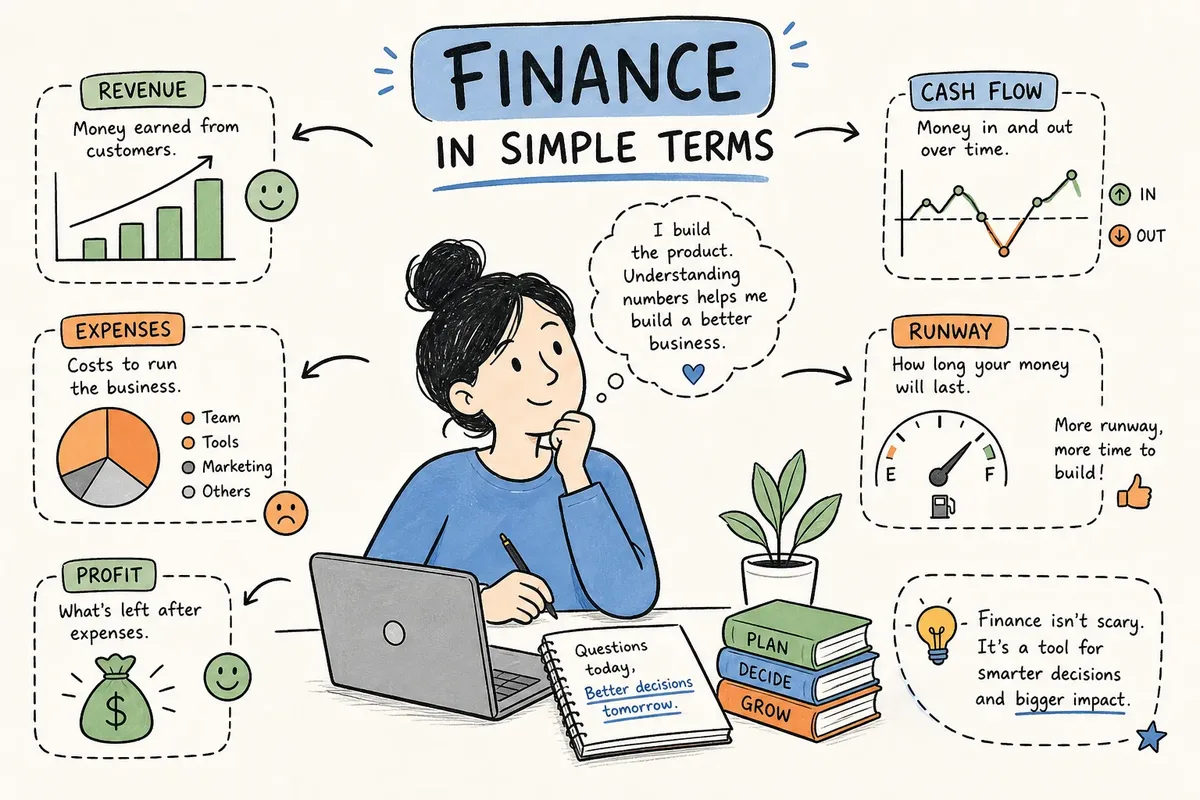
Imagine sitting across from an investor who asks: "What's your ARR growth rate quarter-on-quarter?" and you pause just a second too long. That pause is expensive. It signals that while you may understand your product deeply, you haven't yet mastered finance terminology — the shared dialect investors use to evaluate whether a business is worth backing.
This article breaks down the core finance terminology you'll encounter in investor conversations — from revenue metrics to term sheet clauses — with plain-language definitions and real examples grounded in an Indian startup context. Think of it as a practical financial glossary built for founders, not accountants.
Revenue Metrics: Essential Finance Terminology for Founders
Before an investor examines your product or team, they scan your revenue metrics. These numbers tell the story of momentum, and momentum is what moves conversations forward.
ARR, MRR, and the Difference That Trips Most Founders
ARR vs. MRR: What Each Measures
ARR
Annual Recurring Revenue — total predictable revenue from active subscriptions over 12 months. 10 customers paying ₹1 lakh/year = ₹10 lakh ARR.
Not the same as total revenue — ARR excludes one-time payments and professional services.
MRR
Monthly Recurring Revenue — the same figure measured over one month. ARR = MRR × 12. Investors track ARR growth rate as the primary health signal for SaaS and subscription businesses.
Burn Rate and Runway: Your Financial Survival Clock
Gross burn rate: total monthly spending. Net burn rate: total spending minus revenue — the actual cash leaving the business each month. Runway: months your current cash balance lasts at net burn rate.
A fundraising process typically takes three to six months to complete. If your runway is shorter than that, the negotiation dynamic shifts entirely in the investor's favour. Knowing and communicating runway confidently — alongside a plan to extend it — demonstrates financial discipline.
Calculate Your Burn Rate
Know your gross and net burn before your next investor conversation.
Burn Rate Calculator →Calculate Your Runway
See exactly how many months of capital you have left before outreach begins.
Runway Calculator →Profitability Terms That Show Up in Every Investor Meeting
EBITDA in Plain Language
EBITDA = Earnings Before Interest, Taxes, Depreciation, and Amortisation. A D2C brand with ₹50 lakh in revenue and ₹35 lakh in operating costs and ₹3 lakh in depreciation on machinery: EBITDA = ₹18 lakh, even if net profit is lower after a term loan and GST liabilities. EBITDA tells you how the engine runs, not how the car is financed.
Critical misconception: EBITDA is not cash in the bank. It excludes working capital movements and capital expenditure. A business can show strong EBITDA while still running tight on cash.
Gross Margin, CAC, and LTV: Unit Economics That Investors Benchmark
Unit Economics at a Glance
Gross margin: revenue minus cost of goods sold, expressed as a percentage. CAC: what you spend to acquire one customer. LTV: total revenue that customer generates over their lifetime. Even pre-revenue founders should model these figures.
Calculate Your CAC
Model your customer acquisition cost before your next investor meeting.
CAC Calculator →Calculate Your LTV
Understand your customer lifetime value and how it stacks against acquisition cost.
LTV Calculator →Break-Even Analysis
Find when your revenue covers total costs — the number investors always ask about.
Break-Even Calculator →Equity, Ownership, and What Dilution Actually Means
Pre-Money vs. Post-Money Valuation
Pre-money: agreed company value before new capital enters the round. Post-money: pre-money valuation plus the investment amount. A startup valued at ₹4 crore pre-money that raises ₹1 crore has a ₹5 crore post-money valuation — and the investor owns 20% (₹1 crore ÷ ₹5 crore). Negotiating a higher pre-money valuation means founders retain more equity for the same investment amount.
This distinction is especially important with post-money SAFEs, where the investor's ownership percentage is fixed immediately from the investment date and calculated against the larger figure.
Startup Valuation Calculator
Estimate your pre-money and post-money valuation before you negotiate.
Valuation Calculator →Pre / Post-Money Calculator
See exactly how a round changes ownership percentages before you sign.
Pre/Post-Money Calculator →Dilution and the Cap Table Explained Simply
Typical Founder Dilution Trajectory
Dilution is not inherently damaging — if valuation grows proportionally, a smaller percentage of a much larger company is worth considerably more. The risk is uninformed dilution, where founders sign without understanding how ownership shifts round by round. Keeping a live cap table and modelling future rounds before you raise is the simplest way to stay in control.
Cap Table Simulator
Model your current and future ownership across every round before you sign anything.
Cap Table Simulator →Term Sheet Language You'll Encounter Before Closing
SAFE Notes, Convertible Notes, and Liquidation Preference
| Factor | SAFE Note | Convertible Note |
|---|---|---|
| Interest rate | None | 2–8% per annum |
| Maturity date | None | Fixed deadline |
| Founder-friendly? | Generally yes | Adds repayment pressure |
| Speed to close | Fast (few pages) | Slower (more negotiation) |
Liquidation preference is the investor's contractual right to receive a minimum return before founders see any exit proceeds. A 1x non-participating preference is most founder-friendly: the investor gets their investment back, but does not also participate in remaining proceeds on top of that. A 2x participating preference in a modest exit can leave founders with very little.
Pro-Rata Rights and Why Founders Negotiate Them
Pro-rata rights give an early investor the option to invest in your next round in proportion to their current ownership, maintaining their stake as the company grows. An angel holding 8% may exercise pro-rata rights at Series A to avoid dilution to 4%. This clause doesn't cost founders equity at signing; its impact appears in later rounds when it constrains how much of the new allocation is available to incoming institutional investors. Map which investors hold pro-rata rights before structuring a Series A. For a deeper read on how these clauses interact, see What Is a Term Sheet? A Founder's Complete Guide.
Putting This Knowledge to Work
Fluency in finance terminology shortens fundraising timelines because it eliminates the back-and-forth when investors need to clarify basic definitions before evaluating substance. The founders who stumble over these terms are not less capable builders — they are simply less prepared for the specific language of capital.
Use the EzFunding calculators to model and verify your numbers before any investor conversation: Burn Rate, Runway, Valuation, Pre/Post-Money, CAC, LTV, Break-Even, and Cap Table Simulator. Then check whether your narrative holds up to investor scrutiny with fundraising-readiness" style="color:#7a5cff;font-weight:600;text-decoration:underline;">EzFunding's Fundraising Readiness scoring.
Know your numbers. Speak the language. Match the right investors.
Build Your Investor-Ready Profile →References
- Andreessen Horowitz: 16 Metrics Every Startup Should Know
- saas/" style="color:#7a5cff;text-decoration:underline;">SaaStr: What Is a Good Net Revenue Retention Rate?
- fundraising/term-sheets/" style="color:#7a5cff;text-decoration:underline;">Carta: Term Sheet Basics for Startup Founders
- MRR vs ARR: Which Revenue Metric Matters More for Your SaaS?