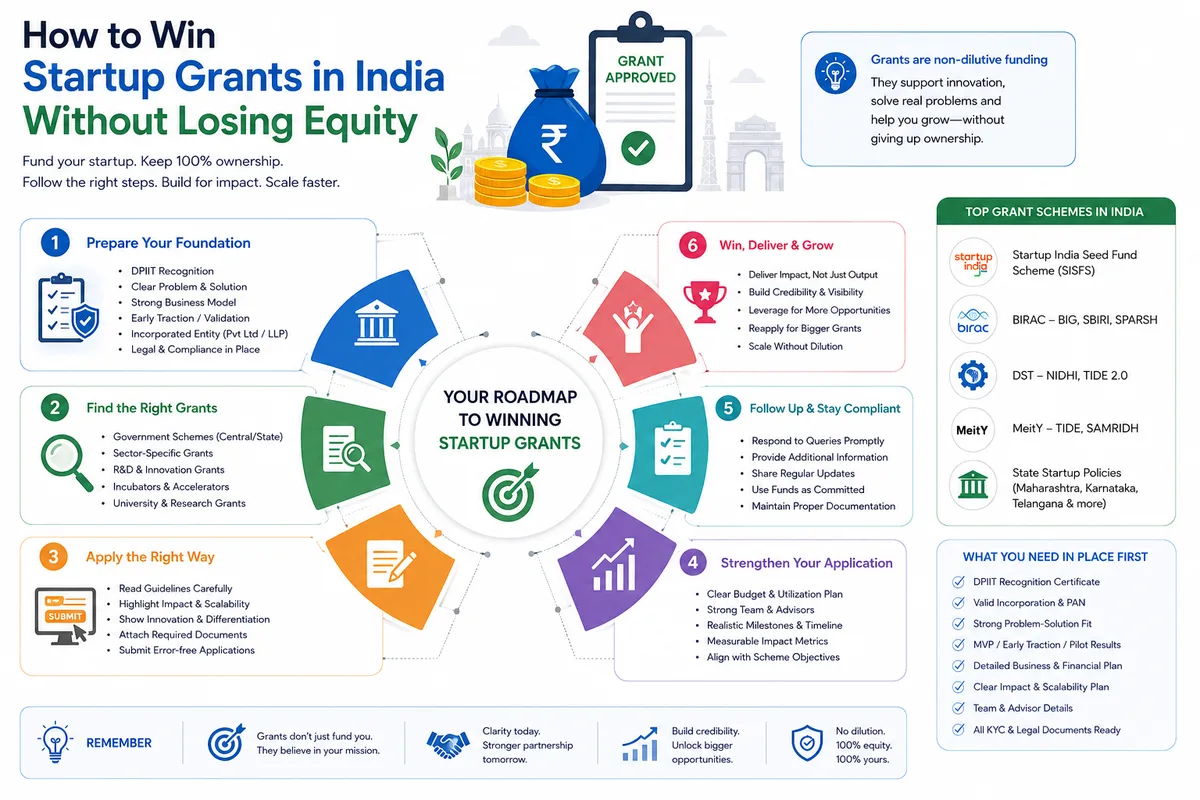
You have a working product, early traction, and a clear capital need — but no appetite to hand over equity at a stage when your company is still being valued on potential rather than performance. That tension is real, and it's exactly why India's government grant ecosystem exists.
Non-dilutive funding through Indian government grant programmes is one of the most underused tools in a founder's arsenal. You keep full ownership, the grant validates your innovation with third-party credibility, and the capital extends your runway without touching your cap table. Here's the practical framework: which schemes to target, what to prepare, how to write a proposal that clears the evaluation bar, and what a realistic timeline looks like from submission to first disbursement.
Which Grant Schemes Should You Actually Target?
The Indian grant landscape spans central government programmes, state-level innovation funds, and sector-specific schemes. Starting with the right shortlist saves you months of misdirected effort.
Central Government Schemes
Maximum Equity-Free Funding by Central Scheme
Many central schemes run rolling or annual cohort intake and are non-exclusive — you can apply to more than one simultaneously, subject to each scheme's cumulative-support rules. Verify current terms on the official portal before applying.
State-Level Programmes
State schemes are worth taking seriously — they often move faster and face lower competition than central programmes.
Maximum Equity-Free Funding by State Scheme
Rule of thumb: cross-reference your state of registration with active state-level programmes before defaulting straight to central schemes.
Shortlist by Stage First
Filter in this order: stage, then sector compatibility, then geography. This sequence prevents the most common mistake founders make — submitting to schemes where they don't meet the primary eligibility threshold.
Idea Stage
Target NIDHI-PRAYAS or TANSEED
Prototype Stage
Target SISFS or BIRAC BIG
Scaling with Traction
Target ANIC or T-Fund
What You Need in Place Before You Apply
Get DPIIT Recognition First
DPIIT recognition is the gateway requirement for most central grant schemes, and sorting it out first unlocks far more options than any other single action. Apply via the Startup India portal. To qualify, your entity must be a Private Limited Company, LLP, or Partnership Firm; incorporated within the last 10 years; with annual turnover below ₹100 crore; and working toward innovation or scalable commercialisation.
Some state programmes accept state-level recognition instead, but get DPIIT recognition regardless — it also unlocks tax exemptions and patent fee reductions unrelated to grants.
Build Your Document Pack Once
Once DPIIT-recognised, your document requirements are largely standardised across most portals. Prepare it once and reuse it everywhere:
Founders who pull documents together at the last minute before each application consistently miss procedural requirements — and procedural rejections are the most avoidable kind.
How to Write a Grant Proposal That Actually Wins
Experienced evaluators can tell within the first two paragraphs whether a founder understands the structure. Your proposal needs to cover: the problem your innovation solves, your solution and its unique mechanism, market opportunity and scalability, your team's relevant credibility, exact use of funds by activity, and measurable milestones tied to each disbursement tranche.
The Three Axes Evaluators Score You On
Innovation Score
Market Impact Potential
Financial Clarity
Based on published evaluation criteria from SISFS, BIRAC BIG, and DST. Address all three explicitly — not implicitly through assumption.
The Three Rejection Patterns to Avoid
Funder Misalignment
Applying to a scheme whose sector mandate or stage focus doesn't match your startup.
Budget Vagueness
Listing lump sums without line-item justification tied to deliverables.
Weak Impact Evidence
Proposing outcomes that can't be measured or verified at review time.
Before you submit, request a review from the incubator or Technology Business Incubator (TBI) affiliated with the scheme — many DPIIT-recognised incubators act as intermediaries for SISFS and NIDHI and offer free, committee-specific feedback. Confirm exactly what services are available directly with the incubator.
The Step-by-Step Process: From Application to First Disbursement
The full process from first submission to receiving funds runs 3 to 6 months for most central schemes. Understanding each stage prevents the frustration of misinterpreting silence as rejection.
Deadline note: some schemes run fixed application windows rather than rolling intake. SISFS, for instance, had a final deadline of 31 May 2026 for its current cohort, with incubators completing selection by June 2026. Track your application status on the official portal, and follow up with the programme coordinator if you haven't received a screening confirmation within 30 days.
Run Your Grant Search Alongside Investor Outreach
A grant decision takes 3 to 6 months. Investor conversations, pitch iterations, and term sheet negotiations run on a parallel track. Treating these as sequential — finishing the grant application first, then raising from investors — compresses your runway unnecessarily and weakens your negotiating position.
Non-dilutive funding actively strengthens your investor narrative. It signals third-party validation: an independent government evaluation committee found your innovation credible enough to fund. That signal carries real weight with investors, particularly at the seed">pre-seed and seed stages where your traction data is still thin. A grant doesn't replace equity capital — it de-risks your cap table, extends your runway, and gives you more leverage when you do sit across the table from a VC.
This is where running both tracks from a single dashboard matters: surfacing non-dilutive grant programmes alongside matched investor profiles — VCs, angels, and family offices — scored by stage fit, sector fit, and geography fit, so you're not maintaining separate spreadsheets for grant deadlines and investor shortlists. Learn more about how that scoring works in Investor Matching Explained, or see the wider non-dilutive landscape in Startup Funding Sources Every Founder Should Know.
Don't choose between grants and investors. Track both in one place.
See Matched Grants & Investors →