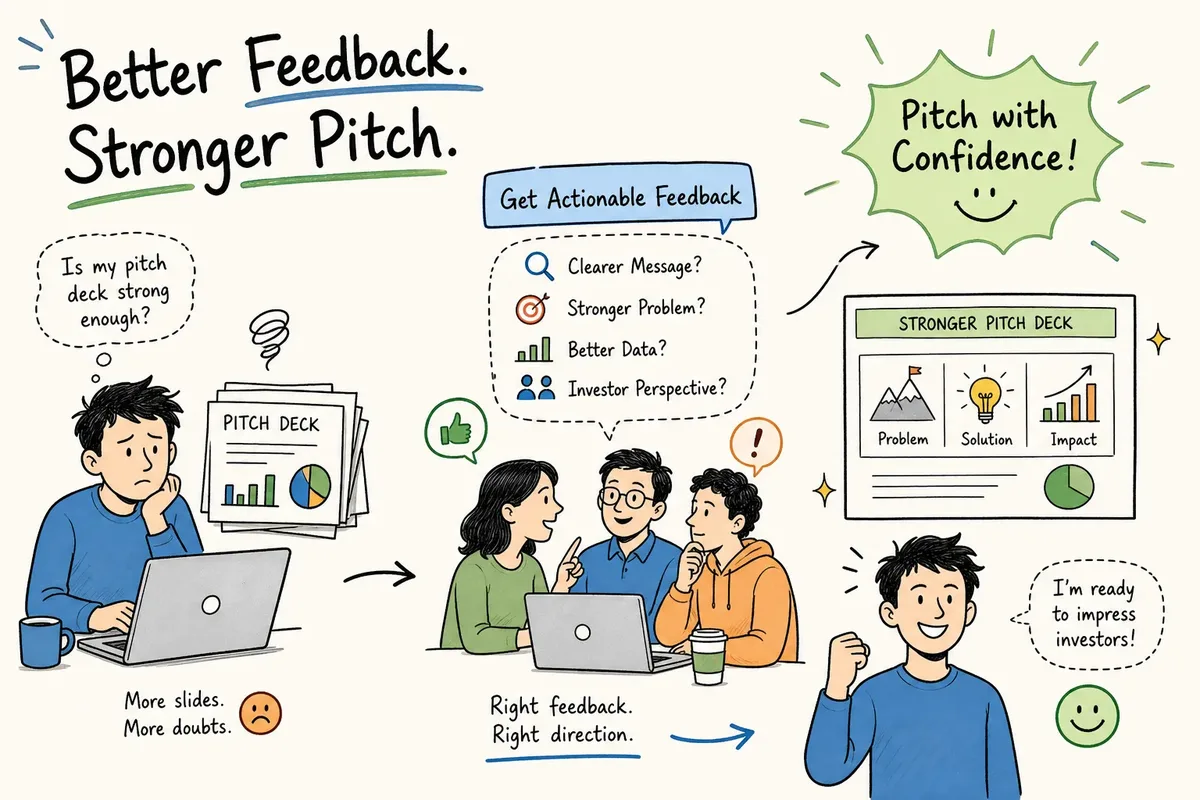
How do I get feedback on my pitch deck before approaching investors? It's a question more founders should ask — but most don't.
They show the deck to a co-founder, maybe a supportive friend, and then approach a VC whose attention they'll never get back. The cost of that sequence is steeper than a simple rejection.
A weak deck doesn't just fail to raise capital. It closes doors that are genuinely hard to reopen — because first impressions in fundraising are remarkably sticky. Investors often share perceptions informally, so a poor early approach can affect future conversations across an entire network. That's a reputational cost most early-stage founders never account for.
This guide covers every channel available for getting genuine pitch deck feedback, how to make those sessions produce usable input, and how to know when your deck is actually investor-ready.
Founders now have access to platforms that deliver instant, data-driven deck critique with no warm introduction or accelerator acceptance required — tools like AI-powered review platforms that evaluate your slides against real investor criteria. But those tools work best when you understand the full feedback ecosystem around them.
Of 82 decks reviewed had excessive wordiness — the single most common problem across the entire sample
Had missing or incomplete financial slides — the second most common issue found across early-stage decks
Time investors spend scanning a deck before deciding whether to keep reading — first impressions are structural, not visual
Independent feedback rounds most founders need before recurring structural critiques stop appearing across sessions
What investors actually flag when they read early-stage decks
In one documented review of 82 early-stage pitch decks, a remarkably consistent set of problems emerged across the entire sample. These aren't random complaints — they are the exact signals investors pattern-match against when scanning a deck in under two minutes.
Source: Documented review of 82 early-stage pitch decks — investor feedback aggregated by slide category
The subtler insight is that most founders over-index on visual polish and under-index on narrative logic. The story connecting problem, solution, market, and traction is what investors actually interrogate. Before seeking external feedback from anyone, use this list as a self-audit checklist and mark every slide where one of these issues might apply — the revision work shortens considerably before the first external reviewer even sees it.
The three slides that carry the most weight in a first-pass read
Feedback from experienced reviewers consistently clusters on three slides. Understanding where reviewers will focus helps you ask sharper questions when you enter any feedback session.
How do I get feedback on my pitch deck — starting with AI
Before you schedule time with advisors or attend a pitch clinic, run your deck through a platform that evaluates it slide by slide against investor criteria. This is the smartest first step because it gives you a structured baseline before any human sees your work. You go into every subsequent conversation knowing exactly which sections are weak — rather than waiting for reviewers to identify them.
EzFunding's pitch deck analysis scores your deck across multiple startup dimensions — traction, market sizing, team quality, and financial projections among them — and returns a fundraising readiness score that tells you where you stand before any investor reads it. The advantage is speed and objectivity: no relationship to manage, no scheduling lag, and no risk of a reviewer being too polite to flag your weakest slide.
A good AI-powered investor pitch review doesn't just flag problems — it explains the logic an investor would use to evaluate that specific slide, so you understand why something isn't working, not simply that it isn't. Use your readiness score as a baseline and track it across feedback rounds. It gives you a clear before-and-after benchmark as you iterate, and helps you walk into human feedback sessions with targeted questions rather than open-ended ones.
Run your deck through EzFunding's pitch deck analysis · fundraising-readiness-checklist" class="li">See the full fundraising readiness checklist
Human feedback channels that give you investor-perspective input
AI tools establish your baseline. Human feedback — from the right sources, structured correctly — gives you the investor-perspective critique that no automated tool can fully replicate. Not all human feedback is equal, and knowing which channels produce signal versus noise is itself a competitive advantage in the feedback process.
The feedback channel hierarchy
They remember exactly what investors pushed back on during their own raise — and they'll be direct in a way advisors and mentors sometimes aren't. Tap startup WhatsApp groups, LinkedIn founder circles, and curated founder platforms. Ask: "What did you expect to see on this slide that wasn't there?"
The closer a reviewer is to current deal flow, the more their observations reflect what investors are actually looking for right now. Brief them: send the deck in advance, state your stage and round size, and ask them to respond as an investor would in the first two minutes of reading.
Accelerators such as Axilor Ventures, India Accelerator, and Venture Catalysts include pitch feedback for accepted startups — and many run public office hours that founders can attend regardless of application status. Structured written feedback from dedicated pitch clinics gives you investor-perspective critique without needing an existing relationship.
Advisors who have operated in your sector bring both market credibility and investor-perspective critique. Compensate them fairly for their time — equity or cash — so the feedback relationship is professional rather than casual.
Dedicated pitch feedback platforms compared
For structured, written feedback without requiring an existing investor relationship, several platforms offer tiered access from free to paid professional review:
| Platform | Cost | Turnaround | Format | Best for |
|---|---|---|---|---|
| EzFunding | See platform | Instant (AI) + human | Slide-by-slide score + readiness report | Structured baseline before any human session |
| OneDollar.vc | Free | 72 hours | Written structured feedback | First external perspective, no relationship needed |
| Design For Decks | Free | 24 hours | Written structured feedback | Fast turnaround before accelerator deadlines |
| PitchDeckFire | ₹25,000 – ₹1.25L per session | Scheduled session | Live critique with back-and-forth | Deep critique when Series A prep warrants investment |
| Deck.vc | Stage-based pricing | Varies | Written + optional call | Stage-calibrated review at seed through Series A |
Platform data correct as of 2025–2026. Verify current pricing directly with each platform before booking.
How to structure a feedback session that produces usable input
The quality of feedback you receive is almost entirely a function of how you structure the session before it begins. Reviewers who haven't read the deck beforehand give surface-level reactions. Reviewers who've had time to sit with it give substantive ones.
Protecting your deck while it circulates for review
Sharing your deck with external reviewers is necessary. Sharing it without basic protection is not. These practices are standard in professional review contexts and should not make the process cumbersome for your reviewers:
PDF prevents easy editing and makes copying harder. Send a PDF to anyone outside your immediate team — always, without exception.
Add a visible watermark with your company name and the word "Confidential." This deters casual sharing and signals you take confidentiality seriously.
For paid reviewers and advisors you haven't worked with before, a short mutual NDA is entirely reasonable and is common practice in professional review contexts.
Consider sharing just your problem, solution, and traction slides before releasing the full deck. This staged approach is especially relevant for early conversations where the relationship isn't yet established.
How to prioritise feedback and know when your deck is ready
Not all feedback carries equal weight. Prioritise input by proximity to investor decision-making — feedback from a practising angel investor or VC associate outranks feedback from a founder who raised three years ago in a different sector.
Narrative logic problems, missing information, vague claims, and unclear slide sequencing. These must be addressed before anything else. Design improvements on a structurally broken deck are wasted effort — always resolve structural issues first.
Cluttered layouts, excessive wordiness, and inconsistent formatting. Address these after structural clarity is confirmed. Design polish on a clear structure creates a strong deck; design polish on a broken structure creates a beautiful problem.
When two reviewers contradict each other, that conflict usually points to an ambiguity in the deck itself — not a genuine disagreement about preference. Fix the slide so both readings converge on the same meaning, rather than choosing one reviewer's preference over the other's.
The concrete signals that tell you your deck is ready
How to pitch investors — the complete guide · Startup investor readiness: what VCs actually look for
The sequence that gets you to a fundable deck
Most founders who ask "how do I get feedback on my pitch deck before approaching investors" are really asking a harder question: how do I know when I'm genuinely ready? The answer isn't a feeling — it's a process.
A deck that survives three rigorous feedback rounds without recurring structural critiques is a deck that earns its place in an investor's inbox. The goal of this entire process is not to make your deck perfect — it is to remove every reason an investor might say no before you've even had a conversation.
How EzFunding closes the gap between a weak deck and an investor-ready one
EzFunding's slide-by-slide pitch deck analysis gives founders the structured, objective baseline that human feedback sessions build on. Rather than waiting for an investor rejection to identify weaknesses, the platform flags precisely where your deck falls short — across traction, market sizing, team quality, business model logic, and financial projections — so you spend your limited preparation time fixing real problems, not polishing the surface.
Every slide evaluated against investor-grade criteria with specific explanations — not just a pass/fail rating — so you understand the logic behind each flag.
A single composite score across all critical dimensions. Track it across iterations to measure real improvement — not just subjective confidence.
Once your deck is ready, match with investors whose stage, sector, geography, and thesis align with your profile. See: How investor matching works.
Personalised investor outreach built on each investor's portfolio, thesis, and recent investment activity — so your deck reaches the right people with the right context.
Approach your first investor meeting knowing your deck has been pressure-tested
Run my pitch deck analysis Find matching investorsReferences
- Y Combinator Library — Pitch deck and fundraising resources
- First Round Review — Pitch preparation and investor feedback frameworks
- Sequoia Capital — Pitch structure and business plan framework
- OpenVC Blog — Pitch deck review and investor targeting
- fundraising-report" target="_blank" class="lr">DocSend — Annual Pitch Deck Report 2024 (investor reading time and slide engagement data)