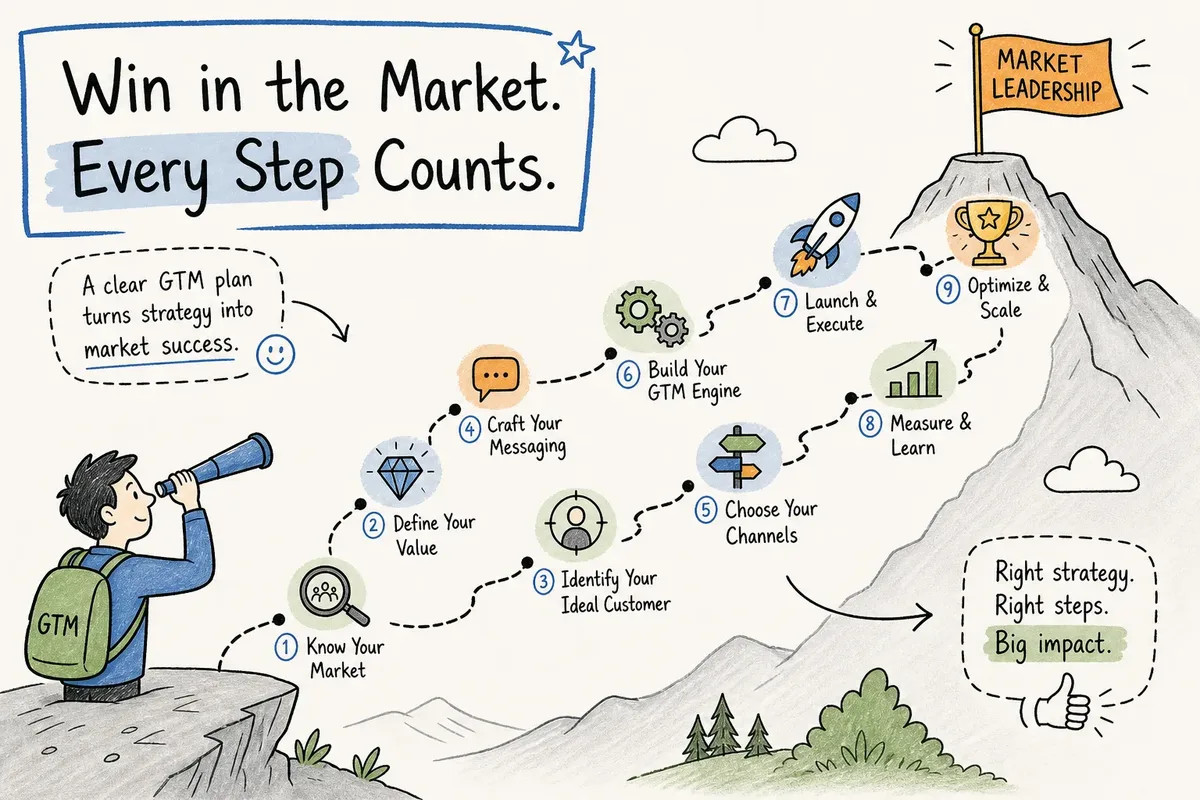
Most product launches don't fail because the product is flawed. They fail because the go-to-market strategy was either rushed in the final weeks or treated as someone else's job. A well-built GTM strategy is the difference between a launch that stalls at 10 customers and one that reaches 100 with a repeatable motion.
This 9-step GTM framework gives you a clear sequence: who owns each step, which channels to pick, what KPIs to track, and how long it realistically takes.
🔑 Key Insight
A go-to-market strategy covers the full journey from ICP definition through customer acquisition and retention. A marketing plan is just one component — not the whole thing. Conflating the two is one of the most common founder mistakes, and it usually shows up as campaigns launching before anyone has validated the customer or the channel.
What a GTM Strategy Actually Covers (and What It Doesn't)
The Scope of a GTM Plan Versus a Marketing Plan
A go-to-market strategy covers the full journey from ICP definition through to customer acquisition and retention. A marketing plan is one component of it, not the whole thing. Conflating the two is one of the most common mistakes founders make, and it usually shows up as campaigns that launch before anyone has validated the customer or the channel.
Who Owns the GTM Strategy in an Early-Stage Startup
In early-stage startups, from seed">pre-seed through to seed, the founder owns the GTM strategy — not the head of marketing, not an agency. This stays true until ARR reaches a point where a dedicated GTM hire makes commercial sense, typically around the ₹4 crore (approximately $500,000) ARR mark. Until then, the person with the most context on the customer needs to drive every step of this product launch plan.
💡 Founder Tip
Lead sales personally until around $500,000 ARR before hiring a dedicated GTM lead. Founders who stay close to early customers consistently close faster and learn more than those who delegate too soon. Use the startup runway calculator to check how much room you actually have before that hire makes sense.
Steps 1–3: Understand Your Market Before You Move
Step 1: Define Your ICP With Real Specificity
This is where most founders shortcut and pay for it later. Defining your ideal customer profile means going beyond job title and company size. You need to map:
- Pain points
- Price sensitivity
- Decision-maker hierarchy
- How your buyer currently solves the problem
Validate this with at least 10 real conversations before you commit any resources to channels or messaging. If you're building this playbook for a B2B SaaS company specifically, this seed-b2b-saas" style="color:#2563eb;font-weight:600;text-decoration:underline;">seed-stage B2B SaaS playbook maps ICP validation alongside fundraising sequencing.
Step 2: Analyse Your Competitors and Find the Gaps
Most founders look at competitor features and stop there. Go deeper: analyse your competitors' pricing tiers, messaging angles, and the sub-segments they're ignoring. That's where your entry point usually lives. If a competitor is priced for enterprise, the underserved mid-market segment is often your opening. This market-entry strategy — identifying the white space your rivals haven't claimed — is frequently more valuable than any feature advantage.
Step 3: Build a Value Proposition With Measurable Outcomes
Your value proposition needs to be something a CFO would fund. The structure is straightforward:
- The problem your buyer faces
- Why your solution is superior
- A measurable outcome they can report upwards
To differentiate this proposition across buyer segments at scale, tools such as Clay or Apollo now allow founders to personalise outreach sequences based on firmographic and intent data — a practical action rather than a theoretical capability. Once this value prop is locked, it should flow straight into your pitch deck narrative so investors and customers hear the same story.
Steps 4–6: Pricing, Channel Selection, and Acquisition Planning
Step 4: Choose a Pricing Model That Matches Your Growth Motion
Most founders commit to a pricing model too early. Test two or three structures before locking in — the right model is the one that aligns with how your customer actually derives value, not the one that looks cleanest on a pitch deck.
| Pricing Model | Best Suited For |
|---|---|
| Value-based | Products where ROI is clearly quantifiable per customer |
| Seat-based | Team collaboration tools with predictable per-user usage |
| Usage-based | Infrastructure or API products with variable consumption |
Step 5: Pick Your Distribution Channels With Intent (PLG, SLG, or Hybrid)
Product-led growth (PLG) runs on self-serve onboarding and content, with lower upfront acquisition costs and a typical CAC payback period of around 8 months. Sales-led growth (SLG) requires demo teams and outbound investment, with payback periods closer to 18–19 months, but it closes enterprise deals faster. Many SaaS startups now run a hybrid: PLG for bottom-up adoption and SLG for top-down enterprise conversion.
📊 CAC Payback Period: PLG vs. SLG vs. Blended Median
Choose your primary motion based on your product's complexity and your buyer's purchasing behaviour. For a detailed comparison of the two approaches, see this article on product-led growth vs sales-led growth.
Step 6: Build Your Outreach and Acquisition Sequence
Match your outreach sequence to where the buyer is in their journey. Cold prospects need a different approach than buyers who've already trialled the product. Use predictive targeting and buyer intent signals to improve timing.
- Run three to five campaigns in parallel
- A/B test subject lines and calls to action
- Cut what doesn't convert within 30 days rather than waiting to see if things improve on their own
If you prefer a visual structure for sequencing and experiments, a GTM template on Miro can help you map campaigns and decision points clearly. The same discipline applies to building an investor list that actually converts — sequencing and qualification matter just as much when the "buyer" is a VC.
Steps 7–9: Retention, Growth Prep, and Cross-Team Alignment
Step 7: Plan for Activation and Retention Before Day One of Launch
Retention planning is routinely treated as a post-launch problem. It isn't. Before launch, define your activation event (the specific action that signals a user has found real value), segment users by behavioural signals, and sequence the right intervention at the right moment. Build the loop before the first customer arrives.
⚠️ Warning
Churn in the first 90 days is a GTM failure, not a product failure. If activation isn't defined before launch, you'll be diagnosing churn with no baseline to compare it against.
Step 8: Structure Your Scaling Roadmap in Weekly Milestones
Set clear decision criteria for each channel from the start: what signal tells you to scale it, and what tells you to cut it. Founders who wait too long to drop underperforming channels waste runway and lose momentum at a critical stage.
✅ Best Practice
Give each channel a 30-day window to produce a consistent signal before you decide, and build that decision point into your weekly milestone plan from the outset.
Step 9: Align Sales, Marketing, and Product Behind One Shared Funnel
This is where most GTM plans collapse in execution. Sales, marketing, and product need to operate from a single message repository, a shared definition of a qualified lead, and one agreed metric for success. Without this alignment, every team optimises for a different outcome and the funnel fragments.
Assign a single owner for the GTM process, document the shared funnel in one place, and review it weekly in the first 90 days post-launch.
How to Measure Your GTM Strategy: The KPIs That Matter
B2B SaaS Benchmarks to Track in 2026 (and What They Mean)
Start with five metrics and resist the urge to track everything at once.
| Metric | Healthy Benchmark |
|---|---|
| MQL-to-SQL conversion | 25%–40% |
| CAC payback period | Median 15–16 months overall (PLG ~8 months, SLG ~19 months) |
| Win rate | 15%–25% for tightly targeted leads |
| LTV:CAC ratio | 3:1 or better for capital-efficient growth |
| Pipeline velocity | Tracked alongside the four metrics above |
For a quick reference on typical CAC payback period benchmarks, this resource is helpful when tuning your financial model — or model it directly with the CAC calculator and LTV calculator.
B2C Launch Metrics That Signal Genuine Product-Market Fit
For B2C launches, the signals are different. Five metrics tell you whether you've found genuine product-market fit:
- Activation rate
- User retention
- Visitor-to-lead conversion
- NPS
- Usage depth
📈 Market Insight
B2C leans on engagement and retention to validate fit; B2B leans on capital efficiency and pipeline quality. Know which game you're playing before you start reporting numbers to your board or investors.
GTM Strategy Timeline: MVP to Your First 100 Customers
Phase Breakdown From Discovery to Scale (With Typical Durations)
The typical timeline from MVP to 100 customers runs 6 to 12 months. Structure the execution window around a T-90 to T+90 day arc:
If you want a broader SaaS-focused view to compare against your timeline, see this saas-gtm-strategy/" style="color:#2563eb;font-weight:600;text-decoration:underline;">SaaS GTM strategy guide for additional framing. Your fundraising timeline should track alongside this arc — see investors by stage to line up outreach with where you actually are.
What a GTM Plan Costs by Motion Type (PLG Versus SLG)
Budget varies significantly by motion:
PLG Motion
$50K–$120K
Bulk of spend goes to content, SEO, and self-serve onboarding infrastructure.
SLG Motion
$120K–$250K
Covers outbound tools, demo team salaries, paid advertising, and sales training.
Lead sales personally until around $500,000 ARR before hiring a dedicated GTM lead. Founders who stay close to early customers consistently close faster and learn more than those who delegate too soon. Model your runway against these figures with the startup runway calculator and the break-even calculator before you commit to either motion.
GTM Strategy Checklist: Nine Steps Before You Launch
Use this as your go-to-market checklist before you commit budget to any channel:
- ICP defined and validated with at least 10 customer conversations
- Competitive gaps identified and documented
- Value proposition written with a measurable outcome
- Pricing model tested against at least two structures
- Primary distribution motion chosen (PLG, SLG, or hybrid)
- Outreach sequences built and A/B test plan in place
- Activation event defined and retention loop mapped
- Channel decision criteria and 30-day review points set
- Sales, marketing, and product aligned to a single funnel and metric
Wrap Up: Your GTM Strategy Doesn't Stop at Launch
A GTM strategy isn't a one-time document you file after launch day. It's a living framework you run on a continuous loop, adjusting based on what the data tells you about your customers, channels, and messaging. The 9 steps above give you a clear sequence to follow, but the real advantage comes from running that loop faster than your competition. Revisit your GTM strategy each quarter and treat it as a go-to-market playbook that evolves with every new signal your market sends you.
A strong GTM plan also requires the capital to execute it without cutting corners on channels or timeline. Founders who pair this framework with a matched investor pipeline move faster and waste less runway on misaligned meetings.
EzFunding Helps You Match the Fundraise to This Launch Plan
EzFunding helps founders build an investor pipeline with the same precision this launch strategy brings to customer acquisition: right stage, right sector, right check size, with compatibility scores that explain every recommendation. EzFunding surfaces curated partners backed on the platform, such as:
Build Your Investor Pipeline on EzFunding →Start with your ICP, lock your value proposition, and build from there. The founders who move earliest with the most clarity — on both their market-entry strategy and their funding runway — are the ones who reach 100 customers while others are still debating positioning.