Most B2B SaaS founders walk into fundraising conversations with a generic startup playbook. They prepare a deck, build a list of VC names from a Google search, and start sending emails. Three months later, they have a pile of polite rejections and no clear sense of why. The problem is not the product. The problem is that B2B SaaS funding operates by a completely different set of rules, benchmarks, and investor expectations compared to any other startup category.
The bar has also shifted significantly in 2026. Compressed valuation multiples, stricter efficiency expectations, and investors who now place heavier emphasis on Net Revenue Retention alongside ARR growth have changed what "fundable" actually means. Founders who walk in with the right numbers, matched to the right investors, close faster. Platforms like EzFunding exist precisely for this: helping Indian B2B SaaS founders identify investors with a verified enterprise and SMB software thesis, cutting the time from first match to first conversation.
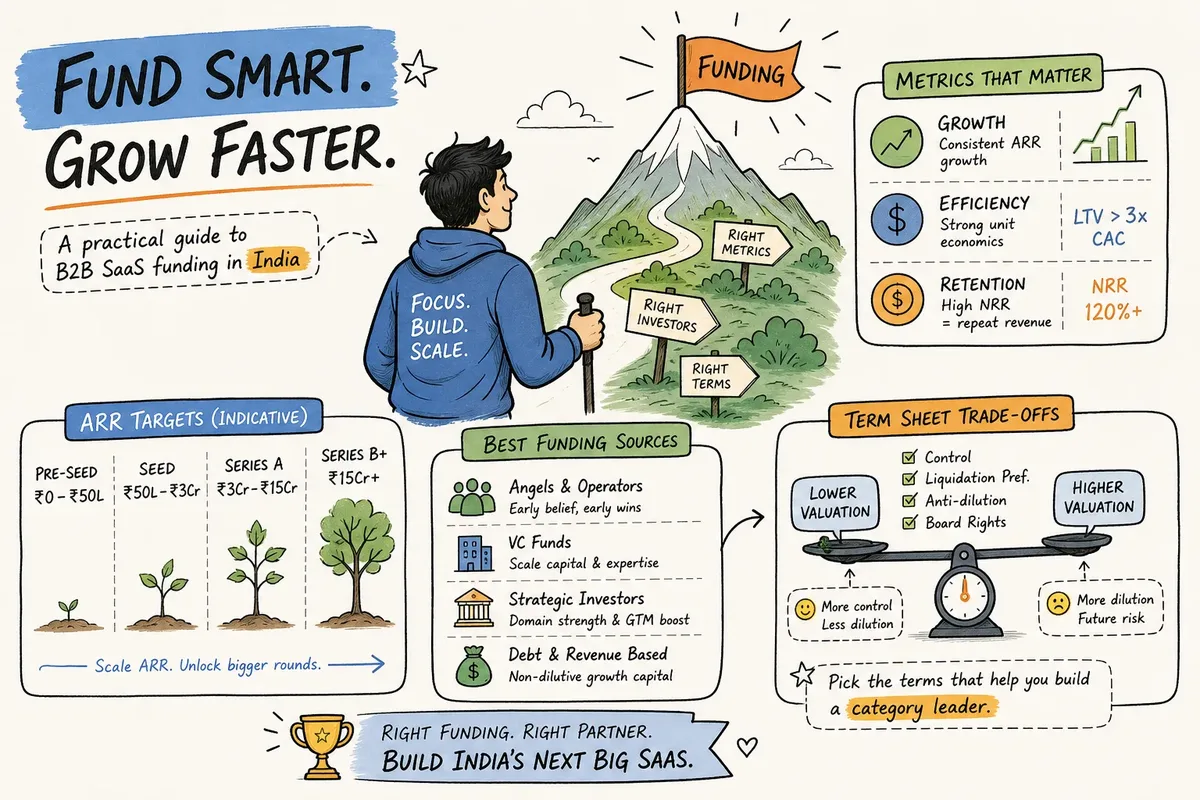
This guide covers everything you need to make smart decisions at every stage of B2B SaaS funding: the metrics that matter, ARR benchmarks by round, funding routes, and the term sheet trade-offs that determine your control and your upside.
Why B2B SaaS funding follows different rules
The subscription model signals predictability, not just revenue
Investors price B2B SaaS differently because a rupee of ARR is fundamentally not the same as a rupee of one-time revenue. Recurring revenue renews, expands, and compounds. It gives investors a forward-looking lens that transactional businesses simply cannot offer. This shifts the entire valuation conversation away from trailing revenue multiples toward retention-adjusted projections, where the quality of revenue matters as much as the quantity.
Net Revenue Retention therefore carries more weight than gross revenue growth for SaaS investors. A company growing 80% year-on-year with 90% NRR is telling a very different story from one growing 80% with 115% NRR. The second business is compounding on its existing base while adding new logos. Investors recognise that difference immediately, and it shows up in valuation multiples.
Why efficiency now outweighs growth at all costs
The 2021 era of growth-at-any-cost is well behind us. In 2026, a B2B SaaS startup growing 3x year-on-year with a burn multiple above 3x will struggle to raise at the same terms as one growing 2x with a burn multiple below 2x, though the precise trade-off will vary by investor and stage. Investors have repriced risk, and founders who understand this framework before entering conversations have a measurable advantage over those who arrive assuming that headline growth is sufficient.
The Rule of 40 captures this shift cleanly: your annual revenue growth rate plus your profit margin should equal or exceed 40%. It is not a hard gate at early stages, but it sets the direction of travel that institutional investors want to see as your MRR scales past the $1 million mark. For a concise explainer of the metric and its interpretation in investor conversations, see the Rule of 40 guide.
The metrics that move B2B SaaS investors
NRR, ACV and why they matter more than MRR
Net Revenue Retention measures whether your existing customers are spending more, less, or the same over time, without counting new logo growth. At Series A, investors expect NRR of 110% or above. At Series B, the bar rises to 130% and beyond. For Indian Series A startups targeting mid-market customers with an ACV between $25,000 and $100,000, the global benchmark sits at approximately 106 to 108%. Hitting above 110% puts you in a strong position for that conversation.
Annual Contract Value tells investors whether you are building an enterprise, mid-market, or SMB motion. Each has a different cost structure and a different scalability story. An SMB motion with an ACV of $3,000 needs a completely different go-to-market than an enterprise motion at $80,000. Knowing which motion you are running, and demonstrating that your unit economics fit it, signals commercial maturity to investors who have seen founders confuse the two.
CAC payback period and the burn multiple test
CAC payback is the number of months it takes to recover what you spent acquiring a customer. By most institutional SaaS investors' standards, the targets are under 12 months for Seed and Series A, and under 18 months for Series B. A payback period stretching beyond 18 months signals that growth is destroying value, not creating it. Investors at every stage will run this number themselves, so arriving with it already calculated shows you understand your own business economics.
The burn multiple, net burn divided by net new ARR, gives investors a single number to assess capital efficiency. At early stages below $2.5 million ARR, a burn multiple of 2.4 to 3.4x is tolerated. Between $2.5 million and $10 million ARR, investors want to see it at 1.6 to 1.8x. A founder who walks into a growth-stage conversation with a burn multiple below 2x, alongside a CAC payback under 12 months, is signalling commercial maturity that few peers can match. If you want to benchmark cash performance and runway dynamics for SaaS specifically, cash-flow benchmarks for SaaS startups can be a useful reference.
ARR thresholds for B2B SaaS funding stages
seed">Pre-seed and seed: what the bar looks like in 2026
seed">Pre-seed investment in B2B SaaS is primarily about founder-market fit and early validation. ARR at this stage often sits between zero and approximately Rs. 80 lakh (roughly $100,000), and investors are looking for strong problem-solution signals rather than hard revenue benchmarks. Seed rounds in 2026 globally require ARR between $500,000 and $1.5 million, with India-specific rounds accepting slightly lower thresholds given the domestic market context.
To be competitive at seed, you need 10 to 20 paying customers, month-on-month growth of 10 to 20%, and an annual churn rate below 10%. These are not aspirational targets; they are the baseline filters that pre-screen you for investor conversations. Indian seed-stage VCs such as Inflection Point Ventures and Titan Capital deploy cheques in the range of $150,000 to $10 million at this stage, with angel networks like IAN Group and LVX Ventures writing earlier at approximately $150,000 to $7 million.
What Series A and Series B investors want to see in India
Series A expectations in 2026 cluster around $3 million to $5 million ARR for most institutional investors, though some India-focused funds may engage at $2 million ARR depending on growth trajectory. Investors also look for 2x to 3x year-on-year growth, NRR above 110%, and a CAC payback period under 12 months. Indian Series A investors are equally focused on go-to-market repeatability: not just a few large contract wins, but a demonstrated, reproducible sales motion. Firms like Blume Ventures, Accel, and Peak XV Partners are active at this stage, with Lightspeed India Partners and Nexus Venture Partners both showing a clear sector tilt toward enterprise software.
Series B raises the bar further: ARR in the $5 million to $10 million range (with strong rounds reaching $10 to $20 million globally), NRR above 130%, and a scalable sales motion with predictable pipeline. Valuation multiples in India at this stage cluster at 8x to 14x ARR for high-retention businesses. At Series B, you are no longer proving you can build a product. You are proving you can build a repeatable machine. For more on how expectations at Series B have shifted, see commentary on the new bar for a Series B.
Funding sources for B2B SaaS in India
Equity routes: angel networks and institutional VCs
At seed">pre-seed-investors">seed">pre-seed and seed-investors">seed, Indian angel networks are the first port of call. IAN Group, LVX Ventures and Marwari Catalysts write cheques in the range of $150,000 to $10 million, with B2B SaaS clearly within their mandate. Angel platforms such as LetsVenture also syndicate early checks and can be a useful distribution channel for founders looking to aggregate multiple angel commitments.
At Series A and beyond, global B2B SaaS specialists with active India portfolios become the right targets: Accel ($1.5 million to $74 million), Peak XV Partners ($2 million to $75 million), Bessemer Venture Partners, and OpenView Partners all have the stage fit and sector thesis that Indian SaaS founders targeting global markets should prioritise. Matching your stage to the right investor type is not optional; misaligned outreach wastes months of runway you cannot get back. Early-stage VCs including Inflection Point Ventures, Titan Capital, PointOne Capital, Blume Ventures, and Kalaari Capital are actively deploying at seed-investors">seed and Series A, with cheques ranging from $600,000 to $45 million depending on stage and fit.
Non-dilutive alternatives: revenue-based financing and venture debt
Revenue-based financing is a genuinely practical option for B2B SaaS companies with at least $10,000 MRR and three to six months of revenue history. Repayment is pegged to 2 to 8% of monthly revenue, with a fixed cap of 1.1x to 1.5x the advance, typically repaid over 6 to 18 months. In India, GetVantage and Efficient Capital Labs (ECL) are among the most accessible platforms for early-stage SaaS founders, specifically designed for lower ARR thresholds and cross-border entity structures. For an accessible primer on revenue-based financing and how it works for SaaS, see this guide to revenue-based financing for SaaS businesses.
For companies with $1 million ARR and low churn, ARR loans and venture debt offer larger capital, up to $20 million, at 7 to 15% interest rates, without immediate equity dilution. These instruments are best used to extend runway between equity rounds rather than as a primary capital strategy. For R&D-heavy SaaS products, government grant programmes and innovation funding are worth exploring as a fully non-dilutive complement to your equity stack.
Matching with the right investors for your SaaS thesis
Why a generic investor list costs you time and credibility
Sending a pitch to every VC on a public list is one of the fastest ways to burn outreach capital. B2B SaaS investors have specific theses: some focus on enterprise, others on SMB, some by geography, others by ACV range. A founder approaching a consumer-focused VC with a workflow automation product for mid-market logistics companies is not just wasting a conversation. They are burning a referral pathway that could have connected them to a genuinely aligned investor.
The quality of your investor list determines the quality of your fundraising timeline. Founders with a focused, thesis-matched list close faster than those who mass-broadcast with no targeting logic. This is the single most common and most costly mistake Indian SaaS founders make when they start a raise.
How EzFunding surfaces investors with a verified B2B SaaS thesis
EzFunding's AI matches B2B SaaS founders against a verified database of investors, scoring each match across sector thesis, stage fit, geography, and cheque size. For founders in enterprise and SMB software, the platform identifies investors who have actively funded companies in those verticals, not investors who have a general interest in "SaaS" as a broad category. Every recommendation comes with a MatchScore that explains the rationale behind it, so founders enter conversations with context rather than just a name and an email address.
The platform also generates personalised outreach sequences tailored to each investor's known preferences and portfolio history. For Indian founders without warm introductions into institutional networks, this kind of targeted matching significantly reduces the time from research to first conversation, compressing what can otherwise stretch into a prolonged fundraising cycle. That intro velocity is where EzFunding delivers its clearest advantage for Indian B2B SaaS founders.
Evaluating a term sheet before you commit
Dilution ranges from seed to Series B and what they mean for your cap table
Indian B2B SaaS founders should expect seed rounds to dilute 18 to 25%, Series A to dilute 15 to 20%, and Series B to dilute 10 to 15%. By Series B, founders typically retain 30 to 50% of equity depending on option pool adjustments and prior round sizes. One critical detail that catches founders off guard: the option pool is created pre-money, which means it dilutes the founder before the investor even enters the cap table. A 15% option pool negotiated pre-money costs you far more in real ownership than founders typically expect at signing.
AI-native B2B SaaS startups in 2026 are commanding notably better terms, with some seeing dilution as low as 10% at seed given premium valuation multiples of 20x to 30x ARR. For traditional SaaS, the multiples cluster lower at 8x to 14x. Knowing where your business sits on that spectrum, before you enter term sheet negotiations, determines how much room you have to push back on valuation and dilution.
The clauses that determine your control and your exit
Three terms carry the most weight in any term sheet. First, liquidation preference: insist on 1x non-participating, and reject any participating preference structure. A participating preference allows investors to take their original investment back first and then share in the remaining proceeds, severely compressing founder returns in modest exit scenarios.
Second, anti-dilution: weighted average anti-dilution is founder-friendly; full ratchet is not. In a down round, full ratchet can reset the conversion price to the new low, causing significant and often irreversible founder dilution. Third, board composition: keep investor board seats to one at Seed and no more than two at Series A. Board structure shifts strategic control, hiring decisions, and future financing terms. Protect your ability to make decisions early, because renegotiating board composition in later rounds is significantly harder than holding the line in earlier ones. Term sheet negotiation is not about winning every point. It is about preserving your ability to make decisions, raise future rounds cleanly, and retain meaningful upside in a successful exit.
Build your fundraise on solid foundations
Every B2B SaaS founder raising capital needs to get three things right before the first investor conversation: knowing where their metrics sit relative to stage benchmarks, choosing the right funding route for their ARR and burn profile. The third, and arguably most consequential, is targeting investors whose thesis genuinely aligns with their sector and stage. Getting all three right separates founders who close their rounds in a fraction of the time from those who find themselves still fundraising many months later.
The founders who shorten their fundraising cycles are not necessarily the ones with the best product. They are the ones who walk in prepared, NRR, CAC payback period, and burn multiple already calculated; a term sheet framework already studied; a focused list of investors who have written cheques for businesses like theirs. That preparation is not luck. It is a process.
If you are ready to accelerate your B2B SaaS funding process, EzFunding gives you a matched, scored, and verified starting point. Run your startup profile through the platform, get your MatchScore, and approach your raise with more clarity and targeting than any spreadsheet or VC directory can offer. The right investor for your stage and sector already exists. Start finding them faster.