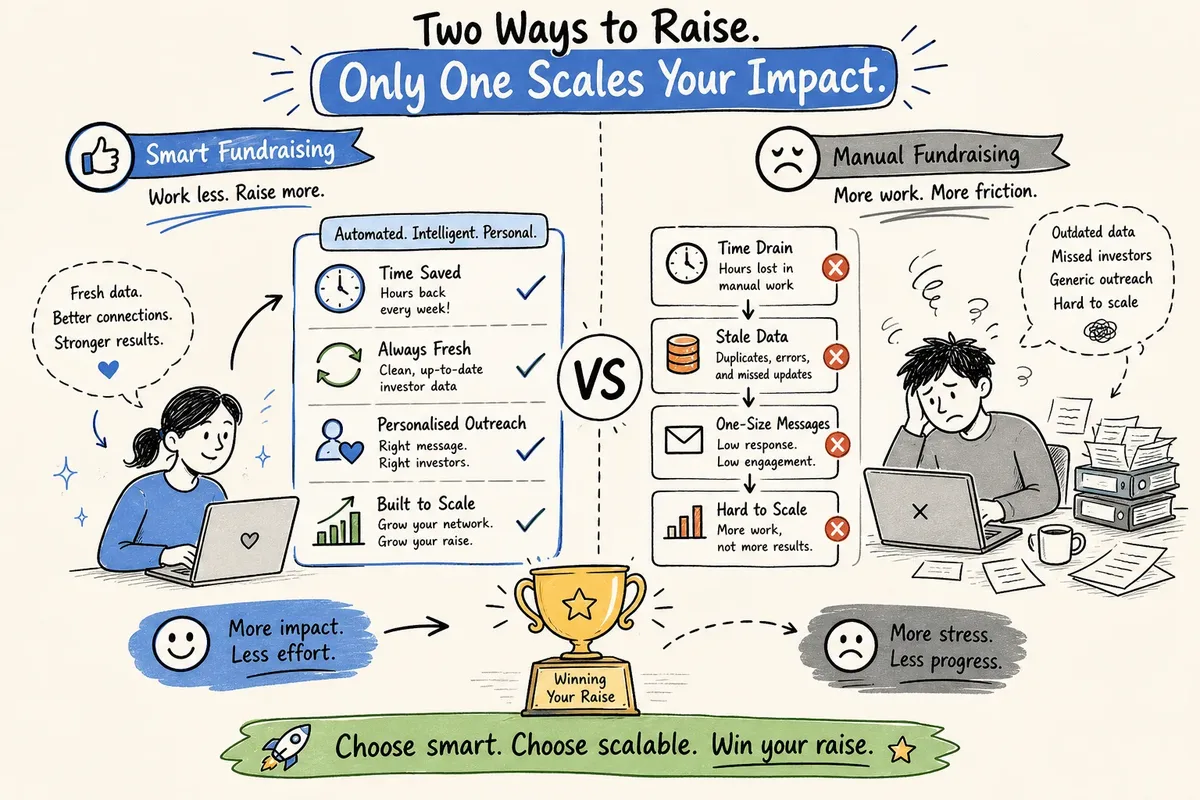
How does EzFunding compare to other investor matching tools, and does that comparison actually help you raise faster? Founders evaluating these platforms face a specific kind of decision fatigue. There are dozens of tools promising access to capital: directories with millions of profiles, CRM tools dressed up as matching engines, and AI-powered platforms claiming to surface the right investors in minutes. Most founders default to the biggest name they recognise, spend weeks on misaligned outreach, and wonder why their inbox stays quiet. EzFunding is the AI-native fundraising platform many early-stage founders are actively evaluating, particularly those who have been burned by generic directories and want a purpose-built workflow instead. This comparison covers the dimensions that actually matter, database quality, AI matching logic, pitch deck analysis, outreach automation, and pricing, so you can make the right call for your stage and strategy.
Why database size is the wrong thing to compare first
AngelMatch advertises 110,000+ angel investors. Crunchbase Pro has 4 million+ company and investor profiles. PitchBook indexes 4.7 million professional profiles with decades of deal history. These numbers look impressive until you consider that a founder raising a seed">pre-seed round in fintech needs 10 to 15 highly aligned investors, not a contact dump of hundreds of thousands. A large, unverified database with poor filtering logic produces the same outcome as no database at all: wasted outreach sent to investors who do not write cheques at your stage, in your sector, or in your geography.
The metric that actually matters is verified, stage-appropriate, sector-specific matches that lead to real conversations. Verification matters more than volume. A curated, regularly updated database of investors who are actively deploying capital will outperform a static directory of profiles that have not been validated in years, regardless of which platform you are comparing.
Beyond database quality, workflow completeness separates the tools that compress time-to-meeting from those that simply give you a longer list to work through. A platform that delivers a shortlist still leaves you to write the pitch, build the outreach emails, and track responses in separate tools. The platforms that actually accelerate fundraising connect pitch analysis, investor matching, and personalised outreach into a single end-to-end loop. For a clear primer on how modern, AI-driven matching engines function, see this article on AI-powered investor matching that explains the key components and trade-offs founders should evaluate.
How EzFunding compares to other investor matching tools: Gust, AngelList, Crunchbase, and Visible
Gust and AngelList are the default starting points for many early-stage founders. Gust functions primarily as a manual search engine: you filter angel groups and accelerators by location, industry, and keyword, then apply directly using your company profile. It is useful for structured applications but offers no AI matching, no pitch deck analysis, and no outreach personalisation. For guidance on best practices when using Gust and similar networks, see advice on connecting with investors. AngelList (now Angel.co) has improved its matching logic in recent years with AI-powered deal scoring and syndicate sourcing, but it remains built around a Silicon Valley software startup profile and is less useful for founders outside that narrow archetype.
Crunchbase Pro and Visible
Crunchbase Pro, at around $99 per month, is a strong research tool for tech and SaaS founders who want to explore investor portfolios and funding histories. What it does not offer is match logic: it gives you data to research investors manually, not recommendations based on your startup profile. Visible, which starts with a free tier and scales to $199 per month, is well-designed for managing existing investor relationships and sending portfolio updates, but its own documentation acknowledges it is not built for sourcing new investors. If you want a broader comparison of VC databases and investor matching platforms, this overview of VC databases and investor matching platforms is a useful reference.
EzFunding's approach
EzFunding takes a different approach across all three dimensions. Its database of 500+ verified VC firms, angel investors, family offices, accelerators, and government grant programmes is smaller than Crunchbase or AngelList in raw numbers, but each entry is validated and regularly updated. More importantly, the matching logic goes well beyond category filters. EzFunding's multi-dimensional compatibility scoring evaluates stage fit, sector fit, geography fit, and check size simultaneously, and importantly, it explains the rationale behind every recommendation rather than producing a sorted list with no context.
The gap widens most sharply on outreach and pitch analysis. Visible has no pitch deck review capability. Gust offers basic profile tools. AngelList provides no personalised outreach generation. EzFunding's slide-by-slide pitch deck audit assesses readiness across eight critical dimensions and produces a score that tells you exactly where your deck is investor-ready and where it needs work. You can review a sample audit for context, see the Leapsome pitch deck as an example of how slide-level feedback maps to investor matching outcomes. That audit then feeds directly into the matching engine, so the investors you are matched with are relevant to your current pitch quality and stage, not just your sector tag.
Where EzFunding pulls ahead when comparing investor matching platforms
The most practical advantage EzFunding offers is workflow consolidation. Most founders using Crunchbase Pro or a broad angel database are also paying for a separate pitch deck review service, using a cold email tool, and tracking conversations in a spreadsheet or basic CRM. That stitched-together stack typically costs more than a single platform subscription once you add it all up, and it creates cognitive load during an already demanding process. EzFunding replaces all three steps with one connected workflow: upload your pitch deck, receive matched investors with compatibility scores and transparent reasoning, then deploy personalised outreach sequences tailored to each investor's known portfolio history and stated preferences. For a deeper look at how matchmaking platforms and tools are structured, see this analysis of matchmaking platforms and tools.
The platform reports a 60%+ meaningful introduction rate within 48 hours, based on EzFunding's own internal data. For context, cold outreach to investors without personalisation typically yields reply rates between 1% and 3%, a floor that reflects what happens when a founder sends a generic message to an investor with no evident thesis alignment. According to EzFunding, the stronger introduction rate is driven by three reinforcing factors: verified investors who are actively deploying at the relevant stage and sector; AI-matched relevance that ensures every contact is genuinely compatible; and outreach copy that references the investor's specific portfolio and preferences. Each element compounds the others. Note that this figure comes from EzFunding's own reporting and has not been independently verified.
Non-dilutive funding discovery is another differentiator worth noting. EzFunding covers government grant programmes alongside VC and angel matching, which means founders who want to preserve equity while building traction can pursue both tracks from a single platform. Among the tools covered in this comparison, none of the others offer that dual-track discovery in one place, though founders should verify current feature availability directly with each vendor before making a final decision.
Pricing and what each tier actually delivers
The pricing comparison that matters is not subscription cost in isolation. It is total workflow cost. Crunchbase Pro at $99 per month and Visible's free tier both look attractive on a line-item basis. But Crunchbase Pro offers no AI matching, no pitch deck analysis, and no outreach automation. Visible's free tier gives you investor update tools and limited pipeline management, with no investor sourcing capability at all. When you add the cost of a pitch deck consultant (typically $500 to $2,000 per engagement), a cold email tool, and a CRM to manage conversations, the stitched-together alternative can exceed a single EzFunding subscription within the first month of fundraising, though actual costs will vary depending on the tools and consultants you choose.
EzFunding's pricing is built around outcome value rather than feature count. For a seed">pre-seed founder, compressing the fundraising timeline from several months to a matter of weeks directly extends operational runway, the most finite resource any early-stage company has. When the comparison is framed around total workflow cost and time-to-outcome rather than sticker price, EzFunding positions itself as a cost-effective choice across many early-stage scenarios. Founders should request current pricing details directly from EzFunding to confirm which tiers apply to their stage.
Choosing the right platform for your stage and fundraising goal
At the seed">pre-seed and seed stages, the priority order is clear: pitch deck feedback first, investor matching second, outreach support third. Founders at this stage typically lack warm networks, which makes verified investor data and personalised outreach essential rather than optional. EzFunding is built for this use case. Crunchbase Pro and AngelList can supplement your research, but neither addresses the workflow problem of going from a deck to an investor conversation in a compressed timeframe.
At Series A, founders need to build a pipeline of 20 to 40 institutional investors quickly, with precise check-size and sector filters applied from the start. EzFunding's compatibility scoring across stage fit and check size is directly relevant here. Visible's CRM layer can complement this if investor update workflows are already in place, but it does not replace the matching and outreach generation that EzFunding provides. The two tools are serving different jobs.
To make the final call, run through five questions for any platform you are evaluating. Does it verify its investor data, or is the database self-reported and static? Does it provide AI-powered matching with a clear rationale behind each recommendation? Does it audit your pitch deck before sending you to investors? Does it generate personalised outreach tailored to each investor's portfolio history? Does it cover both dilutive and non-dilutive funding options in one place? EzFunding is the platform in this comparison that addresses all five, but put those questions to any tool you are seriously considering and let the answers guide your decision.
EzFunding alternatives: a quick reference
For founders who want a concise view of the main EzFunding alternatives before committing to a platform, here is how each one is positioned. Gust suits founders applying to structured accelerator programmes and angel networks. AngelList works well for software-focused founders with a Silicon Valley-adjacent thesis seeking syndicate access. Crunchbase Pro is the right choice when your primary need is manual investor research and portfolio intelligence. Visible is best suited to founders who already have investor relationships to manage and want a clean update and CRM workflow. Each of these tools does one thing well; none of them combine investor sourcing, pitch analysis, and personalised outreach in a single connected workflow the way EzFunding does.
The bottom line: which investor matching tool is worth your time
For founders who need a complete fundraising workflow rather than a research database, the comparison between EzFunding and tools like Gust, AngelList, and Crunchbase Pro comes down to scope. Each of those platforms serves a specific purpose reasonably well: Gust for structured accelerator applications, AngelList for syndicate access in software-focused rounds, Crunchbase for manual investor research. None of them takes a founder from pitch deck quality assessment through to a personalised introduction with a compatible investor in a single, connected workflow.
When comparing investor matching tools at the early stage, EzFunding's proposition rests on four capabilities working in combination: 500+ verified investors across VCs, angels, family offices, accelerators, and government grant programmes; AI compatibility scoring with transparent reasoning at every step; slide-by-slide pitch deck analysis across eight dimensions; and personalised outreach sequences built around each investor's actual portfolio and preferences. According to EzFunding's own data, that combination produces a 60%+ meaningful introduction rate, a figure that generic directories and category-filter tools are not designed to match.
Run your own startup profile through EzFunding's matching engine and see exactly which investors align with your stage, sector, and check size. The recommendations are specific, the rationale is transparent, and the workflow takes you from match to outreach in a single session. For a concrete example of a deck run through EzFunding, review the Pearpop pitch deck to understand how slide-level feedback maps to investor-fit recommendations. Start your first investor match on EzFunding and measure the output against any other platform you are considering. The difference will be apparent from the first session.