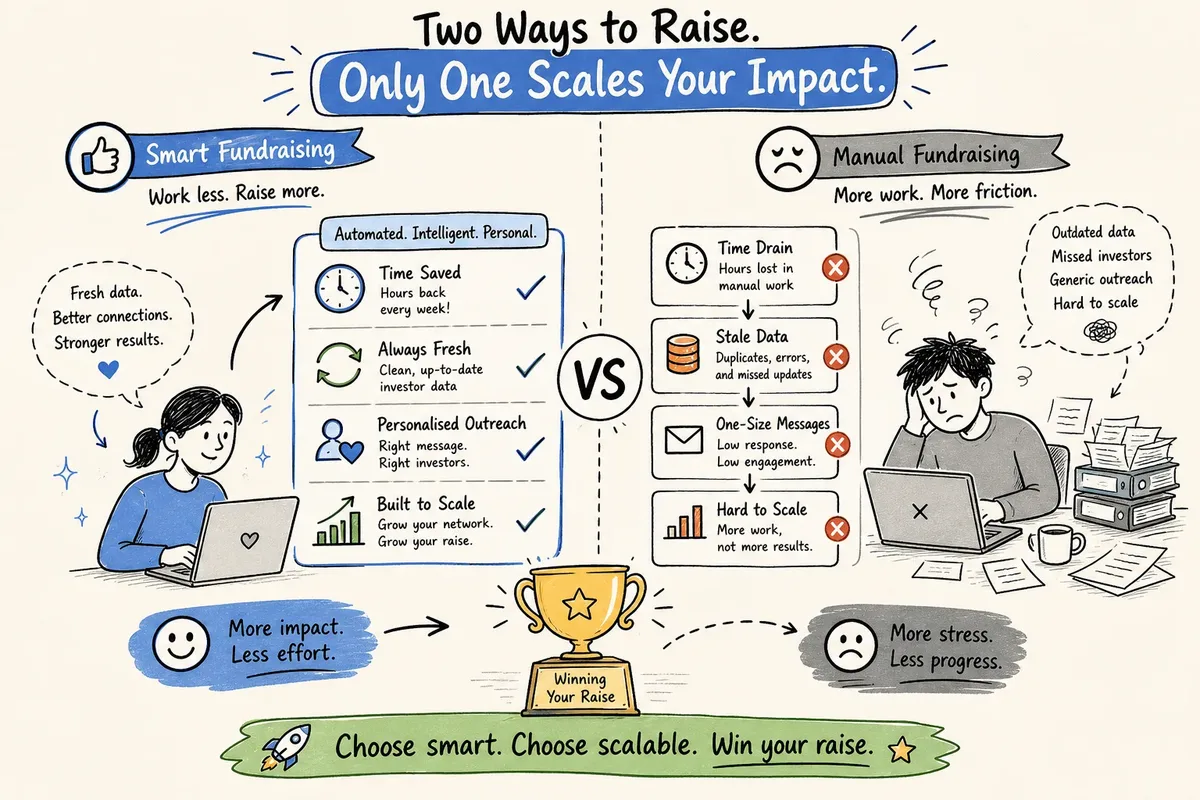
Fundraising in 2026 is a paradox for founders seeking early stage capital: more money is flowing into early-stage startups than at any point in recent history, yet closing a round feels harder than ever. The median seed cheque in India has jumped from $1.5M in 2023 to $3.8M today, driven largely by AI and deeptech inflows. But more capital also means more competition, more sophisticated investors, and a higher bar for what "fundable" looks like. According to Inc42's India Startup Funding Report, deal volumes have grown year-on-year while the number of first-cheque closures has remained flat, a clear sign that capital concentration is intensifying.
This guide cuts through the noise. It covers the types of early stage capital available, what each investor type actually expects, and why not having a warm introduction is no longer the obstacle it once was. AI-driven platforms like EzFunding now match founders to verified capital sources based on stage fit and sector alignment rather than personal connections. This guide gives you the targeting logic to identify the right capital source, the right investor type, and the right outreach approach, without the months of wasted effort.
What early-stage capital actually means in 2026
"Early stage capital" is an umbrella term, not a single thing. It covers seed">pre-seed, seed, and sometimes Series A funding, and each stage carries different expectations, instruments, and cheque sizes. Founders who treat these as interchangeable often spend months pitching the wrong investors and wondering why nothing is moving. For a concise primer on the fundamentals of early-stage investing, see early-stage-investing">what early-stage investing means.
seed">Pre-seed, seed, and Series A: the real differences
seed">Pre-seed is the concept-to-MVP phase. Investors at this stage back founders before much of anything exists: the idea is sharp, the problem is well-defined, and funding is typically structured via convertible notes with cheques up to $200K. Seed funding kicks in once the product is live and early traction exists. In India in 2026, median seed cheque sizes sit around $3.8M, with pre-money valuations between $10M and $30M. For a clear comparison of early- and late-stage characteristics that helps founders target the right investors, read this early-stage-vs-late-stage">early-stage vs late-stage overview.
Series A is a priced institutional round with a considerably steeper bar: investors expect $1M to $3M ARR, strong year-on-year revenue growth, and clear unit economics. One important India-specific note: SAFE notes are not a recognised instrument under Indian law. Convertible notes issued under the Companies Act 2013 are the standard early-stage instrument, and founders must use them accordingly.
India cheque sizes and valuation benchmarks for 2026
The numbers have shifted meaningfully in a short time. Median seed round sizes have more than doubled since 2023, driven by AI, fintech, and deeptech inflows. Seed pre-money valuations typically fall between $10M and $30M, while Series A pre-money valuations range from $25M to $50M. Founders should treat these figures as market context rather than targets. Understanding the range helps you avoid two common mistakes: under-raising in a way that limits your runway, or over-pitching a valuation that signals you haven't done your homework on the market.
The four main sources of early stage capital
Most founders, when they think about fundraising, think only about venture capital. The reality is more varied, and knowing the full landscape matters because each source type has a different risk appetite, timeline, and expectation profile. Approaching the wrong source at the wrong stage wastes time you can't afford to lose.
Angels and angel networks: fast capital, high founder focus
Individual angels move quickly. They close deals on convertible notes, write cheques between ₹10 lakh and ₹2 crore, and bet heavily on founder conviction and credibility. If your idea is strong and your clarity of thought is evident, an angel can move from first conversation to term sheet in weeks. Angel networks like the Indian Angel Network add structure and third-party validation to the process, and can collectively write cheques up to ₹50 crore. The trade-off is time: networks involve prescreening and due diligence, so the process moves slower than a single angel decision. The upside is that a deal backed by a well-regarded network carries credibility that attracts subsequent investors. You can also discover curated investor groups on platforms such as EzFunding | AI Fundraising Intelligence, which lists syndicates and angels active in specific sectors.
seed">Pre-seed VCs, accelerators, and government grants
seed">Pre-seed and micro-VCs in India typically write ₹2 crore to ₹5 crore cheques and want to see startups preparing for a larger institutional round. Accelerators such as Y Combinator, Antler, and IAN Incubator offer smaller cheques but provide mentorship and network access that can be worth considerably more than the capital itself. For founders who want to preserve equity entirely, government programmes deserve serious attention. India's Startup India Seed Fund Scheme offers up to ₹20 lakh in grants for prototype development and ₹50 lakh in debt for commercialisation, available to DPIIT-recognised startups under two years old. In 2026, AI, fintech, and deeptech sectors are attracting a disproportionate share of early-stage inflows across all four source types. For curated seed">pre-seed investor profiles and active micro-VCs, see listings like EzFunding | AI Fundraising Intelligence.
What investors expect before they commit capital
Walking into an investor conversation without knowing what they're looking for is one of the most reliable ways to leave without a deal. Expectations vary sharply by stage, and the bar in 2026 is meaningfully higher than it was two years ago. Preparation here is not optional.
Traction metrics that actually matter by stage
At seed">pre-seed, investors want evidence of deep customer discovery: detailed interviews, waitlists, paid pilots, or pre-orders that show genuine market pull. The question they're answering is whether you understand the problem better than anyone else in the room. At seed stage, the expectation shifts to consistent month-on-month revenue growth, typically 10 to 20 per cent for SaaS companies, combined with low churn and early signs of an LTV:CAC ratio above 3:1. For Series A, the median bar is now $2.5M ARR with 100 per cent or more year-on-year growth for AI startups. Investors are explicitly filtering out vanity metrics. Total app downloads or social media followers without engagement data are red flags, not proof points, and experienced investors will call them out immediately. Practical frameworks for evaluating this kind of traction are well summarised in resources about evaluating startup traction.
Documents you need ready before you reach out
Rushing legal documentation after investor interest kills deal momentum faster than almost anything else. Have these ready before your first conversation: a term sheet framework you understand, a Shareholders' Agreement structure, a Share Purchase Agreement, and clean IP assignment documentation. In India, FEMA 2020 compliance is mandatory for any round that includes foreign investment. You also need a clean cap table, three-year financial projections, and a pitch deck that has been reviewed for fundraising readiness. Investors interpret incomplete documentation not as an administrative oversight but as a clear signal that the founder isn't ready to run a professional fundraising process.
Why not having a network shouldn't stop you from raising early stage capital
The funding ecosystem has historically rewarded founders who attended the right institutions, worked at the right firms, or built their startups in Bengaluru or Mumbai. This geographic and institutional skew is widely observed across the Indian startup ecosystem; platforms such as EzFunding | AI Fundraising Intelligence and AngelList India have noted that the majority of funded deals originate from a handful of metros and alumni networks. In 2026, a new category of tools is actively dismantling these barriers, and founders who know about them have a genuine advantage.
The warm-intro barrier that most guides don't address honestly
Most fundraising advice assumes you already know someone who can introduce you to an investor. For the majority of first-time founders, solo builders, and founders outside major metro areas, that assumption is simply wrong. Cold outreach to investors without any context typically yields very low response rates, industry observers and platform data consistently place them well below 10 per cent. The result is that talented founders with strong ideas get filtered out not because their startups aren't fundable, but because they can't get in the room in the first place. This is the gap that deserves an honest answer, not a vague suggestion to "attend more networking events."
How EzFunding levels the playing field with AI-driven matching
EzFunding's AI platform analyses a founder's startup profile against a verified database of 500+ VCs, angel investors, family offices, accelerators, and government grant programmes, generating a MatchScore across four dimensions: stage fit, sector fit, geography fit, and cheque size fit. Instead of guessing who to approach, you see exactly which investors are genuinely aligned with your startup and, crucially, why. The platform also generates personalised outreach sequences tailored to each investor's known portfolio history and sector thesis. Platform data shows that matched introductions generate a significantly higher rate of first conversations compared to untargeted cold outreach, for founders without a warm intro, that is the difference between months of unanswered emails and a structured pipeline that actually moves. The database includes detailed profiles of leading early-stage investors and firms, including curated entries like EzFunding | AI Fundraising Intelligence and others that help founders prioritise outreach.
How to move from research to your first investor conversation
Knowing the theory of early stage capital is useful. Converting it into an actual meeting is what matters. The practical steps are straightforward once you know them, but most founders skip two of them and then wonder why their outreach isn't working.
Getting your early stage capital targeting right from the start
The single biggest targeting mistake founders make is building a broad list instead of a precise one. Prioritise investors who have written cheques at your stage, in your sector, and in your geography within the last 18 months. An investor who led a Series B SaaS round two years ago is not the right target for your seed">pre-seed fintech raise. Use sector thesis alignment and recent portfolio fit as your primary filters, not name recognition or fund size. A shorter, better-targeted list will consistently outperform a large, unfocused one. For guidance on the specific metrics seed">pre-seed investors focus on when deciding whether to engage, refer to industry summaries of seed">pre-seed-investors-look-for/">key metrics that seed">pre-seed investors look for.
Cold outreach that actually gets a response
A good cold outreach message is short, specific, and investor-centric. Reference why this particular investor is a fit, based on their portfolio, sector thesis, or recent public statements. State your ask in one line. Include a single data point that demonstrates traction. Keep the first message under 120 words. Founders who personalise outreach consistently see meaningfully higher response rates than those who send a templated pitch to a hundred investors at once. The goal of the first message is a 20-minute call, not a term sheet.
What to take away from this guide
Early stage capital covers a spectrum from seed">pre-seed-investors">seed">pre-seed to Series A, and each stage carries distinct expectations, instruments, and investor types. The four main sources, angels, angel networks, seed">pre-seed VCs, and government grants, each serve different needs and move at different speeds. Investors want stage-appropriate traction and clean documentation before they commit. And the network barrier, while real, is increasingly solvable with the right tools and the right approach.
For founders ready to move from education to execution, EzFunding's AI-powered matching platform removes the guesswork. It surfaces investors who are genuinely aligned with your startup and generates personalised outreach that gets responses. New tools and platforms are reducing traditional barriers to investor access more than ever before, from AI-driven matching on EzFunding to open networks like AngelList and LetsVenture. The founders who target precisely, prepare thoroughly, and move quickly are the ones who close rounds.